Passage to the Bloodline
Here are the top five things I find myself slightly crippled without, as I navigate the waters of having an acting career:
- A Smartphone: The industry is moving at the speed of light and so should you. Immediate Internet access to up-to-date info on auditions, reading Backstage online, enjoying the latest episode of Submissions Only (which is GENIUS), having your email handy at all times so you’ll know ASAP if you’re being called in for something that’s published on the web or electronically so you can read it on the bus en route to your dance class–these are just a few of the reasons why a smartphone is a vital tool in today’s jobbing-actor lifestyle. Not to mention it can also be used as a phone (the hint is in the name), so you can call your mom when you get the big job. Alternatively you can sport a phone that is only a phone, accompanied by some kind of iTouch technology that gives you access to all of these things as well. But why weigh yourself down with extra objects? Why carry around “paper bound” copies of plays? Just to seem ironic? How very hipster of you.*
- Spotify: I. Love. Spotify. Despite some controversy surrounding how much they pay their artists and how they determine to pay out, I think you have to give the devil its due here. I have not found a better alternative for this vast online music database. Need to quickly check on a song for an upcoming audition, but don’t have time to get to the library and would rather save the $.99-$1.29 from an iTunes download for the Ramen you’re going to have to subsist on tonight? Don’t worry: you can probably find that song and play it for free on Spotify. Create an account, and you can listen for free or choose to upgrade. For the very reasonable fee of $9.99/month, you can become a “Premium Member” and sync the playlists you make on your account to your smartphone/object, allowing playback of your new-found-not-quite-paid-for-music in places where Internet access is hard to come by, like in a subway tunnel or remote locations where wireless do not exist. Like Pandora, it will also offer requests of other artists/albums similar to what you’re listening too. Unlike Pandora, you can request a specific song or album and actually listen to what you’re looking for immediately, instead of waiting through a lot of things that sound like it before you hit on the money. And eventually when you can afford to eat more than food made by Nissin, you can also buy music from them, too. If you really want to.
- Netflix: As much as I hate admitting that I give money to Walmart (union busters!), I do use Netflix. I had my own plan several months ago, but moved that money over to Spotify, and now split a monthly tab for a “Watch Instantly” account with my roommate. It’s the best $3.995 I spend a month, and is one of the sources of the movie musicals I write about for This Very Blog. It’s great for the same reasons a smartphone or Spotify is: if you need something–instantly!–you can have it. You want to watch a film starring one of your idols, because you need a little inspiration and fortitude? You can probably do that. And you can figure out why that performance was so effective (so you can blatantly steal from your hero) by watching as many times as you want because it is UNLIMITED. And you can do it ANYWHERE: your TV, your PC, your smartphone/object. Hulu is a fair alternative, as well as Amazon Instant Video. But Netflix was there first, so despite what I learned in Nickle and Dimed, this is where my money is going. For now.
- My Judy Garland Signature Collection DVD Box Set: Speaking of idols: YES. Judy Garland is (one) of mine. Ever since I was a fourteen and saw A Star Is Born, I knew I was destined to become a great singer who only knew disaster in love. I am satisfied to report that so far things are going according to plan. But in all seriousness, Judy Garland has always been there for me. Every day where I feel badly about an audition, or am worried about an approaching callback, or am so low I start thinking about giving out and giving up, all I have to do is watch a Judy Garland musical and somehow things don’t seem as bad anymore. Is it the voice that holds the whole being of the performer in every note? Is it her (sometimes surprisingly impressive) skills as an actress? Or is it just a sense of hope that seems to be sewn up within the brutal mythology of her own biography? I don’t know. I only know I love her. And she sometimes helps carry the weight I occasionally feel too small to bear.
- Friends (mixed with Alcohol): There doesn’t even really need to be alcohol in this equation, though it is often very nice to have. Despite the impression I may have made with the first four items on this list, I do go outside and interact with living people, away from technology. All too often we can get wrapped up in where we’ve been and where we’re going. Good friends help you remember the past while encouraging you to grow into your future while having fun with you in the present. My actor friends can listen to my woes with understanding and sympathy, while my non-theatrically inclined friends offer me perspective from outside the fish bowl. All in all, these people help me stay balanced in a world that is anything but. And I would like to thank them. Over drinks.
*In actuality, I do not read any book or other publication in electronic format. I believe in paper, and not because I’m a hipster.** I write all over my books, and pens don’t work well on touchscreens.
**A hipster would say that.

Tool + Expectation = Results
My acting life doesn’t consist of waiting at EPA calls, hoping an Equity member gets grazed by a pedicab on the way to her audition, enduring a slight injury (nothing she can’t bounce back from), but enough to put her out for the next few hours so that I can snag her audition slot which I will then proceed to flub up due to the fact that my warm up consisted of me sitting on a freezing floor for the past five hours, wearing shoes that I don’t like, overhearing conversations that don’t help and suffering from the psychological illusion that I am some sort of under dog, when in reality, that isn’t true at all.
I want to fill my time with enriching experiences that inspire and fill me. Therefore, I’ve been having a blast traipsing around the terrain of what it is to be an artist in New York City. This is how I’ve been doing it ….
TOOL: Goal Setting
EXPECTATION: To shoot for something tangible so that I use my time purposefully and effectively.
RESULT:
- In September, I aimed to be cast in three shows by April 22nd (my birthday). I’ve been in five so far (count the webisode I shot, and that’s six), and there’s still time for a possible seventh.
TOOL: Twitter
EXPECTATION: To become a part of the Twitter conversation.
RESULT:
- I’ve been recognized at events before I’ve even introduced myself
- I’ve gotten wind of auditions
- I’ve won free tickets to Freud’s Last Session
- I’m about to be involved in a play reading book club, and have found out about tons of networking events/shows/etc
- I became a Green Room Blogger
- I obnoxiously use hashtags in normal spoken conversation
TOOL: Networking Events
EXPECTATION: To meet the next person who will cast me.
RESULT:
- I’ve developed relationships with On The Square Productions
- The Seeing Place Theatre knows me by name
- I ravenously have my sights set on the Flux Theatre Ensemble and have made being cast with them one of my next goals
- I’ve enhanced my relationship with Full Stop Theatre Collective
- I’ve grazed the surface with At Hand Theatre Company.
TOOL: Workshops
EXPECTATION: To find people who share my passion of the true meaning of theatre.
RESULT:
- I’m in love with Shelter Sundays and feel more alive every Sunday night than any other time of the week.
TOOL: Maintaining Industry Relationships
EXPECTATION: To work with the people I’ve meshed with again.
RESULT:
- Andrew Squier of FullStop Theatre Collective and I are currently creating a movement piece
- Jeremy Williams, director of the children’s theatre show I did, asked me to take over the role of Miss Julie when Convergences Theatre Collective takes Refracting Miss Julie on the road.
- Of the six projects I worked on since September, I only auditioned for three. The rest, I was asked to be in because they knew and trusted my work.
As “non traditional” as these “industry tools” are, they seem to be working. For me at least – and that’s what’s important. Decide what’s going to make you and your career happy and fulfilled, draw our your own map, and construct its own compass.
Onwards and Upwards,

Packing Up My Backpack
When I was going to college, my grandma bought me a backpack. It was bulky and blue and even had a compartment for my brand-new laptop and I hated that backpack to this day. It gets used only when I’m packing to come home for breaks and only then. I prefer my really nifty messenger bag that I’ve had since ninth grade but still holds everything I need to get though my day.
I’m back for another post and since this week’s prompt is “Share the top 5 industry tools that you can’t live without — things that make your day-to-day life easier, or set you ahead of the competition”, I thought I’d share the five things I put in my bag that this theatre major needs.
- My iPod: it’s a no-brainer. I have an iPod Touch and that is what keeps me grounded as I go; with the wi-fi access all over campus and the clever apps I put on it, like the free texting app, facebook, Wikipedia, etc. I can check my email for the latest updates, make a note to myself without scrambling for a scrap of paper and pen, learn music for class, get texts about rehearsals…and it can also be used as a handy prop on occasion.
- My Acting Journal: perhaps this doesn’t set me ahead of any competition since the whole department is supposed to have one but it is something I can’t live without! I’ve chronicled everything I’ve learned and what I still need to, in these pages. Also, it’s very helpful when I need inspiration for a new blog post as I can re-read my initial thoughts and remind myself how far I’ve gotten along.
- Binders: and binders galore! I bought a stack of them last summer and they are all being used for various projects for my script copy, to hold my photos for Makeup class, sorting old scene scripts, as my portfolio, taking class notes and generally organizing my life into these three-ringed sections.
- The Commons: my college theatre department is planning on some construction to give us more space (post-my-graduation) but we do have among our studios, classrooms and offices, is a large space with tables and couches and chairs, a board to pin notices on and it happens to be the place for theatre majors, which we call The Commons. On any given day, I’ll walk in on someone practicing a monologue or tap dance while people are gathered around the table in conversation while waiting for class or an audition. It’s where I am right now, writing this! But more importantly than the actual space is the people in it: I’ve had some of the best conversations, the best rehearsals, the memories alone in this place. I’ve made friends here whom have taught me a lot about acting, auditioning, networking, how the theatre department works and even after some of them have graduated, those friends have helped me out on more than one occasion. So, I guess Number Four is actually the Commons/Friends/Theatre Department/Alumni Connections?
- My ASM Kit (cellphone included!): I’m cheating a bit because this is kept in another little bag that I bring to rehearsal but this bag is a necessity. It holds my script, pens and pencils, a first-aid kit and my cellphone. I actually hate my cellphone but it’s as important as having bandages—I usually just use it to call people who are late but once I had to call for an ambulance. The Girl Scout in me reminds you to always be prepared!
I’m surprised at some of these choices myself—I even checked my bag and sure enough, I had my iPod, journal and a binder along with a few pens, some Ricola cough drops, an apple for later and some scripts (Crimes of the Heart and Stage Door). Speaking of Stage Door—I’m off to rehearsal! Perhaps that will be my next post, about being an Assistant Stage Manager and all that I’ve learned to stock up my ASM kit with.

My top 5 industry tools I can’t live without!
“Share the top 5 industry tools you can’t live without — things that make your day-to-day life easier, or set you ahead of the competition.”
5. Dance Shoes– Something that I use every rehearsal, every dance audition, every callback are my two trusty pairs of T-strap Character heels! I have them in black and in tan, and they are more comfortable than some of my street shoes. Or maybe they just feel that way after the hundreds of hours I’ve spent in them?
4. The Internet– I spend a good few hours every day looking up auditions, casting breakdowns, researching shows or industry people I’d like to work with. Not to mention networking through facebook and twitter!
3. My Car– I enjoy the time I get to spend driving every day. I sing as I drive; warming up my voice, or just belting along to the radio. I often review lyrics or choreography in my head, stuff that I don’t always make time for otherwise. My car also doubles as a storage unit. I never know when I’ll need an extra headshot or an alternate outfit. Both of which always live in my trunk.
2. My Mentor– I am so blessed to have a great relationship with my vocal and acting coach-turned-mentor. We talk often by text or phone call, and he helps me keep my priorities straight. We deconstruct auditions and talk about what things were in my control that could have gone better, and how I can let go and move on. He also keeps me updated when he comes across projects or people that I need to know about. Our relationship is INVALUABLE to me.
1. My iPhone 4s– I promise this isn’t an advertisement for apple, but I could not function without my phone! Siri helps me find directions and send text messages while I drive. The internet capabilities help me stay connected while I am out and about. I have a piano app that can play any pitch – perfect for right before going into singing auditions. The calendar helps me keep my schedule from becoming overwhelming. I even have an app that helps me memorize lines from a script! I could go on… “iphone apps for actors” could probably be a whole blog post!
I can’t wait to see what industry tools everyone else uses!
P.S. What IS your favorite smart phone app? Now I want to know!!

Tools of the Turg
Dramaturgy, as a profession, varies from project to project. Each assignment carries with it its own requirements based on the nature of the work being done. For instance, Production Dramaturgy on a classic work is vastly different from New Play development Dramaturgy. However, there some tools remain constant.

1) Pencil – Every Dramaturg on every project should always come armed with a pencil. I say pencil, not pen, because it is erasable! Very often you will have to take/pass notes to and from members of the creative team that are confidential for a time. I find it helpful to be able to completely erase a note once it is safely stored in a password protected project file on my computer. Theatre is ever-changing and rarely slows down; that is why I suggest mechanical pencils. You will never have to excuse yourself to sharpen it when it breaks and the fine point allows you to write small footnotes wherever necessary (especially when there are textual changes to be made to the working script).
2) Pad – I say pad and not paper because it is most helpful to see the progression of a project as it unfolds moment-to-moment. If you have to search for random loose-leaf pages from a month ago, you are taking time away from more important tasks and it runs the risk of breaking the continuity of the work being done. Keep organized by keeping everything attached.
3) Reference – As a Dramaturg you are the one to whom everyone look for answers. Quick reference guides are extremely helpful for those random questions thrown at you. Luckily for us we live in a technological era where information is readily available. I can’t even count the times I’ve been saved by my Shakespeare iPhone app for those random “what does this word mean?” or “we’d like to use a sonnet, do you know of any, off-hand, that will work?” questions in rehearsal. That’s not to say that Shakespeare is the only case where referencing is required. Dramaturgs are often called in to collaborate on adaptations or translations. Here it would be helpful to incorporate multi-language dictionary, thesaurus, or instant translation apps (in the old days a turg would have to carry these in book form, which made for very painful travel to and from rehearsals).
4) 3-Ring Binder – Every Dramaturg has their “book.” You fill your binder with such important stuff as: Script, research (playwright bio, historical context, production history, character analysis, etc.), notes, textual variations, and anything else that may pop up during the process. True most of the filler for this tool is acquired only after you have been working on the project a while, but showing up with a Binder filled with your prep work on the first day or even at the first pre-production meeting definitely shows your professionalism. You will notice your teammates confidence in you and your work shoot up. I’ve even had directors request copies of my Binders for other productions they’re considering.
5) Library Card – As a Dramaturg you will find, more often than not, that the internet is NOT the all-knowing, all-powerful entity it claims to be. Many books have not been converted to an electronic format; especially those regarding theatre history, criticism, and theory. Therefore, you will have to venture into your local Library. Unfortunately, Libraries, unlike the internet, have “hours of operation” that may conflict with your schedule. I find it very helpful to look up the books you need online first then have them made available at the Library closest to you so that you may arrange a convenient time to collect them. Library books can be renewed online as well, making it easy to hold on to them for the duration of any given project. In order to access any of the aforementioned facets, you will need a Library Card. Get one.
Of course, all of these tools are only as useful as you make them. A 3-Ring binder is worthless empty, just as a Pad is of no value blank. The dramaturgical gear listed above has helped me stay focused, organized, and on point with every project I’ve had the privilege of working on. Have you used these tools in your work? What are your tools of the Dramaturgy trade?

The 5 (Actor) Things I Can’t Go Without
1-Actors Access. Without a doubt. Though I probably get 1 audition for every 45 submissions (maybe not even that much) there is no doubt that this is the place us unrepresented folk MUST look multiple times a day. I probably check it about 10-15 times a day, starting at about 10:15 and finishing around 9 P at night.
2-My blue shirt. This rather affordable ($20?) shirt was purchased from Filene’s Basement before they closed down (tear tear) and it is one of those shirts that probably gets worn more days than there are in the week. Why? Because it can make me formal, informal, blue collar, chilling out you name it. This shirt can pretty much do it all, and it fits me like a glove…er shirt.
3-The Actors Equity mobile website/my iphone in general. Yeah I know iphone is probably tops on a lot of my fellow bloggers lists, but these two come in handy so many times. Especially at auditions when the line around the table is so crazy that I can’t see the character breakdown and I can simply pull it up on my device, but especially during a sides call, when I can just take a picture of them and be on my way, instead of writing ’em out and standing there for 25 minutes. There are pros to that approach too, but I like to be able to look at it wherever.
4-My Little Black Book. No, not the one I use to call up exe’s and not that (probably bad movie). But my book where I record what I wore to an audition, who was in the room, their address and a little note about what happened or how it went. This especially comes in handy when I get a callback for an on camera thing and need to see what I wore (probably my blue shirt). But it also helps to know that this is the 4th time this month I have auditioned for Alaine Alldaffer with that Neil Simon monologue and maybe I should switch things up this go around.
5-My fiancée. Simply put, even before she worked on “the other side” (she is currently an agent assistant) it always benefitted me to run sides with her, ask advice on what to wear and get an outside perspective on anything from how to approach an agent to headshots to what I should write on my postcards. Hopefully you can find someone as loving in other ways to you as I did, but even so, have that friend or roommate who can give you that opinion other than yours that can save you from sending out that inappropriate email to a casting director or making that really wrong choice for the scene.
Of course there are many more things we need, my honorable mentions include a bathroom in every neighborhood, Yum Yum Bangkok’s lunch special and a close Happy Hour for those crappy 5 PM auditions, but these are my top 5. Hope they help you in some way! Keep on keepin’ on!

Editor’s Note: New Post Series This Week!
This week, our bloggers have all written posts responding to the following prompt:
Share the top 5 industry tools you can’t live without — things that make your day-to-day life easier, or set you ahead of the competition.
We hope you enjoy reading their tips and tricks; please feel free to share your own most valuable industry tools!
Movie Musical Monday, March 19th: “Lady Be Good”
Good morning, and Happy Movie Musical Monday!
Today’s film is MGM’s 1941 film, Lady Be Good.
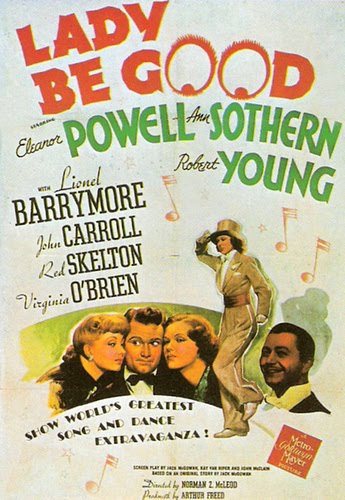
Conceived to be a vehicle to introduce Ann Southern (former Goldwyn Girl) as a name-musical talent, the film is your typical backstage-story-meets-light-marital-satire. It borrows the title and accompanying song from a 1924 Broadway show, but that’s about it for similarities between the product and the source material. The movie is also another feature from MGM’s Freed unit, and includes a couple of songs co-written by the famous producer.
Despite the fact that Ann Southern and Robert Young are the leads in this film, Eleanor Powell has top billing. This was meant to compensate for the fact that no one really knew Ann Southern could sing, and Robert Young never seems to much. By giving Powell top billing, MGM was basically trying to convince the public that, “No, seriously, guys: this is actually a musical. For reals.”
WHAT IS THIS MOVIE MUSICAL ABOUT?
Robert Young (no longer fakely Spanish) and Ann Southern (no longer in the chorus) are married couple composer and lyricist Eddie Crane and Dixie Donegan, respectively. The movie opens with Dixie testifying on a witness stand to Judge Lionel Barrymore (who must not have had anything better to do one day than be in three scenes of this movie) that she wants a divorce. But first, Lionel Barrymore asks, tell us how you two got together? Apparently Dixie was the waitress that used to charge Eddie $.20 for $.50 worth of breakfast, until finally one day they started going out and “became a habit” to each other. Then, faster than you can say, “And then one night,” we flashback to the night where Eddie is playing a song on a borrowed piano for a lyricist, while Dixie watches (because she’s a woman) with a dog named Buttons. Eddie keeps breaking out the same sixteen bars with the lyricist is pacing back and forth, who finally turns to Eddie and says, “Listen, nothing personal, I just don’t like the tune.” He goes, leaving Eddie in the dumps and Dixie desperate to console him. Eddie believes that a composer and lyricist have to work together for some time to build up a style and quality that’s recognizable. Then he goes on to list the big-name composers whose work will be passed off as songs these two characters write in the movie, plus a couple more for good measure.
Dixie blushing asks if Eddie would mind if a girl wrote lyrics to his song. He doesn’t object to this. Then she confesses that she’s written lyrics to his song JUST NOW on her handkerchief. Would he mind giving her a chance? Of course not:
(I love how playing the piano in a movie musical manifests a whole orchestra.)
Understandably, this song will be a hit (because only people in love write hits), and so they get married. DUH.
But then of course: CONFLICT!
Back in the courtroom, Marilyn (Powell), Dixie’s BFF, tells Lionel Barrymore what happened to drive a wedge between the two lovebird-hit-machines. She says that Eddie went “Park Avenue,” forgot his old friends and where he came from. After a party one night, where Eddie spent most of the evening pandering to 1%-ers, Dixie tells him before bed that she wants to write a song. Right Now.
At this point it’s important to remember that the first time these two wrote a song, it basically engaged them. So for this couple (in 1941), song writing is essentially: having sex. Good sex. Top-of-Variety-charts-for-18-weeks-sex. He tells her he’s “not in the mood.” She reminds him that they used to be able to do it any time. He still refuses, and they have a small tiff. She says he’s changed, he has no idea what she’s talking about, and then Dixie drops the hint of divorcing him. Instead of doing what men are supposed to do when they love a woman who is threatening to leave (FIGHT FOR HER, YOU IDIOT), Eddie pulls a Franklin Shepherd-esque power play by undoing his silk bow tie and telling her casually, “I mean, do what you want, I won’t stop you. I’ll be busy eating lobster for lunch tomorrow. We cool.” They agree to throw in the towel. Just like that. Because someone wouldn’t bother to stay up for 20 minutes (do you really need more?) and write a song.
BACK IN THE COURTROOM: Marilyn is dismissed from the stand, and Eddie is called. But of course: he’s eating lobster, so he’s not there. Lionel Barrymore is all, “Generally divorce in the 1940’s is a damn shame, but what are you going to do? Granted. And now I will wheel off to the cantina to meet my brother John.” Marilyn and Dixie get out to the street, where Marilyn says, “Let’s celebrate!” and Dixie says, “Let’s pick up Eddie’s blue suit from the cleaner’s and drop it off to him because it’s raining, and he always liked to wear it when it rained. ::SOB!::” Clearly being in love with someone is not enough of a reason to stay married to them.
For his part, Eddie deals with the divorce by playing the piano in a lot of other women’s houses. But one day he comes home to his bachelor pad to find that his servants have quit. He is looking around the room and finally calls Dixie and asks her to come over right away so he can speak to her. Dixie bolts over to the apartment–like every woman desperate and in love will always do–and Eddie tries to clean up a little for her. When she arrives, both lie and say they can’t stay long. They look at each other longingly, until finally Eddie confesses why he called Dixie over. It takes a woman to run an apartment, he tells her, and could she possibly get new servants for him since his other ones quit?
Wrong question to ask. Dixie flips, understandably. But instead of walking out and making Eddie find the phone book and call The Maids his own damn self, she starts clucking away and picking up every piece of trash she finds. It’s only because she’s still in love with him that she is a subconscious door mat. While someone else cleans up his mess, Eddie takes this opportunity to sit down at the piano and tinker with a new song. Dixie perks up. She asks him to play back this new melody again. And then: Inspiration. She gets out her handkerchief and a few hours later they’ve written a brand new song. Let’s consider this make-up sex.
In fact, they’re so exhausted from the orgasmic frenzy of song writing, that Dixie is ready to crash, so they agree to sleep and listen to it again in the morning. This song was so good, they have also completely forgotten they are divorced, and make their way to their plush twin beds. It’s not until Dixie gets her dress off and sees Eddie untying his shoes that she remembers: she doesn’t live here anymore. She runs off into the night.
The next day, word has begun to spread that E&D have written a brand new hit. It also comes out that crooner Buddy Crawford is making a move for Dixie. Eddie finds out and is instantly taken with jealousy–I mean, he just wrote a song with the woman last night, does that mean nothing? Eddie tries to punch Buddy, but fails. A couple of nights later, Buddy performs the song live on the radio (as does a very queer, expressionless Virginia O’Brien, playing a character named Lull) and Eddie shows up at the club to make sure no shenanigans are taking place. He asks Dixie to leave with him so they can talk (and maybe write another song), but she says she arrived with Buddy and it would be rude to leave with someone else. Eddie gets upset and goes.
The next morning, Eddie sends a small greenhouse in assorted flowers to Dixie to apologize for his behavior and tells her that they have to work much more, giving him a handy excuse to see her. Then they sit down to write another song. Since Eddie is finally doing everything he should have done when they were married, this song-writing-love-making session results in a HIT by the Gershwins. It takes the world by storm in a four-minute montage. Everyone is playing this song: symphonies, the Chinese, lifeguards, jazzmen. It’s so huge that the music industry actually holds a gala in their honor while they’re both still alive. While there, Ann Southern sings another song her character didn’t write:
During this sequence on film, Southern’s face is cross dissolved with images of Paris, France. Why? These characters have never been to Paris before, and they have no ambition to go there. We know this because it has never come up in the dialogue. So here’s another moment where MGM was pandering directly to its audience with material from the time: A year prior to the release of the film, the Battle of France had occurred. This was when Nazi troops invaded and began their occupation of that country. So singing a song about the last time you saw Paris while it was occupied by a growing world threat, with the US about to enter the war, probably caused the audience of the time to think a little and possibly cry. This is the only time any historical events of the day come up in this film.
(NOTE: This song actually won the Oscar for best song, but had been released the year before, not written for the film. This caused a small uproar amongst the people who care about that stuff, and the following year the rules for Oscar nominations changed to ensure this sort of thing would never happen again.)
In the cab home, Eddie again makes another plea for Dixie to get back together with him for good. She refuses, saying since their divorce, he’s finally ambitious. He decides to give up once and for all, and gets out of the cab.
This is the point where the movie should have ended. Eddie has carried the cross long enough, they have all this money coming in, everyone loves them and loves them together. And they still love each other. But Eleanor Powell hasn’t danced once, so we better keep going.
Marilyn thinks the only way to get Eddie and Dixie back together is to make Eddie insanely jealous (so I guess we are just forgetting the fact that he has said repeatedly that he wanted to get back with her, and now Ann Southern’s over it even though she isn’t). She convinces Buddy (somehow) to send Dixie a HUGE diamond ring. Then she’ll make sure Eddie hears about it and storms over to take his woman back by force. Because for some reason, this seems necessary. But let’s ignore the fact this movie is still happening and watch this AMAZING DANCE SEQUENCE with Eleanor Powell and Buttons:
It’s just so awesome. I’m so glad we held out for that. Powell trained that dog herself, PS. For that, I can even forgive those patterned harem pants.
So everything goes according to plan: the ring arrives, Dixie accepts it (thinking it’s from Eddie), Buddy shows up, and Marilyn tells Eddie over the phone that Dixie got this diamond ring from Buddy. But oops: Eddie is so enraged that he says he’s coming over and BRINGING A GUN. General panic takes over the company while they try to get themselves together (and the women change their outfits) so they can leave without getting shot. Eddie arrives, and everyone mistakes a boxed-pearl necklace in his pocket for a gun, and there is your typical business. Everything works out, and Eddie dares Dixie to marry him again. Apparently that was all he had to do all along, because she does.
As the four of them are driving back from the small ceremony in Connecticut, (I don’t know why they were there), Buddy and Marilyn cuddle in the back seat and decide they’ll get married, too, why not? Then Dixie starts talking about a new show she and Eddie are going to start writing, and Eddie says it can wait till after their second honeymoon. Dixie over-reacts (in this bloggers humble opinion) and tells Eddie this is a deal breaker. He gets angry, and makes her and Buddy and Marilyn get out of the car, and leaves them on the side of the road.
Maybe Dixie preferred the song writing over hot-make-up-second-honeymoon-sex because it would have been better? Hmmmmm. A thought.
Anyway, cut back to New York and one day Dixie has to visit Eddie to pick up some lyrics she left in his piano bench (now how did those get there?). And what does she find: another woman standing near while Eddie is composing! And she is wearing a taller hat! Eddie explains that he’s going to write a symphony, since he had always wanted to, and it looks like this sophisticated lady is going to introduce him to the right people. The rejection of Dixie is total and complete: not only is he writing music for another woman, he is writing music in a completely different genre. Dixie and Eddie yell at eachother, and then we get to watch a Busby Berkeley musical number, choreographed to “Fascinatin’ Rhythm.”
Even Lionel Barrymore liked this number. He tells us because, yes: Dixie is BACK IN THE COURTROOM to ask for a second divorce. Again, however, she says it’s not because she doesn’t love her husband. Then Lionel Barrymore gets to be the voice of reason that should have happened about 20-40 minutes prior in this film and tells her NO she can’t have a divorce this time, silly girl, and commands her to “Go home and behave yourself.” She, Marilyn, and Buddy leave. Eddie shows up to court after everyone’s gone, deus ex machina style, and receives a chastising himself from L. Barrymore, who is packing up to meet his brother John for lunch again, no doubt, and wondering if the money for this project was really worth the strain to his arthritis. Eddie leaves court thinking he and Dixie are divorced, then finds her at a roadside inn and begs her to marry him again. Right before they kiss he stops and says, “Wait–we’re not married.” She says, “Will you keep right on thinking we’re not?” They kiss, the supporting cast enters, everyone sing, END OF MOVIE.
Oh: also Red Skelton is in this. If that matters to you.
HIDDEN GEM SONGS:
- Your Words and My Music: this would be a great audition song for a man going up for Jimmy Powers in City of Angels. Provided you can find the sheet music.
- The Last Time I Saw Paris: Good for a World War II musical review, or if you accompany burlesque shows in music of this style. And generally, it’s pretty.
- Lady Be Good: It’s a jazz standard, so you (and I) should probably know it. Also, since everyone loves shows set in the 20’s and 30’s lately, and Broadway has fallen back in love with the Gershwins, it would probably behoove you to take a listen to the score of the 1924 show.
That’s all for now. Be good, and Happy Movie Musical Monday!


 The Green Room