Movie Musical Monday, April 9th: “Easter Parade”
Good morning, and Happy Movie Musical Monday!
Today’s film extends the Easter holiday weekend by one more day. I know Passover began last Friday, too, but we’re discussing a musical from 1948: at this point in American history, the only holidays were Christian ones and they were celebrated with movies featuring songs by Jewish composers. In accordance with this formula, we have yet another Freed Unit Feature, Irving Berlin’s Easter Parade.

The film paired Fred Astaire and Judy Garland in the only movie musical they would star in opposite each other, but this happened completely by accident. Let me explain:
WHAT IS THIS MUSICAL ABOUT?
This musical is all about settling, both professionally and romantically. Even the circumstances under which this movie was made speak to this central theme. The feature was originally pitched by Berlin to 20th Century Fox, but they wouldn’t give him enough money. So it got picked up by Arthur Freed over at MGM. Gene Kelly was initially slated for the male lead, but broke his ankle (playing some sport, very manfully I’m sure), so after only a year of retirement, Fred Astaire was coaxed back into movies with this role. Cyd Charisse was originally meant to fill the dancer part in the film, but she pulled a tendon, and was replaced by Ann Miller. And finally, director Charles Walters was a replacement for Vincent Minnelli, after psychiatrists advised the studio that the all-too-fragile Judy Garland (released from a sanatorium just before filming began) would not be able to cope with the pressure of being directed by her then-husband. Somehow, despite all this flux, the movie got made, resulting in the highest grossing film of either Garland or Astaire’s careers.
WHAT IS THIS MUSICAL NOT ABOUT:
Easter.
BUT BACK TO THE SYNOPSIS:
It’s 1912, and ballroom dancer Don Hewes (Astaire) is out the day before Easter buying a lot of stuff for a lady. How exciting it must have been for movie-goers in 1948 to see their beloved Fred Astaire back in action, and to be treated to an opening sequence like this:
OH MY GOD GUYS THAT WAS SO GOOD! You have to give it up to Astaire–he could use props in dance probably better than anyone on film, and his amazing sense of rhythm shines through in this number. Don’t let your experience of current cinema have you disbelieving that he is actually dancing. There are no CGI effects at work here. Just talent.
However, the dance sequence to “Drum Crazy” tells us something very vital about this character: this man would steal a from a child. Oh yes, it seems very clever in the moment, and no doubt we all smiled when he tipped his hat that last time. But it does suggest a certain lack of morality and/or a means-to-an-end mentality in this character, who has no qualms in depriving a child of a pink stuffed bunny. Does a man like that deserve our (or anyone else’s) love? I have my reservations.
Anyway, Don shows up at an apartment belonging to his dancing partner Nadine (Miller), with all his purchases in tow. For some reason Ann Miller’s costume designer thought they could hide her very-round-cheeks by attempting to camouflage them with blush the same color as her dress. This does not deter Don (for some reason), and he gives her all those presents, including the ill-gotten lagomorpha and that hat he picked out specially. He notices that her steamer trunks are sitting in the room and asks about this–they’re meant to be leaving New York tomorrow after they walk in the (title tie-in) Easter parade. They’re going on tour ballroom dancing. But Nadine breaks it to Don: she’s been offered a show here in town and wants to stay. Don tries to shirk this off, and then confesses that things with Nadine have been different from with other girls he’s danced with in the past.
(NOTE: You may have noticed–as I did–that Ann Miller was wearing slipper-like shoes in this sequence. She wears flats when dancing with Astaire in this movie, and heels for the rest of her numbers. This is probably because she and Astaire were too close in height, and if she had worn heels she would have been taller than him, and that’s a big “NO.” Judy Garland, however, was only 5′, so dancing in heels with Astaire was not an issue, and more a requirement.)
Ending their dance with a deep kiss, Don and Nadine are interrupted by their mutual friend Jonathan Harrow the III, played by Peter Lawford.

Poor Peter Lawford: the most unpopular member of the Rat Pack, who (as usual), plays the guy who’s good-looking, charming, reliable, and therefore ultimately ends up relegated to the “friend zone.” All things considered, though, you could do a lot worse than Peter Lawford. And he was British. Come on.
Anyway, he shows up and is all, “Ooooooo, you guys were totally making out,” and then gives Nadine a present himself: a new puppy. (Ann Miller has a lot of dogs in this movie, no joke. She even had one when Fred Astaire entered the scene initially. And as an upper class, vain lady, her first reaction to the pug is to comment on what she’ll wear with it. Clearly this character helped make way for Paris Hilton.) Jonathan reminds them that he’s taking them to dinner before they leave town, and Nadine says, “I’m not leaving.”
WHOA! Did that kiss NOT just happen? Did that dance number NOT just happen? She looked so into it while it was going on, with her come-hither stare and her very nimble limbs. But we have to face facts: Nadine was just leading Don on–through dance. The woman is cold, despite arguments to the contrary.
Don storms out, leaving Nadine alone with Jonathan, who then asks why she won’t go. She says, “Don’t you know?” Apparently, Nadine has designs on Jonathan. Whoops. Jonathan’s sense of brotherhood towards Don, which makes this pass a turn off, and he runs off after his friend leaving the harlot behind. Jonathan isn’t into the strong come-on from a girl, especially one who paints an inch thick. He is British, after all.
Don ends up at a local bar, trying to drown the memory of Nadine in a tumbler FULL of alcohol. According to the philosophizing bartender Mike, it takes a lot of bourbon to forget a brunette–they’re the ones you’ve got to watch out for. Jonathan shows up and consoles his friend with a half-hearted “Bitches, man.” Don is all, “Whatever, dude, I’m done with her, I’m over it,” and makes the PLOT POINT statement that he could take any girl out of the chorus and replace Nadine with her. AS IF BY FATE, a chorus of girls shows up in the background of the frame as he’s saying this.
Jonathan leaves, possibly to go get dinner with Nadine–I know, I know, but come on: I mean, he’s *in* there–but it is unclear. Then Don picks out some small light-haired brunette (Judy Garland), sees that’s she’s wearing heels and is therefore tall enough to be his partner, and offers her $150 a week to dance with him. He gives her his card, and she says “thank you very much,” and he goes. She immediately rips up his card, scoffing to Mike that the man wanted her to give up a good $15 a week job. Suddenly she realizes who he was, has a minor freak out, picks up the pieces of his card, and composes herself just in time to get out and sing one of Irving Berlin’s many songs about a state.
The next day, Judy Garland shows up a minute late to rehearsal, just as Fred Astaire is walking out, having had second thoughts about the whole thing and still missing Nadine. She apologizes for her tardiness, and explains how she quit her job to do this. So now Don is all like, “Oh shit, she quit her job,” and he’s going to have to keep. He asks her name. It’s Hannah Brown. He says they’ll fix that, and then yells all these dance moves in her face. But it seems Miss Brown doesn’t actually know the difference between her left and right foot. Literally. The only reason she could get through in the dance numbers at the bar is because she wore a garter on her left leg in the show, and that’s how she could tell them apart. But she doesn’t have a garter today. Don gives her a rubber band to put around her leg to rehearse with. They finish rehearsing the number, the final moment almost leading to a kiss. Hannah gets hot under the collar, but Don calls for lunch and breaks the mood he didn’t even notice. They end up on the Avenue during the (title tie-in) Easter parade, and who do they pass by but Nadine, with a couple of dogs and wearing the hat Don gave her the day before, like a huntress displaying her latest kill. (The woman is a tarted-up mantis.) Hannah praises Nadine and says that she must be famous because everyone is trying to take her picture. In a state of jealousy and rejection, Don tells Hannah that at next year’s Easter parade (title tie-in & FORESHADOWING) people will ignore Nadine on the street and be clamoring to take pictures of her. “They will?” Don says yes, mostly to buck himself up, and they go shopping.
After buying a lot of clothes that would look better on someone taller with a less impressive belt, Don tells Hannah she’s being renamed Juanita, because girl dancers are supposed to be “exotic.” ::INSERT STRIPPER JOKE HERE:: They have their first performance, but it’s a bit of a mess, and they only get one bow. Don has roses sent up to the stage for Hannah. She, like any woman would, thinks they must mean something. But Don only sent them because it’s good for business to make Hannah seem sought after. It’s all about PR, it’s all about appearances. It’s clear this extra effort on Don’s part in terms of marketing is meant to compensate for his feeling that he’s had to settle for someone beneath his talent because the woman he’d prefer to dance with and also loves is wearing his hat while walking other men’s dogs (pun intended, if you get my meaning).
At a swank restaurant sometime later, Nadine shows up thinking she’s to meeting Jonathan for lunch. There’s a third place setting, and she assumes she’s going to meet Jonathan’s father. In fact, Jonathan had invited both her and Don to lunch separately, intending to leave them alone so they can make up. While he’s politely trying to tell her “I DON’T WANT TO DATE YOU, YOU SOCIAL CLIMBING, OVER-ROUGED TAP DANCER,” Don shows up, and Jonathan makes a hasty exit. After some preliminary small talk, Don is about to be all like, “Come back, baby,” but then Nadine decides to twist the knife and throws in his face that her show’s rehearsals are starting soon: ha ha ha. Don says something mean, and Nadine says she wasn’t satisfied spending her life being a common hoofer. It comes out that Don took her out of the chorus, too–and who knows what chorine Nadine may have replaced. She also tells him to stop having his new partner imitate her, with her hair and clothes (but not blush). All of her friends are laughing. Don is struck by inspiration and runs off, leaving Ann Miller thoroughly embarrassed at being left in the restaurant by not one, but Two men.
Across town, Hannah is finishing her own lunch for $.15 at a drug store. She goes outside to head to rehearsal, but it’s raining. Suddenly from frame right, Jonathan runs on to take shelter from the downpour in the door frame of the drugstore. He ends up bumping into Hannah, and from the moment he looks at her brown eyes and her clean cheek bones, we know he’s smitten. Suddenly he’s flirting like a professional, and in a matter of moments finds out that she’s A) unmarried, B) from the country, and C) loves to walk in the rain. She keeps complaining about being late, and finally Lawford pulls the most chivalrous act of buying an umbrella off a fruit stand to walk her the two blocks to her appointment, while doing his best audition for Freddy in My Fair Lady:
But alas, before he can get his card out, Judy Garland disappears into his friend Don’s apartment. Which he has visited before, but doesn’t recognize in the haze of love and rain, I guess. Wha-wha.
When Hannah gets inside, Don complains that she’s half-an-hour late. Even though it’s normal to be half-an-hour late to everything on days when it rains in New York City, she was only two blocks away, and also managed to get in a two-minute duet on her way there. So yeah–she kind of doesn’t have an excuse. But never mind that, Don says, he’s realized what’s wrong with the act: “You’ve been trying to be somebody else.” Oh yes: because it was Judy Garland’s idea to remake over her whole image from wholesome song-and-dance-girl-possibly-from-Michigan into *Juanita.* Right. I remember when that happened–never. She points out his flawed logic, and he changes the subject and asks her if she knows a song he has handy. Well of course she does, and Don finally discovers the real purpose of having Judy Garland in a film: that she is meant to dance AND sing, not just dance. That would be pointless and poor casting. The act is revamped, and the pair become more and more popular, as evidenced in this medley:
They become so popular that they eventually get an audition for God Himself, aka Florenz Ziegfeld:
They are obviously getting this job, but then who comes sauntering down the aisle by Nadine, carrying yet another dog and wearing a couple of other animals. Don’s face falls at seeing her, and Hannah notices. And what do you know: the show they were auditioning for has Nadine as the headliner. Nadine rather pointedly drops to Hannah that “Don’s told me all about you,” then slinks off to run her own number. It dawns on Hannah that not only was Nadine the woman they saw at the (title tie-in) Easter parade, but also Don’s former dancing partner. She questions Don directly, “Were you in love with her?” and then runs off as Don begins to stammer out an answer.
From her reaction, it’s clear that Hannah is in love with Don. Here’s the problem with that: not once up to this point, aside from that almost-kiss in the rehearsal hall, has the audience ever been privy to an awakening of love on the part of Hannah for Don. So it’s just like, “What? When did this happen?” Of course, the logic of the stage and the stage-on-screen tells us that all double acts end up falling in love with each other. But she’s never even sung a song about it by herself to an invisible orchestra. It just doesn’t make sense. She must have thought that when he told her “I want you to be yourself in the act,” that he was actually saying, “I want you to be yourself because I love you and who you really are.” A common misinterpretation amongst women in similar situations, so it’s forgivable. But it’s still wrong and not well justified, dramaturgically speaking.
Don heads up to meet Ziegfeld, and Hannah runs out to the street to get a cab and head home to cry in her bathroom, when what do you know, who pulls up but Jonathan in a large raccoon coat. Hannah’s all smiles, and Jonathan realizes that she is *THE* Hannah Brown, his friend-who’s-like-a-brother-to-him Don’s new partner. He asks her to dinner and Hannah, emotionally rebounding and desperate for male attention, says yes.
Later, Hannah is getting ready for the date when Don arrives at her hotel room. He’s turned down Ziegfeld, telling Hannah they want a marquee all their own, and makes the excuse that Nadine doesn’t deserve to be in the same show as Hannah. All of a sudden they are really close, and Don looks like he might take the opportunity for comfort that’s right in front of him, when suddenly Jonathan bursts in with his usual sense of timing. Don is surprised and happy to see him, and even invites Jonathan to join him and Hannah for dinner, suggesting Jonathan get a date. Jonathan and Hannah look at each other and are both like, “AWK-WARD,” and explain that they have a date. Don is taken aback, but recovers well. He leaves, seeming a little dejected at losing his partner and bestie to each other, and possibly for not getting the easy pity fuck he had been hoping for. Oh well.
Jonathan, having no sense of originality, takes Hannah to the restaurant that he had tried to get Nadine and Don back together at. This offers the viewers another opportunity to see Jules Munshin in his film debut as the bit-but-memorable part of a waiter named Francois.
(I would totally order that salad. Where are all of the waiters like this?)
Before they even have drinks brought to them, Judy Garland is talkingtalkingtalking about Don, and using this dinner as an opportunity to pump Jonathan for information about him. Once Jonathan shuts down the Don-convo, he jumps forward five months in natural relationship progression and goes ahead and tells Hannah he’s in love with her. Judy Garland looks at him with a face that makes you think there may be a chance. But then no. She puts Jonathan down as gently as possible saying, “I’d be such a fool if I didn’t [love you],” but admits, “I’m in love with Don.” Oof. This is probably the worst first date in the history of the movie musical. (To watch the date, go here, to 6:05.) She tells Jonathan that love isn’t anything like she expected it: Don totally neglects her, and yet she loves him. “How is that possible?!” (It’s actually pretty common.) Then she seals this monologue with the most ridiculous line I’ve heard in a long while:
“When they were passing out the wishes…I wished for him.”
^—That is not a paraphrased piece of commentary on the part of the author. That is actually what she says. My hand to God.
(Where are these wishes being passed out? Where do I have to queue up? Seriously, someone tell me.)
Broken hearted, but somehow closer because of their mutual suffering and understanding, Hannah and Jonathan leave the restaurant. In the meanwhile, Fred Astaire has gone to see the Follies, because he’s a bit of a masochist when it comes to Nadine and her dancing:
Can you imagine the inner thigh strength you need to build up to tap like that? I’m sure LB Mayer was drooling all over the place–Ann Miller was his girlfriend for a while.
Fred Astaire skulks out before he can be seen, looking super depressed. Yes: apparently not being with him hasn’t affected Nadine in the least. In fact she seems even better. It’s a shitty situation: there’s nothing worse than seeing that your ex has totally moved on from you, and is excelling in your own chosen life path. Poor Don! It’s going to be okay. Give it a few years and you’ll be in love again, with one of Winston Churchill’s daughters, and do a dance number that’s so awesome everyone will forget that Ann Miller ever existed. Promise.
A few weeks after the Ziegfeld mishap, Hannah calls up Jonathan. They have a dinner date (because I guess neither of them have anything better to do than date-not-date each other), but she’s not calling about that. What she wants to know is if he’s heard from Don. He’s like, “No would you just shut up about him already we have a non-date-dinner-date.” But she goes on and on, because he hasn’t been home since yesterday, and the Follies reviews were so good, she’s worried about him. There’s a knock at the door and Hannah puts the phone down to answer it. It’s Don. He comes in calling Hannah “baby” because Charles Dillingham (another famous theatrical producer from this period) wants to build a show around them. They make a date to have dinner and celebrate, and Don leaves. Hannah suddenly remembers she’s left Jonathan on the phone, and he’s heard everything. Before she can say anything about dinner, he says he has to break their date (so he doesn’t have to be dumped himself) and congratulates her. After he hangs up, he immediately calls Nadine and tells her that he “can make dinner after all.” So Jonathan, now having been rejected by someone he loves, can finally settle himself–for Nadine.
Hannah shows up at Don’s apartment ready to go out to dinner, but he’s planned for an evening in, with lit candles and a smoking jacket. It’s somewhat romantic, until he casually brings up the act, and Hannah flips out, upset that yet again what she thought might be a date is really just a business meal. She tells Don, “when I’m around you I don’t even feel like a girl,” but then he kisses her and that shuts her up. She wanders over to the piano, a little dizzy, and Don finally tells her that even though the whole thing started with him just wanting to teach some other girl how to dance, but now it’s all different. This speech sounds vaguely familiar, but never mind, because more borrowed sentiment is on its way. Hannah busts out Don and Nadine’s old song at the piano (feat. orchestra), in an admission of love that also capitalizes on Don’s emotional attachment to the song. She’s totally using this to her advantage.
Immediately after she finishes the song, Don holds her and says, “Why didn’t you tell me I was in love with you?” If you’ve seen For Me and My Gal, you know that that’s exactly what Gene Kelly said to her after a similar revelation. (Which is one of the few things that would have been extra awesome if Kelly had played this part.)
So now they’re together, they have their show, and all is right with the world. At their opening, Fred Astaire does this very impressive extended dance sequence. The intricacy of the number almost makes you forget that the company is wearing a very light tanning of black face. (Almost.)
Nadine sent her maid to see the show and to report back at intermission. She calls and tells Nadine that it’s terrible–but that she should probably stay for another number…you know…just ’cause. Just to make sure.
By the end of the show, Hannah and Don are a hit. Hannah wants to celebrate by going back to the bar where they first met, but it turns out Don thought the best thing for them to do would be to celebrate by going up to the roof* to watch his ex in the new Follies show. He even thought ahead and made reservations for them. Because that’s romantic. Right? Seeing your boyfriend’s ex in a show? Totally hot? Right?
Huh.
They end up in front seats, so Judy Garland can see just how much taller Ann Miller is compared to her. Well that’s just awesome. Then to add insult to injury, Nadine pulls a dick move after the Ziegfeld production number:
She needs to show everyone she’s still got his balls in a vice. And she does. She’s such a Jolene. (PS: Did you see how Ann Miller’s shoes suddenly lost their heels when she re-entered through the curtain?)
Hannah goes home to the bar she got her start in. It’s closing time, so she pours her heart out to Mike in song. Despite his offer of helpful philosophy about love lost, she’s going through that post-heartbreak stage where she knows she’ll never love again, and won’t hear it:
So yes, now apparently Don loves Hannah. This might be true, but again is less believable, because like I discussed earlier with Hannah, Don never has a moment of revelation on his own where he maybe dances out his discovery of love for Hannah, or sings a song about it. So even now, with his earnest delivery telling Hannah she’s the most wonderful girl in the whole world, we still don’t know if we can totally believe a man who steals toys from children.
The next morning, Jonathan drops by Hannah’s room out of the blue. He tells her that he stayed at Don’s place last night, and that’s he’s trying to figure out where to find a new dancing partner. Hannah is furious–how dare he replace her so soon! Didn’t any of it mean anything to him? And clearly he loves HER, so just what is going on? Jonathan says he thinks that when someone loves someone, they ought to show it. Then Hannah has an epiphany, Jonathan tells her to put on “[Don’s] favorite dress,” and some fucking make-up, then calls his old-standard Nadine to get the hounds, they’re going for a walk, nudge nudge, wink wink.
Don is spending his Sunday morning in when all of these presents arrive at the door for him: flowers, a cake, a new hat and a bunny. He’s confused, until Hannah shows up, and it’s clear she’s sent everything and is trying to ignore the fact that they totally broke up last night by showering Don with distracting gifts and an uncaring attitude. She even sings to him, and they dance off to the (title tie-in) Easter parade, bringing our story full circle.
Okay, wait–and now they’re engaged? Well sure, why not? We all know the best thing a couple can do after they almost break up for good over confusion as to who is still possibly in love with their ex is to get married. That will solve all of their problems. Obviously. And he just HAPPENS to have a ring on him. How convenient.
Hopefully Jonathan will still be hanging around for Hannah and won’t be totally bogged down with Nadine when this marriage ultimately fails. Stranger (and truer) things have happened. In the meanwhile we can bask in the beauty of watching the sequences between Fred Astaire and Judy Garland over and over again, because they just radiate mutual admiration and love of their work–you can see it. And it’s beautiful, however nonsensical the plot.
HIDDEN GEM SONGS:
That Irving Berlin sure could write a song. Here are a few that are pretty great, and should be brought into the room for anyWhiteChristmasaudition, or most musicals written before 1954.
- It Only Happens When I Dance With You: This song is just such a beautiful ballad, and could be sung by a man or woman.
- Shakin’ the Blues Away: GREAT uptempo number, and again appropriate for a man or a woman.
- Steppin’ Out With My Baby: Great smokey jazz number. Traditionally a man’s song, but the lyrics would work for woman as well. And please: no black face.
- Better Luck Next Time: I had no idea this song existed till I saw this movie, and I really like it. It is just the teensiest repetitive, but there are a lot of good cut options in this. Could work for either a man or a woman.
- Mr. Monotony: Berlin wrote this song for the movie, but it was cut. But it’s a good story song. Here is some outtake footage of Judy Garland filming the number–it’s pretty fun to watch. Could be sung by either a man or a woman. Irving Berlin did not discriminate due to sex! Hooray!
Have a wonderful holiday-like-mindset today, regardless of your religion, and Happy Movie Musical Monday!
*New York theaters didn’t have great ventilation in the 1910s, so in the summer the Follies used to play in rooftop gardens. FACT.

GUEST POST BY JEN PONTON: On Twitter
Today’s guest post is brought to you by the brilliant and talented Jen Ponton! Jen is not only a busy working actor whose indie films are currently taking the festival circuit by storm, she’s also a clever marketing whiz and one of the most positive and proactive people I’ve met in this industry. Please welcome Jen Ponton to the blog!
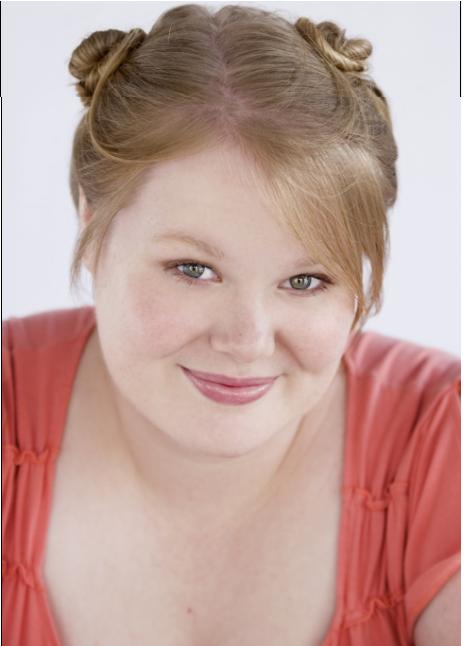
“Mastering Twitter for your Acting Career”
With social media as a formidable tool, we actors now have SO many fun ways to promote ourselves and make a big impact on our careers! Let’s cover the Top 10 Rules about applying Twitter to your career cause. 🙂
1. Consistency is KING. My dear friends, if you show up for Twitter…then abandon it for several months…then come back for a few weeks, then disappear again…you’re not going to build relationships there. This really IS rule #1, because Twitter is more like an intimate conversation than any of the other social outlets. You don’t have to go crazy–the Dallas Travers rule is Do Less, More Often–but come along regularly, at least 2-3x per week. Too crazy-busy? Apps like Hoot Suite and TweetDeck are SO helpful in managing Twitter!
2. It’s not the You-Party. Don’t worry, other things can be! 😉 But Twitter is more about forming bonds and making relationships than it is about selling yourself. That said, make a point to do self promotional tweets regularly, but that shouldn’t be your WHOLE feed. Most of your feed should be at-replies, retweets, and engaging and celebrating other users.
3. Don’t Spaghetti-Sling as the awesome Bonnie Gillespie would say! Twitter is HUGE–go forth with purpose. What do you want to do? Befriend other actors? Befriend celebrities? Indie filmmakers? Producers? Agents? Start with that, then utilize Twitter’s killer SEARCH function. And listen to Follow Friday (#FF)–the people you follow will suggest MORE people–and people only recommend others worth following.
4. Personalize Retweets. Retweeting used to allow for a comment, but the new Twitter interface just automatically processes it. To add your own message, click ‘reply,’ then put your text at the forefront of the Tweet. Throw in an ‘RT’ and there ya go–a personalized retweet!
5. Choose wisely who to follow, because following TOO many people is just going to overwhelm your feed (and likely keep you inactive or disengaged). Make sure to only follow users who are active Tweeps, not someone who logged on in 2009 and then wandered away. Follow people who are easy to engage with, too!
6. And don’t feel badly if YOU don’t have many followers. Believe me–they will come! Be patient and start small–besides, why do they need to follow you if most of your content is engaging with them directly? Just keep on creating and nourishing relationships and eventually you’ll be a total magnet for followers. 🙂
7. Rome wasn’t built in a day. Can I re-emphasize patience? I simply must. ❤ Patience, friends! Twitter takes a while to give you some clout. But just keep on keepin’ on.
9. Utilize Klout and give accordingly! Check out your Klout score, then dole some out to the people you admire. Again, you’ll make their day, and in addition to that–you gain Klout yourself, both online AND to the people you admire.
10. If you can, take Twitter into REAL LIFE! I know that both coasts have NY/LA Actor Tweet-Ups–and everyone just gets SO EXCITED to meet each other. I almost swallowed my tongue the first time I got to meet @CandiceOden. It’s thrilling, and builds your relationships even more! And who knows? You’ll probably get more followers, too! 😉
I do hope this has been helpful for all you ass-kicking actors! Please swing by my Facebook to give me a like, my Twitter for a follow, and frequent the official blog–I’d love for you to join the Ships Ahoy community!
Ahoy, Mateys!
Jen
Thanks so much for your wisdom and insight, Jen! Please leave Jen a comment if you found her tips helpful, and feel free to like her on facebook and follow her on twitter!
Taking a Study Break-What Do I Study?
Spring break! That time of year when college students flock somewhere sunny and alcoholic and when I drive seven hours back home for a few days. Although I’ll admit I’m enjoying the break from studying, classes and rehearsals and for once, I didn’t bring much work with me to get done. Usually I have scripts to memorize, paperwork to do, jobs to search for but this week is strictly relaxation, sleeping in and practicing my black eye for Makeup class. As a theatre major, I do get really cool classes like Stage Makeup but it’s not always as much fun as creating wounds with a bottle of fake blood and not all my classes are acting oriented either. As I’m reaching the halfway point of my studies, I have so far taken:
- Theatre Majors Seminar
- Theatre Practice
- Introduction to Performing Arts
- Script Analysis
- Technical Theatre
- Acting
- Scene Study
- Acting Lab (Directing class)
- Intro to Dance
- Modern Dance
- Voice and Movement
- Dance Improv
- Makeup
I’m not counting my required courses like Geology and my writing minor but the classes I’m taking offered by the department of theatre and dance. I took the basic requirements like Script Analysis my first year and so I get to focus more on my interests now that I’m in my second year now, and I am taking Voice and Movement, Modern Dance, Dance Improv, Acting Lab, Scene Study, Makeup and Theatre Practice:
I took the first level of Modern Dance last fall. I’m no dancer but I love to dance and according to my evaluation, I did pick up a little technique so far. I couldn’t fit Modern Dance again in for this semester, but I did get into the Dance Improv class and I’m acting away in Scene Study class. We’re working on our second scene already, where I’m Babe from Crimes of the Heart. We’re supposed to perform it when we get back from break and I’m excited, especially since I’m mostly sitting and eating chocolate for the scene.
What I’m most excited to be doing this year though, is Voice and Movement. It’s the sophomore Acting/Musical Theatre BFA class to develop their physical and vocal abilities. We’re learning Tai Chi and exercises in movement theatre and right now, we are slowly working our way up to putting together a performance for our final. This is the class where all my Star Wars references come from: the class where I feel like Luke Skywalker learning to be a Jedi. My professor has something of Yoda in him too, so my class jokes. The funny thing about this class is that I’m not even supposed to be in it—my school offers BFA majors and the BA. I’ll keep this short and say that as a BA, I wasn’t supposed to be taking a BFA class but I asked if I could join the class. What is BFA? What does BA stand for? Respectively, Bachelor of Fine Arts and Bachelor of Arts. A BFA is usually more strictly focused on Acting, Dance, Technical Theatre while a BA studies more liberal arts. Every school is different but that’s a general observation. All I know is that I jumped through hoops to get the paperwork in to everyone’s satisfaction to take V+M, but it was worth it.
What else is there? Theatre Practice is what we call our show assignments. Every theatre major is either cast or assigned work on a show every semester, be it the leading role or painting scenery. Freshmen have to work one semester in the Scene Shop, learning how to build sets and then the second semester in the Costume Shop making costumes. I did my time building and sewing and now, I’m doing my Theatre Practice as the Assistant Stage Manager for an upcoming production of Stage Door. It’s directed by the same professor I have for Acting Lab. It’s not really a class for acting but it’s the directing class. Seniors take Directing and a lot of the class is directing scenes with a group of volunteer actors. When I heard there was an opening in Acting Lab for more students, I heard “acting” and volunteered and since freshman year, I’ve been in Acting Lab every semester. I love it, it’s where I really first got to know the upperclassmen and people started to know my name (my real name. My first semester, I was frequently confused for another freshman until she changed her major). I like my acting classes, where the focus is on the actors, but it was Acting Lab where I really started to learn to act beyond what I figured out for myself.
I’m not finished with my major yet though. I still have to at least take Directing, Theatre History, Theatre Management and I want to take the Stage Combat courses. Of course, there is still more acting and dance I can do, plus I have a minor to work on and it’s been suggested we might get a playwriting class, my fingers are crossed. In the meantime, I’m going to finish up this semester and then, I’m taking one more very special class hosted by the English department that’s held in New York City, reading plays and then seeing them performed!
Reading this over again, I realized I kept saying I love all these classes but it’s true. You know you picked the right major when you’re excited to go to class or in my case, you can’t wait to go back. In the meantime, enjoy these photos of my practicing a black eye with my stage makeup for class.



Good morning, and Happy Movie Musical Monday!
Last week MMM took a week off because of tech rehearsal obligations. Outside of writing about movie musicals, the author sometimes has a play on herself, as evidenced by this photograph:

Aquanet: I am awaiting your endorsement call. PS: I’m from New Jersey, so hairspray is like AIR to me.
But today we’re back with 1967’s How to Succeed in Business Without Really Trying, a musical that has special affinity to this blog, as our very own California Triple-Threat was understudying the female lead in a production of this not too long ago. This film was released by United Artists six years after the original Broadway production opened and not only won seven Tonys (including Best Musical), but was also awarded the Pulitzer Prize in Drama. It ran for three and a half years, with only three previews before it opened. I find that last fact especially shocking, given the penchant for weeks-to-months of previews for today’s Broadway circuit. It’s one thing to only have three previews. It’s another thing to have three previews and have a show that turns out this good.
Let’s take a moment, then, to talk about the source material for this musical. According to Wikipedia, a man named Shepherd Mead worked his way up from the mail room to vice presidency of an ad agency. In his spare time, he wrote a tongue-in-cheek satire how-to book about climbing the corporate ladder, that was finally published in 1952 and became a best seller. Despite containing statements like, “Be an ‘all-around’ man of no special ability and you will rise to the top,” the Library of Congress decided not to classify this book in “Humor,” but rather in the non-fiction section of “Business Books.” Perhaps this is because the Library of Congress understands all too well what makes this material so funny and rife for musical theatre parody: It’s Real.
(Fuckin’ libraries, man. They always know.)
Playwrights Jack Weinstock and Willie Gilbert wrote a straight play adaptation of the book in 1955. And then nothing happened for five years, until the work was picked up by an agent and introduced to the right people to be re-tooled as a musical. Enter Abe Burrows to help with the book and direct, plus the brilliant Frank Loesser to write the music, with choreography by Bob Fosse, and suddenly you have a viable commodity.
And Shepherd Mead was laughing all the way to the bank.
WHAT IS THIS MUSICAL ABOUT?
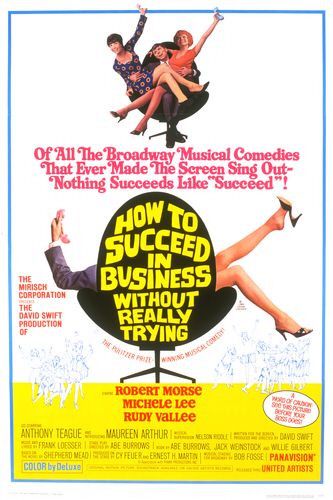
This, like so many musicals, is a story of the Everyman. A person with a dream to make it big somewhere, to leave the world better than how they came into it, to make a difference. Or at least die rich and possibly famous.
Our man/projected-self is J. Pierrepont Finch (“F-I-N-C-H”), played here by a young, energized, wide-eyed Robert Morse, reprising his Tony-award winning performance as a window washer with ambition. One day Finch is buying a paper at a newsstand, and sees a book called How to Succeed in Business Without Really Trying. He immediately buys it, and is overcome with visions of the possibility of making a splash in the corporate world.

“The Voice” of the book becomes his guide. Finch makes his entrance into the World Wide Wicket Company, and after assessing that the company is large enough for him to find success in (the first stipulation offered up by the Voice), he takes his first step at gaining employment by running head on into the President of the company, J.B. Biggley (played by Rudy Valle, also reprising the role he originated on Broadway). After an abrupt dismissal from Biggley, Finch begins to head over to the personnel department when he’s approached by woman wearing the ugliest hat I’ve ever seen. This is Michele Lee in her screen debut, playing Rosemary Pilkington. Lucky for us, she radiates beauty and warmth, so it’s pretty easy to forget about the hat. Seriously: I’m heterosexual, but there’s something about Michele Lee’s face in this introductory shot that’s just captivating. She feels the same way–about Finch. Unfortunately he’s too pre-occupied with business to notice. That’s okay, though: this is a musical comedy, so it’s a sure thing that she’ll wait till it works out.
Finch gets placed in the mailroom alongside foil Budd Frump, Biggley’s nephew, who uses his familial clout to get away with not doing much work and constantly advancing in the company without cause. Frump was originated on stage by Charles Nelson Reilly, but here is played here (very well, I think) by Anthony Teague, who was last seen previous to this film on-screen playing Big Deal in West Side Story. He’ll be the Jet in the back row, all the way to the right of frame at the cut to Ice’s POV shot.
It soon comes out that the head of the mailroom, Mr. Twimble, will be moving up to the shipping department. He’s been with the company 25 years, and explains to Finch how he’s stayed employed so long:
Upon hearing this song and following advice from the book, Finch realizes he needs to leave the mailroom as quickly as possible. He declines a promotion to head of the mailroom, turning it over to a squirmingly enthusiastic Budd. His reasons, involving several metaphors about being a small piece of larger puzzle, are overheard by Biggley and a Mr. Bratt, that latter of which then has Finch promoted to Junior Executive. Finch is pleased with his progress, though outwardly humble to everyone around him, and Budd is infuriated.
But we’ve been in the corporate America of the ’60s for about twenty minutes now, and we still haven’t seen any sex. Enter Hedy LaRue, yet another send up of the Marilyn-esque archetype that littered so much popular culture from the mid ’50s to the early ’60s. LaRue is Biggley’s mistress, and has called in a favor to gain employment. Her arrival causes quite the stir, and culminates in one of the most memorable sequences in movie musical history:
All those BEAUTIFUL Fosse lines, they’re just killer. This sequence also showcases how well this movie musical was shot–there is a brilliant blending of traditional, good cinematography and theatrical staging that creates a sense of a real-but-not-too-real reality. We definitely respect this space as recognizable, but still set apart and commenting on our own day-to-day lives. Well done!
So it’s the end of Finch’s second day at World Wide Wicket, and at the elevator he runs into Rosemary (in a better hat) and Smitty, another secretary and Rosemary’s chum. While waiting for the elevator, Smitty does Rosemary a solid by asking just a bit too loudly what she’s doing for dinner that night. This of course is meant to plant the seed for Finch to make a move:
Soon after they all depart, Hedy and Biggley run into each other. She’s not happy being in the steno pool, and wants to be assigned to a big shot. Budd stumbles across them, and secures a promotion with the same kind of perceptive commentary Smitty provided earlier.
After dinner, Finch is walks Rosemary home. Upon entering the lobby to her apartment, he discovers she reads both Fortune and Business Weekly, and tells her she’s the only girl he feels like he can really open up to. This is clearly a female trick gone well: Rosemary never talks about business or how to get ahead throughout the whole of the musical. Clearly she just subscribed to those magazines like yesterday in order to look attune with Finch’s interests. And it worked. He admits to her that he feels depressed: he’s 27 and only a junior executive, what can he possibly do now? Rosemary reminds him that most people take years to accomplish what he’s done in only 2 days, and assures him that she has faith in him. She does this by singing a song to him, while constantly shaking her head, jutting out her chin to an amazing distance from the natural frame of her face and moving it side by side (best shown going into the bridge, and then again the final verse) :
Somehow, this song inspires Robert Morse to go back to the office the next day and pretend that he’s been working there all night so that when Mr. Biggley shows up to grab his golf clubs for a game with the Chairman of the Board, he’ll look like a diligent employee. I’m not really sure when exactly that lighting bolt was meant to hit, but I guess it happened and now we have to deal with it. So we do, and Mr. Biggley is impressed not only by Finch’s dedication to the firm, but also to his apparent (feigned) almuni status of Biggley’s own college, Old Ivy: home of the Groundhogs and enemy to the Chipmunks. On Monday when he returns to the office, Biggley arranges Finch to have his own office. And who gets put on his desk? Hedy LaRue. Finch wisely consults the book before making any advances, and discovers Hedy’s lack of proficiency professionally is made up somewhere by her connections to someone more important than him–namely Mr. Biggley. He then proceeds to use Hedy as bait to trap any other higher-up in his way, getting various people transferred to South America for any advance they may make on J.B.’s property.
After a while, though, he hits a wall: the vice president in charge of advertising won’t fall for any of his usual tricks. He’s always one step ahead. One day, he informs Finch that he’s fired. The VP even arranged a going away party for Finch that Friday. Desperate, Finch drills Rosemary, who’s assigned as the VP’s secretary, for any information. He goes undercover in his old profession as a window washer in order to overhear the VP’s conversation on his private telephone line in his office, and follows him after closing time to an alumni meeting–of Chipmunks! Armed with this information, Finch returns to WWW, has the VP fired, and secures the job for himself. His farewell party has now become a celebration.
At the party, Hedy has a little too much to drink, and goes to Biggley’s office to take a shower and sober up. Budd, looking for another opportunity to sabotage, tells Finch that Biggley wants to see him in his office. Finch shows up to discover Hedy, who drunkenly makes a pass at him, and finally manages to convince him to kiss her. And then:
Rosemary enters to warn Finch about Budd’s plan, but doesn’t get a chance to explain before Finch asks her to marry him. Of course she immediately says yes (since she’s only been waiting about a week or so) and they kiss. Then Hedy enters in a very small towel, and Rosemary is thrown into a rage. She has to subdue herself momentarily, though, when she hears a group of executives (including Mr. Biggley) coming down the hall toward the office. She throws Heddy back into the bathroom, and throws herself into Finch’s arms, just in time for Biggley and crew to burst in. Rosemary takes the blame, saying she wanted Finch to show her Biggley’s office. Biggley excuses it, and reminds Finch that they’re looking forward to seeing his big idea in advertising in 48 hours, when he’ll have to make a presentation that will make or break his career.
Finch is left wracking his brain. For the first time in his career, he’s actually being asked to produce something–not just move blindly ahead to the next rung of the ladder. And he’s having trouble. Enter Budd Frump, who this time offers Finch a proposal for a give away show sponsored by the company. Budd swears he’s never mentioned it to his uncle–though in reality he had, and Biggley hated it. He leaves, and Finch tears into it, since it’s the only idea in the room. The next day before the meeting, Finch sings a love song to himself amongst his unwelcoming peers(which loses some of its humorous panache by having already been song in earnest by shakey-jawed Rosemary):
(It is my dream to someday be in a bathroom like that. Just once. Just to visit.)
So Finch goes into the meeting, makes his presentation, and somehow–through a perfect blend of charisma, business acumen, and double talk–convinces Biggley that the give away show is actually a good idea. They even get Hedy to be “the girl” hosting it. However, at the initial broadcast the show falls apart, due mostly to some upstanding morals of Hedy’s and some forgotten morals of Biggley’s. Disaster befalls WWW, stock is down, and the Chairman of the Board shows up, ready to fire Finch once and for all. Finch thinks his only way out is to blame someone else for what happened, but Rosemary tells him she can’t love him unless he does the right thing and owns up to his mistake. He does, and it comes out that he started out as a window washer. And what do you know: so did the Chairman of the Board. Isn’t that a coincidence?! This secures Finch’s place in the company a little longer, but the Chairman still wants a head to axe and is ready to fire everyone. But our hero comes to the rescue just in time:
Then suddenly everything works out: Budd gets fired, Biggley keeps his job, the Chairman marries Hedy and retires, and Finch becomes the new Chairman of the Board. He even gets Rosemary back. This elevated position leaves Finch free to change his name, age thirty years, and found another company altogether.

End of musical!
WHY THIS MUSICAL ACTUALLY MATTERS:
It’s rare that a piece of art so well examines a section of our culture so well, and perhaps even rarer (or more unexpected) that a musical will. That’s why it won the Pulitzer. The songs are witty, observant, well placed, and fun. The book is spot on and bright. And despite that nothing really happens, social change isn’t called for, and no big problems are tackled, this work is still relevant today. That says something.
HIDDEN GEM SONGS:
Sadly, some of the best songs from this musical were actually cut from the film adaptation. So here is my list of songs so hidden, you can’t hear them when watching this movie.
- Coffee Break: My favorite from this show, and potentially a brilliant comedic song choice if directed well.
- Happy to Keep His Dinner Warm: Maybe over-done, but important for anyone with a mezzo range to know, especially when auditioning for any musical set in the early fifties into the mid-to-late sixties (except Hair—not Hair).
Have a good day, brother, and Happy Movie Musical Monday!
GUEST POST BY EMMA J: On Nudity
Hey, Green Roomers! Please welcome to the blog today, Emma J! Emma is a model and actor who has worked in London, Miami, and New York. You may have seen her work Off-Broadway, on Law & Order, or in a Three Olives Vodka commercial! Be sure to check out her blog HERE when you’re finished reading what she has to say here!
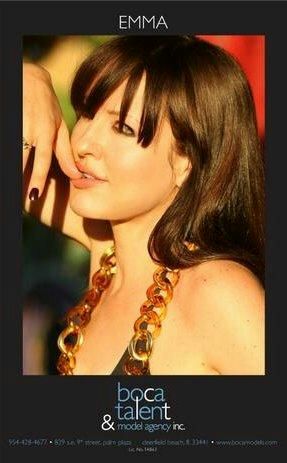
GUEST BLOG BY EMMA J — On Nudity
Remember, you use yourself to act, but the character is not you; the character comes through you -Larry Moss.
I made sure to communicate clearly before signing with my agent that I am committed to my craft and therefore comfortable if the role requires nudity. My agent still asks, to double check, before submitting me for a role if some form of nudity is required. Infact just last week my booker made sure before submitting me for a feature film. Modeling has been my springboard into acting. It has prepared me in ways I never imagined it could. Modeling, like acting, requires you to be comfortable within your own skin and understand your type. While shooting an industrial for Royal Caribbean in the Bahamas I got to explore a character and fell in love with the process.
I had my first taste of being in front of the camera at age 7, while modeling a school uniform campaign for a British superstore called Tesco. I distinctly remember I had to hold hands with the boy that I was shooting with. I reached out to hold his hand and had to wait patiently before he held mine in return. I often smile to myself when recalling this memory as it reminds me how comfortable I’ve always been in front of the camera.
As an artist I made the choice before even studying my craft that I was 100% comfortable with nudity, as long as it was necessary to my characters story. I experienced my first love scene in a short film, on a closed set. It was so choreographed under the sheets that it was anything but sexy. But the experience was extremely valuable and I’m happy I got to learn the intricacies of such a scene while on a small set. I later had an audition for Broadwalk Empire. I was very excited about this, mainly because I trust the director and the integrity of the show and secondly because I love the style of the 1920s. Dressing in 1920s boudoir made use of my fashion history knowledge and my vast vintage collection for the auditions. Infact it was one of my favorite auditions to date.
I didn’t get the role. However, I decided in the process I am comfortable with nudity for a reoccurring role on a television show, providing I believe it is absolutely necessary. I had only considered nudity within film before.
I firmly believe that as an artist it is not my job to edit the truth but to tell it. If my character has a nude scene and it is necessary for the development of the story then as an actress why would I edit that? However authenticity is key and there will be scripts where the nudity has nothing to do with the characters development and everything to do with ratings. A recent example that comes to mind was a script I agreed to read, that was quite frankly hard to even finish. My character was taking off her top in every single scene. It made no sense to the story and needless to say I declined the role.
Whatever you decide, you have to stay true to yourself and what you are comfortable with.
Thanks so much, Emma! We always appreciate actors who are willing to delve into the sometimes uncomfortable topic of nudity in our work. Please share your thoughts on the matter in the comments, readers! And be sure to follow Emma on twitter.
Apple, Armani and pencils: my tools
Like most actors, my “can’t-live-without” tools are mostly ephemeral: discipline, training, belief, perseverance, loving support from family and friends and luckily, very cool representation. But those are things every person has to find by his or herself. So here’s a list of the more concrete tools of the trade, which I rely on and which can be found by you!
1.) Apple Products, even though I hate myself a little bit for it. Apple says it’s improving the working conditions, but the standards under which our personal electronic devices are made still seem harsh. I can’t pretend to be ignorant about this issue. But at the moment, I use my iPhone for just about everything you can think of in this industry: responding immediately to audition requests, submitting for jobs, downloading sides to read on the train, networking through twitter, researching roles and plays, practicing accents with apps, etc etc etc. And my MacBook has held all the sound cues, scripts and contracts for many shows. I don’t know how to reconcile the world in which the products are made and the world in which they are used. But I hope that Apple, with all its brainpower, can soon make these worlds more equal.
2.) A little tube of Giorgio Armani foundation that someone gave me when they were cleaning out their bathroom! It’s just the right shade and size to carry around everyday and slap on moments before an audition. It looks awesome on camera. I just can’t believe that soon I’ll have to buy my own expensive tube, as this freebie is sputtering to an end.
3.) Pencils with erasers. Every time I see someone write on a script in pen during rehearsal, I do a little internal gasp. That was a serious offense in British drama school. I still believe that performance is constantly a work in progress.
4.) Local Arts Councils I’ve said it before on this blog and I’ll say it again: local arts councils are full of resources for actors: grants, acting and teaching jobs, performance opportunities, marketing assistance, listings and overall awesome people who want nothing more than for you, as an artist, to succeed
5.) My reel: I know, it’s a major pain-in-the-butt to get together, but if you have the footage it’s fairly easy to edit on iMovie (yes, Apple again….) Mine is very simple, just two clips cut together, but I’m working on improving it with every new bit of footage I get. However, just this simple, wonky two-clip reel, posted on casting websites, has generated a huge amount of auditions. I guess it shows my type. So get editing yours today!

5 Essential “Tools”
Using Tools as a Stage Manager. This was a very difficult blog to consider for me, as Stage Management is something that I think is so infinitely personal and there are literally one million ways to accomplish the same task. Then I thought, geez, the same can be said about Acting so shut up and share what works for you!
The word “tool” I use loosely, but here are the 5 “tools” that I believe are absolutely essential for promoting yourself as a Stage Manager:
- http://www.actorsequity.org Click on “casting call” then click on “stage managers.” Yes, it’s that easy. Just note that the Stage Managers postings appear about 1-2 days after the same ad appears on http://www.playbill.com. I’ve definitely accidentally applied for the same gig twice. [For you non-AEA SMs, Playbill is a great site for both paid and unpaid work].
- Your System Okay, once you book the gig, you must deliver! My “Templates” folder on my computer has Rehearsal Reports, Line Notes, Prop Tracking, Costume Flow Charts, Petty Cash Sheet, Rehearsal Schedule, and Production Calendar documents that I simply have to fill in the appropriate information and I’m done! This saves me immense amounts of time and helps me be consistent in all my work. In today’s day-and-age, it is especially essential to both attach [as a PDF!] and copy into the body of the email all the information. Half the people receiving them will prefer to print out at a computer desk, while the rest need to access the information effortlessly on their smartphone.
- Stop Watch/Applicable Phone App Even if you’re non-AEA, actors deserve breaks at appropriate times. A stopwatch counting from when you start rehearsal waiting until that 80-minute mark, then restarted for a 10-minute break is very accurate and respected by everyone in the room. Always note exact times in your rehearsal reports, in case of a discrepancy.
- Tape Measure If you’re rehearsing for a show where the performance space is 15′ x’ 15′ and the rehearsal room is 20′ x 27′ it’s easy for the director to block inaccurately if you have no spike marks that notate the exact size of the space.
- Professionalism!!! Last and not least. Professionalism covers a lot and starts with the way you speak to your actors [my common phrasing after a break is something like “Ladies and Gentlemen, we are back – we are back! Please pick up from…”]. Professionalism includes how you use your smartphone and computer while rehearsing [Just because we SMs sit behind a table with technology at our fingertips doesn’t mean you should be texting your roommate what to cook for dinner]. Rehearsal attire is extremely important. As I may have mentioned before, Theatre is a relatively backwards profession when it comes to several practices [It’s completely appropriate to wear jeans to work – but not appropriate to be in a suit/skirt when you have to be moving rehearsal cubes around]. Dress nicely, but in a way that allows you to do your job. My rule-of-thumb is jeans/khakis and a professional top. I don’t think sweatpants and graphic Ts are appropriate for rehearsal. I’m not saying I wear a blazer, but I may wear a blouse or solid-color/patterned top that looks nice while still allowing me to move those cubes 10 times a rehearsal. Oh, and footwear: don’t wear heels or flip-flops if you can’t do your job in them, an actor should never feel as if s/he has to help you move something because you aren’t dressed appropriately.
Stage Management is an individual profession and everyone works differently. But these are the 5 “essentials” that can be applied no matter what your Method of Operation.

Tools That Make Life Easier
Here are my picks for top five most useful industry tools, ladies and gents:
1. My monologue/sides binder: Somewhere organized where I can keep every paper product I might need for an audition.
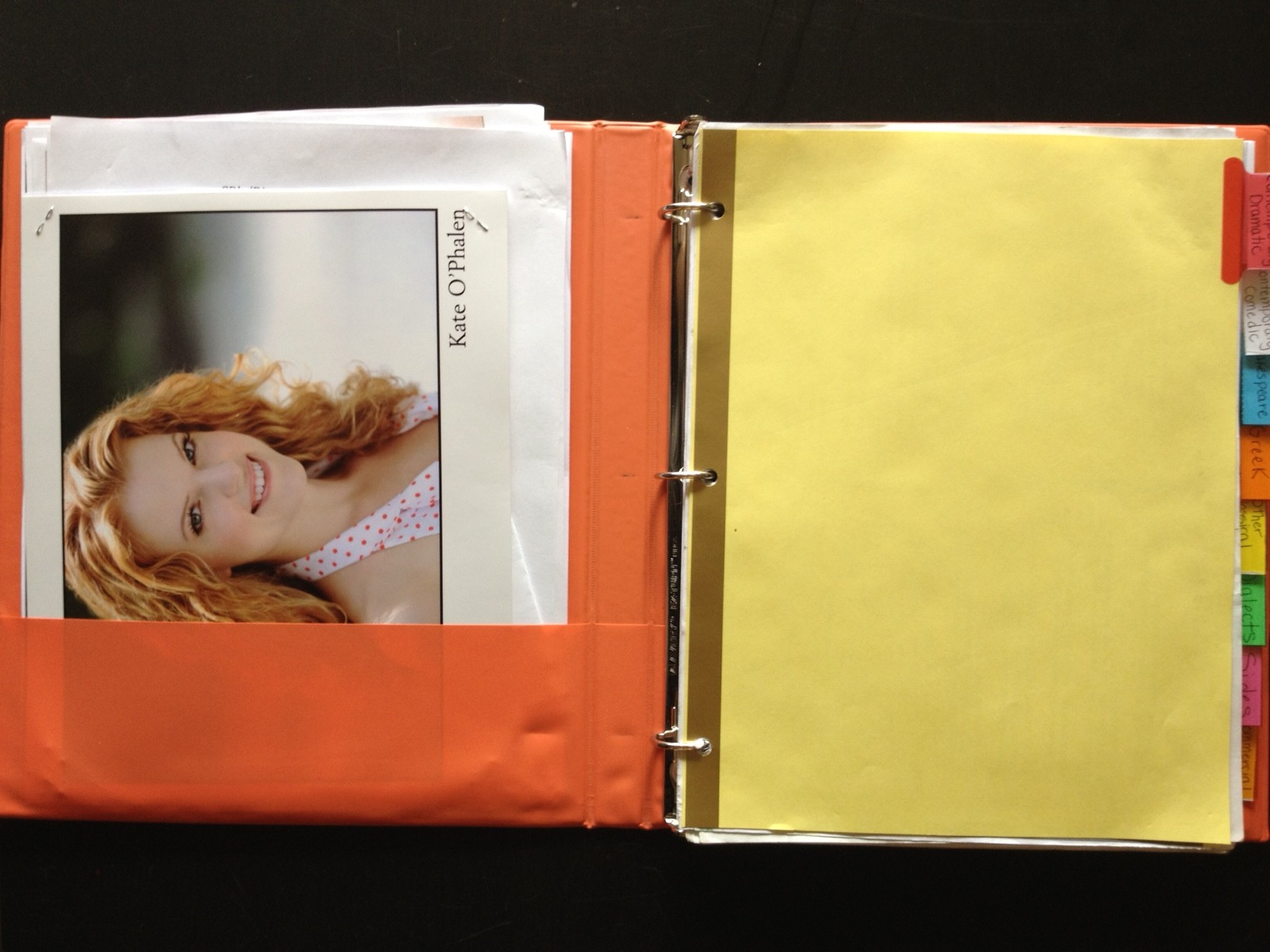
Headshots, printed out sides, and other recent paperwork in the pocket on the left, monologues and prepared sides organized in excruciating detail on the right.
2. iPhone: Cliche? Perhaps. Totally a life-saver in dozens of circumstances? Definitely. I use iCal to store all of the pertinent info for every audition, the map feature to get me to unfamiliar places, the reminders function to keep my actor to-dos organized, and several other super-useful apps (future blog post!) on an at least hourly basis.
3. Playbill/Actors Access/AEA Call/Backstage casting notices: This is also super obvious, but worth mentioning because, honestly? The only way this business could be harder would be if we were having to find audition notices in newspapers and mailing dozens of hardcopy headshots each day.
4. New York Public Library / Drama Bookshop: There’s very little research material you might need to find for an audition or production that you can’t find using one of these two resources. I’ve written a whole post already about how much I love the NYPL, but it’s still worth mentioning again for its usefulness in a nearly unfathomable amount of ways. Similarly, the good ol’ trusty Drama Bookshop is an invaluable tool for the NYC actor. And you don’t even have to spend tons of money to get what you need there. Case in point, I spent the better part of two days there last month searching for the perfect scene and I only ended up buying one play from them. They rock my socks. Also? They have awesome events there in the downstairs theater. I got to meet Paula Vogel that way!
5. Twitter: I had no idea when I joined Twitter to chat with some of my blogger friends that I was dipping my toes into one of the greatest showbiz tools out there. Not only can you keep up with industry news, score free broadway tickets, find a support network of fellow artists, and get nearly instantaneous advice from your followers, but it is also the great democratizer in terms of who you can get to know. I’ve been tweeted at by Jason Robert Brown, for example, and there are many casting directors/agents/directors who know me by name only from my tweeting! I find Twitter truly exciting, if for this reason alone!
Honorable mentions on this list include: Headshots I adore by Jordan Matter, versatile and confidence-inspiring audition clothes/shoes, and IMDBpro for industry research!
What tools help you to navigate this biz?



 The Green Room