Learning to edit yourself
I read a quote that said: “An intellectual says a simple thing in a complex way; an artist says a complex thing in a simple way.” This says to me that the idea of the Intellectual Artist is somewhat of an anomaly. I have met some extremely intellectual actors, directors, designers, in my time; but though they have intellectual tendencies, they almost always classify themselves as Artist first. I feel that the Dramaturg serves both purposes equally and therefore I have a hard time determining which has the most pull. We work in creative context with the eye of an intellectual. However, it is a balancing act when determining which side is meant to emerge and when. This is how we slowly learn to edit ourselves, especially in rehearsal. For example, when determining the artistic value of having a moon shining on the lovers as they say their final goodbyes; you may want to refrain from bringing up the fact that the moon is not in the right phase for the time… it won’t bother anyone but you. I know. The only ones who pick up on those factoids are Dramaturgs because they’ve been trained to. When in production let the creativity flow and see what comes of it. If at the end of the 18 hour rehearsal day you find that the factoids just don’t add up and the audience is confused; then it’s time to speak up and let the intellectual side take over. Dramaturgs are rarely the final decision makers when it comes to any production (with the exception of maybe some playbill notes), but their opinions have value because they are usually grounded in something intellectual. As part of the creative process a Dramaturg must learn when and where their notes are appropriate. If you misjudge either the when or the where you may get a frustrated Director screaming “I hate your notes!” but later use most of them in production. I’m sure I am not the only one with horror stories of when the editing didn’t work. But what about when it did? How have you used your editing skills to get things done?

The Second Most Expensive Piece of Paper I Own
The most expensive pieces of paper I own would be, without question, my degrees from Hofstra University. Don’t even get me started. Yikes.
But the second most expensive piece of paper I own would be…*drum roll please*…
My Equity card!
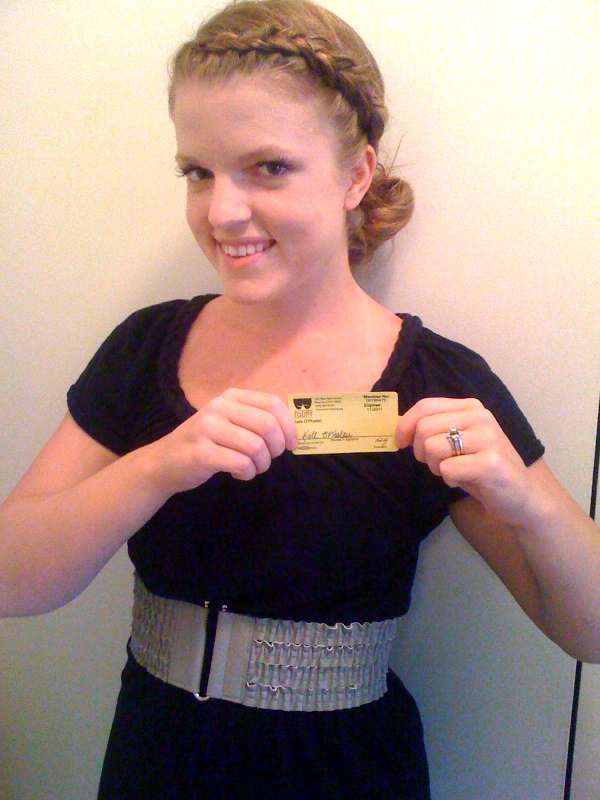
I received this little yellow number in the mail the other day and it feels good.
Although I know that the real work is just beginning, taking this big step is so incredibly satisfying. I feel like I’ve finally proven that I belong in this city and this industry. And I feel like a real grown-up when I get letters in the mail about my 401k 🙂

Mommy Dearest
Last week’s Backstage newspaper was all about auditioning… it’s a great edition of the weekly, full of great advice, so pick up a copy or read it online if you can.
One of the articles, in the Commercial Break section couldn’t have been more relevant to my week—sort of. The article, titled “When Auditioning with Other Actors, Always Remember to Look Out for Number One,” was a great reminder that we can’t be too polite in multiple-actor auditions by taking care of other actors’ needs above ours…we still need to try to book the job ourselves.
I read this article the day after an intense callback where I had to audition with three needy, loud, hyper and non-focused actors. One even had sticky hands. I think another one picked her nose. Oh, yes, and they were all 5 years old.
As a “quirky mom-type” I am grateful to have many, many commercial auditions at the moment. But often, these auditions are with children. Obviously, directors want to make sure that you actually can relate to a kid on the day of the shoot.
Not a problem, I thought, as I work well with kids. I’ve done tons of TYA, interactive storytelling and improv with kids (heck, I was awarded a grant to do improv with kids after all!) So yes, I know how to work with kids to create fun, lively, goofy, creative scenes. And in that work, the goal is always to validate the kids’ creative resources and help them shine with their ideas. As a community-based theatre program, that concept is awesome. But is it so great for me when trying to book a commercial gig? I’m starting to think not.
That callback was great for the three 5-year-olds. The director even told me as I was leaving the room that he really appreciated how I “wrangled” the kids and “made the scene fun,” “getting them all involved.” Sure I made it fun. I pretended we were on a beach, building a sand castle that got so big it collapsed on top of me, at which point the kids continued to bury me. It was funny and silly and we had fun, and I made sure to interact with every kid and accept their ideas and creativity. If I had been playing with my nephews or improvising with kids on stage, it would have been a major success.
But I realized that on camera, I looked: goofy, uncoordinated and maybe even a little deranged. Not exactly the type of “mom” that a major hotel chain wants representing them in national commercials.
It was a huge light bulb moment for me for me, and in the past year of constant auditioning with kids, a lesson I’m sorry it’s taken me so long to learn.
But I wonder, what else can I do? The concept of “take care of yourself first” works when auditioning with adults….but with 5-year-olds?? I’m not sure a self-first attitude would allow for much chemistry or warmth with the kids. What do you think? Are any of you mom-types (or here’s a crazy concept, actual REAL moms–not just actor-moms) who can give some advice on how to play on camera and not look crazy? I would welcome your thoughts….and a few extra wet-wipes if you can spare them. They are always good for sticky hands!

Joy, minus the enthusiasm?
Recently, I took a trip to Disneyland with a few girlfriends. As a joke, one of the girls would say in a sad voice and blank face, “best day ever….”. The joke continued throughout the day, with variations like “this is my favorite ride…..” or “I love disneyland…”. The humor in it was that it really DID feel like a “best day ever” and we DID really love the rides and the park. While the tone and emotion was all wrong, the words were true and expressed the excitement we felt but didn’t show, for the sake of a laugh.
This got me thinking about hidden meanings in the way I speak a character’s words. There is true discovery and joy to me as an actor when I figure out why my character says things, or what the real meaning is that she is trying to show or even hide with her words. (Does this joy make me a little bit of a theater nerd? Oh well, I think I’m in good company!) Also, am I being truthful in the way I speak for my character? Or am I adding too much of my own world view into my character and not letting her be the person the playwright intended?
But seriously guys, The Green Room Blog is the best.blog.ever.

Don’t Run Away from Local Arts
I know… many of you (like me) left your small hometowns the minute you switched the tassel over on your high school graduation cap….while pledging to never return!
But return you do, at least occasionally, and hopefully not too begrudgingly, to visit your family. You may have even found some charm to your hometown that you missed as a sullen, pent-up, desperate-to-escape teenager.
One gem I hope you don’t miss when visiting your hometown is your area arts council. You’d be surprised at what is going in arts at the local level in the United States. For example the tiny Wayne County Arts Alliance in rural Honesdale, Pennsylvania has been presenting the awesome and free Roots & Rhythm Festival for the past 5 years. And in Salmon, Idaho, the local arts council sponsors theatre and concerts in arguably the country’s most beautiful outdoor space — set in the middle of dramatically lit, snow-capped mountains.
Put aside any notion you might have of the local arts scene being inferior to what’s happening in major cities. I have seen Grammy Award winners sing, Broadway-caliber actors perform and admired paintings worthy of any Chelsea gallery– all in tiny towns across America.
To find out what’s happening with your local arts council, start by checking out your state arts council here. They can then direct you to your local organization.
Give them a visit, see a show or an exhibit, expand your perception of who and what can make art… and while supporting your arts council, you’ll be encouraging more arts programming in your community, so maybe kids living there today won’t run away in same panic as we did!
When the show can’t go on…
As I’ve mentioned before, showbiz is 10% show, 90% business. And business isn’t always clean, cheap, or straightforward. A rarely recognized, yet essential position in the theatre business is the Administrative Producer.
Administrative Producers do the number crunching, fundraising, and make all the verify-it’s-actually-gonna-happen decisions on a daily basis. To get a greater sense of the day-to-day tasks and process, check out an interview with Verity Leigh, Administrative Producer at the Quarantine Theatre.
When a wrench is thrown into the process, the Administrative Producer must put out the fire, and weigh the pros & cons of the problem and it’s effect on the project. If something extremely damaging happens (i.e. a promised star breaking off the contract, severe artistic differences, funders/backers/board members being unsatisfied with the project and backing out) the Administrative Producer must evaluate – realistically – if it is still worth it to continue the production. This step can happen at any point in the process: from inception to ultimately closing a show. If a star-driven show loses it’s star, if box office sales tank and profits cannot support payroll, if an unexpected lawsuit is impending, the Associate Producer must advise the other Producers, Executive Producers, and Board Members whether it is financially worth it to continue with the project. If a show is losing too much money, or is artistically embarrassing, the show must stop. If the show has potential, but just ran out of funds, an Associate Producer may advise to sell the show to another Producing Company in an effort to stay out of debt. If an unexpected severe emergency happens (i.e. fire/flood, extensive vandalism, death) the Associate Producer must coordinate with PR and offer the other producers advice of whether to continue as normal, cancel the show for the evening, or close the show permanently. Essentially: the most unrewarding experience in showbiz.
The Associate Producers are the realists, the practical business minds that allow the art to happen, and allow everyone else to earn a living while doing it. Hats off to the Associate Producers who are left to pick up the pieces when the show can’t go on.

Tapping the Vein; ~or~ The Importance of Inspiration from the Source of Self (From the Vantage Point of One Selachimorpha Organism)
I’ll say it without any shame or hesitation: I dislike greatly the summer. Having grown up and resided in the tri-state area for the majority of my life (NY/NJ/CT, not VA/KY/TN), humidity and a generally miserable existence descend upon me annually mid-May through the end of August. It’s the incessant heat that gets me down: I much prefer the autumn with its hustle and bustle, newly sharpened pencils, and the start of the wearing of layered clothing. (The great thing about fall and winter is you can always put more layers on; in the summer sun, there are only so many layers you can take off.) When overheated and consistently coated in a film of my own sweat, I become cantankerous. I often reflect on a fact I learned during one of my many childhood visits to the National Aquarium in Baltimore: the water the sharks live in is maintained at a cool temperature to keep them from becoming aggressive. I am a shark, but no one is monitoring my tank.
Not only do I become a curmudgeon during the summer months, I also collapse into lethargy. Hot weather encourages slow movement in this land-shark. Recently I became aware of just how dull and seemingly pointless my life had become while at home, attempting to stay cool by drinking ice-mixed-with-something-mixed-with-vodka. As I sat projecting the upcoming days of increased torment, I felt a twang of guilt that I could not dismiss merely as the sting of bottom-shelf booze.
I had taken a much needed respite from even the thought of auditioning during June. That month long gone, I mused over having done nothing that appeared substantial for my career in the time since. It seemed like I was wasting an unemployed summer, when I could have been taking time (and time I had) to consider what I needed for the fall audition season. That had been the plan all along. I had been griping for sometime that I wasn’t working with material I liked, that nothing I had–no monologue, no song–felt true or familiar to who I was or what I felt I could do/wanted to do as a performer. Older material seemed stale and impossible to make new or be “discovered in the moment.” New material seemed trite, found slapdash, and largely uninteresting. And as always: the young, female, comedic monologue that was actually legitimately funny and not just neurotic eluded me. I hated my repertoire–which seemed gross, un-engaging, and somehow too easy–and I had begun to hate myself.
Most of this hate stemmed from a sense of disgust at my own complacency. In my grander, more dramatic moments of brooding (something we over-heated land-sharks have a remarkable capacity for), I hearkened on James Tyrone’s lamentation in Act 4 of Long Day’s Journey Into Night. Over a card game and too much watered-down whiskey, he recounts to his son Edmund the decline his career took when he stopped challenging himself: “I lost the great talent I once had through years of easy repetition, never learning a new part, never really working hard.” (Incidentally, here’s Christopher Plummer killing that speech like a genius.) There is nothing more frightening or appalling to me than squandered potential. And here I was doing it. Not only had I resorted to presenting work I was bored with, but that boredom was slowly eating away at what self-confidence and skill I had as an actor. I retreated into a hermitage in June, planning to rediscover my grounding and enthusiasm, and also new material. But the heat had crippled my resolve and a mental vacation had taken hold of me: mind, body, and soul. As I sat baking within the stagnant air of my incubator-like apartment (the saddest, most despondent little land-shark you ever did see), I realized I did not know what to do to get out of this cavern of a rut, or accomplish what I had initially intended to do: find new material, appropriate for what I was aiming for in my career now. I simply had no motivation. I had no inspiration.
To live a life without regret, it’s necessary to continually strive to better ourselves, to expand in our experience. We must find our own personal limit or edge. In order to progress as artists and human beings, we must keep moving forward. (Incidentally, sharks must keep moving forward to survive, too.) We need to do the things that make us proud. In an industry full of hardships, where too often our fate is controlled by someone else’s personal preference, we must be confident in what we have to offer. If we do the things that give us a sense of pride in ourselves and instigate our work, we become what we need to become most of all: our own source of inspiration. If you can inspire yourself, you won’t need to seek other people’s approval for validation of your talent. You will find an endless spring of joy and interest in exploring all you have to offer, right up to the edge. You will be the whole person you already are.
I realized what was holding me back was not fear, disinterest, or even my personal scapegoat of the incalescent season. What was stilling me was a sense of disappointment in myself similar to the one Eugene O’Neill saw or understood to permeate within his real-life father well enough to transpose it so clearly onto the page. I was not assisting my growth through any kind of artistic or professional challenge. I needed to do something that was going to stimulate my mind and work again as an actor, but most of all I needed to do something that was going to make me proud of myself. I needed to inspire myself.
The problem at hand was that I needed new material. I wasn’t applying myself as intensely as I wanted to or could. So I set myself a challenge to read and hear 100 plays and musicals by the 15th of September. I set the start date back to when I had really begun to ween down my professional activity, May 1st. Part of this was to respect the time and effort I had been putting into this task, albeit small, and also to not totally overwhelm myself in the amount of time I had left to complete the challenge (I am one of those people who recognizes their personal edge only after they’ve pitched themselves over it). With these restrictions in place, I began to tackle anthology after play text after musical book-and-score. I am now past the half-way mark, and I am loving it. I am reveling in exploring writers I’ve enjoyed in the past and ones I’ve never heard of before, as well as picking up finally those “great” plays and musicals I’ve been meaning to read or listen to for years. I’ve hit on some wonderful new pieces for my repertoire, and I am excited by the breadth of work out there that interests me, and that I think I have the potential to be right for. Most of all, I feel as if I have begun to reacquaint myself with myself, and that sense of undying, against-all-odds hope and determination that all of us must have every day if we choose to live this kind of life. Those are the things that support us, and we need to feed them by honoring ourselves with these acts of self-inspiration. And someday in the not-so-distant future we will find that in striving to be our best selves we are actually living as our best selves. It’s a self-fulfilling statement. (Pun intended.)
So the water is cooling, but my excitement is up in the best way. I am focused. I am making it through the rest of the summer basking in the glory of my own interest in this art form–and the air conditioner of the New York Public Library. I maneuver the aisles silently, stealthily, searching for prey that will satiate my remaining audition needs. I am enjoying thoroughly the hunt for these materials, and I know when the autumn audition season comes: I’ll be ready for it. I find the idea of being a shark in a controlled, calmer mental environment of my own making rather comforting. I push ahead, I take what’s useful, I grow and go on. I have been here since the dinosaurs, and intend to stay much longer. While not quite as volatile as before, my spirit of survival and purpose is renewed. I am sharpening my teeth. Look out.
What about you? What have you done independently to promote your own growth as an artist, or to pull yourself out of a rut? What suggestions would you make to other artists who are in a similar situation?

With Us, Not Against Us
Last week, I was at the information session for the LMCC grant program. (If you are a Manhattan-based artist with a project to fund, check them out — besides their grants for non-profits, they also grant money to individuals, which is a great way to start funding your own projects.)
During the session, I was reminded of a piece of advice actors are often given by casting directors – they actually WANT us to succeed in the audition room!
It’s hard to wrap your head around this. There is so much competition and rejection in our industry that it seems as if the job of casting is to weed people out and find fault. But every casting director interview I’ve ever read contains this advice. Instead of thinking “please find me worth enough to employ…please please.” The better mindset is “I can provide you with what you need.” Take care of them, don’t make them take care of you.
And for the most part, I believe that is the same mindset to take with grant-givers. It’s the reason why organizations like the LMCC run info sessions… it’s why grantors write very concise grant guidelines and application instructions – they WANT all the applications to be worthy, eligible, well-written and just good. I presume for two reasons: first they don’t want to waste time sifting through piles of incomplete applications. But mostly, I think, it’s because grant committee members value art and their role in financing it, and want to find and fund as many projects as possible. They WANT us to succeed.
Like casting directors, grantors aren’t sadists who enjoy finding fault and rejecting people’s dreams….They are thrilled to find talented people and projects because it makes their jobs easier and more fulfilling.
So the next time, or the first time, you write a grant application, try to keep it in mind: They are with us, not against us.


 The Green Room