Let’s Play A Game …

Why you should buy stock in ice cream
These past few weeks, I’ve been concentrating on three big auditions and two big grant applications that were due. Writing grant applications is great because it really forces you to pare down your words and think clearly and rationally about the project you are pitching……big auditions, though, seem to have the opposite effect, causing irrational thinking. I have the very bad habit of projecting in my mind all the imagined ways that this gig will be amazing while on my way to a callback. I don’t like to schedule events when I’m waiting to hear about a job, because I’m afraid that saying yes to an invitation for something that falls in the rehearsal period will jinx my chances of getting the job. And I’ll admit, I’ve budgeted the income I would get for a commercial gig in the lobby of the casting office. It’s a terrible habit and one I’m working to rid.
But worse, I think, is the irrational thinking I often do…. even after I know I don’t have the job. I became aware of this illogical behavior when I was finalizing one of my grant application. The final question of the application read something like this:
“If you do not receive funding from XYZ Arts Council, will you still go ahead with your project and if so, how?’
And I thought: Why don’t actors get asked that question at auditions? Because, you see, I’ve got an answer.
Imagine the scene: You are at callbacks, and finish a scene with a reader. There’s a great vibe in the room, the director gave you some adjustments that you incorporated well, you felt you understood the character, you connected with the reader, the producer laughed spontaneously at your comic timing and it’s all just AWESOME. But of course, this is still just a callback. The director thanks you again for coming in and as you are about to walk out the door, says, “oh, hey Tara, we were wondering, if we don’t give you this job, will you still do this job, and how?”
And I’d answer (in grant-application-speak): “If this artist does not secure this gig, the artist WILL continue to do this job. The artist proposes to do the job she does not have in this chronological order: if this artist does not receive a phone call or email regarding this job within the next day, the artist will re-play the audition and callback obsessively in the artist’s mind, even when talking to loved ones about other matters, causing annoying inattentiveness. The actor will develop this further, by going over the details of the callback in spoken word with loved ones, with the subtext of asking for reassurance from them that the producers are probably just busy or idiots for not calling yet. Upon the passage of an unreasonable amount of time (1 – 5 weeks, depending on production schedule) the artist will give up hope of being called by the producer, but will continue to work this job, by searching the theatre’s website for casting information to find out which more talented actress has been cast in this role. The artist will then look for reviews of show or, if in the New York Area, the artist will torture herself by going to see the show under the guise of “research.” After seeing the show the artist is not in but is still doing, the artist will go to Cold Stone Creamery.”

Actors and Social Networks

Gratitude in Auditioning
As I was walking back from a very successful audition the other day, it occurred to me that I had a lot to be thankful for. A great audition doesn’t just come about in a bubble, there are always a variety of factors that influence your performance, and usually, you’ve gotten a lot of help alone the way from other people. In fact, the more I thought about it, the more it become clear to me that, not only does it take a village to raise a child, but it truly takes a village to raise a successful audition.
Let me explain.
I felt really great about the way I looked for the role, which boosted my confidence and helped me deliver a better audition. I can’t take full credit for that myself, though. I also owe a debt of gratitude to:
- My friend Katie, who writes She Likes Ruffles’ blog,for introducing me to the Gibson tuck hairstyle that I wore to the audition
- My Mom, who bought me my favorite yellow dress that I frequently wear when I need a good “power dress” to rock
- My Husband, who gifted me the beautiful designer tights that I had been really wanting so that I can wear my dresses well into fall
- ArtnSoulActing’s book club for actors,which is the reason I had already read the play when I saw the breakdown, and it gave it an invaluable familiarity with the playwrights’ work that I could bring to the audition room.
- Twitter, for initially “introducing” me to the CD, who then later recognized me at a showcase, and finally remembered me at the audition.
- My Husband, who always dutifully prints my resume, staples it to my headshot, and cuts off the excess paper for me — partly to help me get ready more smoothly, and partly as a sort of “good luck” ritual we’ve developed that always gives me a little confidence boost
- My friend Kelly, AKA The Practical Artist, for first introducing me to the theater where I got my Equity Card this summer
- The good folks at Actors Equity: both the present, who expend so much time and effort to schedule and run these EPAs; and the past, who fought for them to exist in the first place

Notes From the Other Side of Union Membership
Hey, Friends! It’s me, reporting live from the other side of union membership to say that so far it’s exactly the same, except that I’m a whole lot poorer from paying my joining dues. Oh, and don’t forget the obligatory daily deluge of mail from Equity:
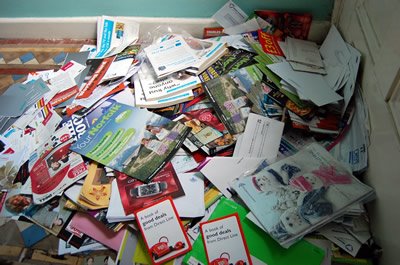
Just kidding, there’s a lot more to it than that, of course 😉 I have a staggering $10.65 in a 401k fund (which I am unjustifiably proud of), access to a whole lot of awesome union-sponsored social services like the free healthcare clinic, the chance to submit myself and get seen for a much higher level of projects, and most importantly, some street cred (definitely the most important part).
In all seriousness, it has been a big transition from thinking of myself as a non-union actor technically able to work on any project, but unable to get seen for the ones that I really wanted to work on, to a union actor with the responsibility to only work on union-approved projects, but the privilege of getting my 2 minutes to shine in front of the casting directors for even the most exciting of productions.
Even the way I check for auditions daily has shifted. Where I used to religiously read the ActorsFirstNY yahoo group emails and NYCastings daily digest, I’ve now unsubscribed from both. They served me well when I was first starting out, but now are full of mostly projects that I’m not interested in or can’t work on. Where I used to see “Equity Principal Audition” in a Playbill job notice title and scroll on by, I now click eagerly and take note of the date. And the Equity Casting Call page got a shiny, new link on my bookmark bar 🙂
After a few (slightly nerve-wracking) EPAs, I finally find myself comfortable in the Equity lounge. I’m familiar with exactly what the audition procedure is (conquering ECCs is next!). And I’m proud to be attending the New Member Reception next week.
Basically, I’m slowly settling into this new world. I know that the hardest work lies ahead for sure, but for now I’m enjoying this rejuvenated sense of excitement and possibility that I’ve found when it comes to auditioning. And if you catch me in the Equity lounge, be sure to say hi, okay?
Any other tips for an Equity newbie like me?
New York New York
Next month I am boarding a plane with my two best friends from college, flying direct- LAX to JFK. Yep, that’s right, this California girl is New York bound! I’m almost embarrassed to admit this is my first trip to the east coast. But I am MORE than excited to go! To contain my excitement I made a tear-off calendar that hangs on my cubical wall at my day job.

My girlfriends and I are visiting a friend who attends NYU, and are determined to pack as much into our week as we can! Of course I’ve made lists galore of things I want to see and do in the city. On the top of my list are (1) take a dance class at Steps on Broadway and (2) Broadway shows, Broadway shows, and oh, see Broadway shows. And then of course all the “tourist” things!
What is your favorite place to go or thing to do in NYC in the fall? Help a girl out! I want to know. 🙂
“Screw the tablework and let’s go home early!” or Directing a Symphony
Alright, this will be an odd post coming from Green Room’s resident Techie, but look at it as an “outside-looking-in” view of the early acting process:
I’ve been thrown into a very unique rehearsal situation as a Stage Manager: Off-Broadway, full length show (over 100 pages), 6 person cast, upper class family, prop heavy… and in the first 3 days: we have had our table read, blocked the entire show, and been released at least an hour early each day. We even canceled a future rehearsal because “we wont need it” (total hours rehearsed: 12). This amazing feat is based on this off-beat director’s philosophy, “screw the tablework and let’s go home early!”
The philosophy is that the script (the dialogue & specific stage direction) speaks for itself. Not just for a fluffy semi-farce comedy, but for complicated works like Pinter. “Don’t analyze!”the actors are told, “No acting this week!” They have been reprimanded when the director sensed someone emoting. The director is musical in her directions of the rhythm in each scene. She emphasizes the rests, interjections, and melody of the words. We are rehearsing a symphony, but we still have the sheet music in front of us. We have done zero tablework and instead cluttered the actors’ minds with complicated blocking, endless props, and have demanded letter-perfect lines from day one.
And…the actors are being duped! We are moving so fast in rehearsal that they barely have time to write down new or changed blocking before we’re on to the next scene. And you know what? I never heard once “why am I crossing” or “I feel the impulse to stand instead of sit” or any such methody-type argument. I can only wonder if this technique is to avoid the burning desire to answer such questions with “you cross because you would be blocking the person speaking if you don’t. Figure out your own *#&%*@% motivation!”
I occasionally feel like the conductor of this symphony by waving my pencil in a crude manner gesturing in a made up sign language (sit, stand, pick up wine glass, cross, etc). But, the actors come to me on each break to review blocking (typically im lucky if 1 or 2 even bother throughout the entire rehearsal process) and this is the most consistent I have ever seen actors in their blocking and their lines this early.
So, as an outside-in eye, this is the most efficient directing process I’ve yet encountered. The actors do their character work at home and apply their characterization to the symphony we compose in rehearsal. In this case the character is your instrument, and you must play the notes as they were composed and follow the beat of the conductor. Yet, as always, it is the way you play the instrument that makes it truly your own. The result resembles Mozart.

Hello! My name is “Impatient.”


