Breaking Up is Hard to Do
We’ve all heard this industry is 99% rejection. We understand that auditioning is our job and performing is our vacation. Still, I’m always amazed at the creative ways people find to tell you “We don’t want you in our play”. Here are some of my favorite “Hey, better luck next time”s:
“Thank you for your audition. The show has now been completely cast.”–Really? Am I IN said cast?
“Unfortunately, it did not work out for you.”–This is also what I tell people who wear jeggings. It’s a priviledge, not a right, ladies.
“We’ll be in touch.”–the theater world’s equivalent to “Let’s do lunch!” It never happens
“Good for you.”–I actually laughed out loud when a director told me this. This is what I tell three year olds when they’re being potty trained.
“The cast list is…”– This is a pretty good way to start a Nancy Kerrigan/Tony Harding-esc situation amongst the cast and not-cast.
“We do not have a part for you at this time.”– …What if I call back in an hour?
The truth is, all of these are better than the phone call that never comes. Even worse is the terrible “Great! I’m gonna bring you in for a callback”…and then nothing. It sends a girl straight back to my mother’s teenage years of waiting by the phone for a boy to call. Did they lose my number? Should I call them? What if that “unknown” number was actually them and they didn’t leave a message? Personally, I would like to start hearing things like this:
“Great monologue, but unfortunately you look exactly like my bitch of an exgirlfiend”
“Thank you, but I have heard that song seven times today and I really hate it.”
“What were you thinking with that outfit?”
“My leading man is skinnier than you so….”
I mean, let’s cut out the “It’s not you, it’s me” crap and tell it like it is, shall we?

How to Sublet Your NYC Apartment
Actors, designers, stage managers, directors, and others spend months seeking out their next awesome job. Finally, they land it. Woo hoo! Only, it’s in Nebraska. Or Florida. Or Oregon. But only for a month, or maybe even three. Certainly not long enough to break the lease on their awesome (and hard to find) New York City apartments.
So now they are faced with the daunting task of finding a subletter. Because you know NYC rents are too crazy to let that shit go to waste. And sometimes, those artists aren’t even being paid enough to maintain an apartment in NYC without the survival job that said artists will promptly be quitting.
That’s where this post comes in. Besides the usual suspects (Craigslist and desperately sharing your plight with facebook friends), I stumbled across an excellent resource: The NYC Actor Sublet Connection group on facebook.
In this group, actors (and other industry pros, as well, I assume) post when they have an apartment to sublet or if they’re looking for a place to stay. Most posts are quickly answered by at least one person, so it seems like the group is large enough to provide real potential as far as potential subletters/apartments go. I think the group is a really great idea for all of the people who are constantly in and out of this city because of the nature of our industry. Because I can’t even tell you how many times I’ve seen the “Guys, desperately need to sublet my bedroom in Morningside Heights for June!!! Help!!!” kind of facebook statuses.
Am I the last actor in New York to hear about this facebook group? Has anyone had any real-life success with it? Does anyone else have any other brilliant subletting ideas? Please share!

From the desk of….. Non-Descript Passerby
I’m writing this blog in the background actor holding area near the set of a big time TV show.
Like many of you, I do do background work, to help pay the bills. And yes, I did mean that double verb in the previous sentence because, let’s face it, doing background work can often make you feel like do do.
So I’ve developed a strategy to make it through the long and sometimes soul-destroying days.
There are other well-written blogs on the practicalities of doing background work (how to dress, how to act, what to bring, etc.) So I wanted to give you my idea on how to just stay positive. And yes, I’m partly trying to convince myself! (remember, I am sitting in holding right now. And I was just told by a Wardrobe Assistant, WHO WAS DRINKING A CUP OF COFFEE, that she could not answer my question, “Excuse me, where is the coffee?” She said she would only answer questions about wardrobe…… NOT that she didn’t KNOW where the coffee is, but that SHE WOULDN’T ANSWER THE QUESTION BECAUSE IT WAS NOT ABOUT WARDROBE….yes, it can be like that on set …. But back to being postitive…… 🙂 🙂 🙂
I give myself a challenge every time I work background to learn something…. Often, it’s the title and responsibilities of a crew member that I learn (so I now know what those long lists of credits at the end of a film really mean.) Sometimes, it’s watching the principals’ behavior (good or bad) that teaches me what kind of actor I want to be. Still, other times, it’s just a simple tip about living that I learn on set (like that your SAG card gets you two free tickets to the first screening of the day at Pavilion Theatre in Park Slope—I would have never known that if another background actor and I hadn’t chatted on set one day).
It’s simple, but it’s a strategy that keeps my mind out of the do do. Maybe all you other BG’s out there can fill us in our your ideas for staying positive on set?
Oh, and Bemba is a language spoken in Zambia. Who knew? Well, this other background actor working today who speaks it fluently. Today’s lesson complete. And the coffee… it was right in the back room here in holding. I found it myself, thank you very much.

The Green-Eyed Motivator
Like many artists still working to establish themselves enough so that they needn’t do anything else besides their art, I have a day job that supports me. I don’t mind this too much–it’s not a terrible job, I like it well enough, and I’m pretty much able to come and go as I please or need. Things had been going pretty smoothly there until not-too-recently when a new employee was hired part-time. This employee is female and also an actor. She’s my height, my complexion, my hair color–though she has a better haircut–and my weight. Alright: maybe she’s thinner. She puts in less hours than me at our place of business and appears to be out at more auditions, callbacks, rehearsals than I am. The little interaction I’ve had with her have shown her to be a nice, focused, relaxed girl.
So of course I hate her.
In an industry that encourages a certain degree of competitiveness, jealousy is an easy emotion to fall back on. It’s always lurking there ready to rear its ugly head when someone else gets the audition appointment we wanted, the role we wanted, the award we had worked harder for that should have been ours. That jealousy is a legitimate human emotion is a fact that any production of Othello will attest to. It is very real, and we have to accept that this piece of ourselves exists. However, there is a danger in this emotion that lies in its intense ability to fester and the skill it has in distorting our perception of reality. Suddenly we cannot define ourselves by what good we had done previously that caused growth in our lives or our career. We only see what we have not done, what we do not have. Already face to face with potential rejection every working day, when an actor functions from this mindset we are effectively doing everyone else’s job for them by telling ourselves we are not good enough. So how do we ride out the occasional wave of jealousy, and not drown in its undertow?
The last time I saw my female co-actor co-worker I tried something new. She had just left to go to a rehearsal, and I was wallowing in a general state of misery, jealousy, and self-pity, when I thought I’d write down all of the things she had that I was envious of just so I could really understand what was going on inside me. Upon reviewing the list I was surprised by how easy and attainable everything on it appeared. I realized the list consisted of things I truly wanted, and that I could also actually accomplish them, several items with great immediacy (like the haircut). What I recognized too was the work she was putting into specific areas of her career that I was not. In truth, I should have taken comfort in her success because it meant that the work does pay off. She was the proof I needed to see to believe in the steps I need to take.
As with all emotions, we should treat jealousy as an opportunity to learn about ourselves. We all know that “people come into our lives for a reason,” and that “we are led to those who help us most to grow.” What the object of my jealousy offered me was a reminder of what was important to me (which I sometimes forget on purpose), what I should be doing to get there, and that success was actually a possible product of those actions. So I would like to thank her for a moment for being just a little more driven than me, a little thinner, and with a better haircut, because she is helping drive me to be a better version of myself.
And when I get there, I will totally eclipse her. And her bangs.

PM, TD, SM… what’s the difference?!
I am an AEA Stage Manager by trade, and have (accidentally) had some experience with being a Technical Director and Production Manager. Often, the job I am hired to do is not the job I end up doing. Now, thankfully, I have a union to back me when I say “that’s not actually my job…” But, being in the part of my career where a majority of my work comes in Off-Off Broadway Showcases or Off-Broadway Workshops & Staged Readings, I often end up running the sound & light boards and am occasionally part of productions that aren’t fully staffed.
When I am part of a production that isn’t fully staffed, the SM is looked upon to be the TD and/or PM as well as the typical SM duties. Certain productions (with really nice, young companies) I’m much more willing to allow the lines to blur for the good of the production and honestly don’t mind offering additional services if I’m able. Other productions (with cheapskate, rude producers) I’m more likely to say “that’s not my job.” But in either scenario, there is usually someone along the way that’s ignorant of who is supposed to do what. So, I’d like to describe the “ideal” job description in a successful theatre company:
PRODUCTION MANAGER N. [Person] responsible for realizing the visions of the producer and the director or choreographer within constraints of technical possibility. (source) The PM begins with a budget lump sum that will include all material costs, techie salaries, transportation, petty cash, and every single thing money could be spent on to execute the necessary set, props, lights, sound, stage management, projections, run crew, costumes & make-up. The PM next goes through the script and notes any special effects or needs and determines the salary breakdown of that budget & how many employees he will have to hire. Designers/Stage Management are usually hired by the PM in conjunction with the Artistic Director & Director hired for the piece. Crew is usually first offered to the Designers/Stage Management’s suggestions and then an open hiring or the theatre’s freelance list. The Production Manager calls the first production meeting once all staff is hired (note: director, artistic director, designers, and senior stage management are usually the only “requirements” at said meetings). At the first production meeting, designers come with their first-draft designs (having already with the director) and the PM can distribute the remaining budget as necessary within the department. It is the PM’s job to schedule and run as many production meetings as necessary throughout pre-production and rehearsals and make sure that communication is clear between all departments and that the designers are executing their craft on schedule and in a way that benefits the production (i.e. make sure the designers are caught up on any changes that would be noted in rehearsal reports). The PM’s “last day” is Opening Night and will oversee the TD on any repairs needed throughout the run.
TECHNICAL DIRECTOR N. [Person whose] job is to make sure the technical equipment in the theatre is functional, maintained and safe; The technical director is responsible for the overall organization of the technical production process. (source) Whereas it is the PM’s job to ensure that all departments are completing the designs, it is the TD’s job to execute the designs and make sure that all is made safely under a strict quality control. For example, the TD will make sure that the Master Carpenter purchases the correct type of wood to be the most effective and safe for the design, and work with the Designer if a design element is impossible or impractical due to safety or budget. The TD will also arrange that speakers that are hung in places the Sound Designer needs, and they don’t affect the plot given by the Lighting Designer. The TD works closely with the PM to ensure all aspects of production are completed safely, efficiently, and on budget. The TD is responsible for any repairs that are necessary to the set/lights/sound once the show is opened, and is also in charge of strike once the show closes.
STAGE MANAGER N. [Person] one who has overall responsibility for organizing & coordinating a theatrical production; as well as the smooth execution of the production. (source) During Pre-Production & Rehearsals, the SM is overall the liaison between the Director and Designers/PM/TD (via daily rehearsal reports). The SM is also in charge of distributing all necessary information to the actors, insuring the actors safety, and that AEA rules are observed by whatever code the production is under. The SM runs rehearsals, takes down blocking, and notes any tech issues that come up in rehearsals (i.e. there will be a quick change for an actor who exits Stage Right and has 28 seconds to enter Stage Left between scenes 2 & 3). The SM schedules necessary Designer Runs and assists the PM in the production meeting that follows. The SM’s primary responsibility is the actors’ safety and the SM is their spokesperson at the meetings. Usually before Tech, a Paper Tech is scheduled with Sound, Light, Projections, and the Director and they go through the script with the Stage Manager, who marks the Call Script with every cue in its proper place (in pencil, they always change but a Paper Tech gives you a head start). Ideally, a Dry Tech (a tech in the space going through the show without actors) happens shortly after the Paper Tech. The SM runs Tech, schedules breaks, and takes care that the actors are integrated into the space with the tech elements safely. Once the show opens, the SM gives daily Performance Reports, noting if a brush-up rehearsal is necessary or if maintenance needs to be done. The SM holds the brush-ups after the show is open to maintain the original direction of the piece. The SM also gives the actors blocking and line notes if there are consistent problems in performances.
So Actors, Producers, Readers who aren’t as savvy in the Techie World, those are the job descriptions of Production Manager, Technical Director, and Stage Manager. Have you ever been hired for one thing, and ended up doing a something totally different?

DON’T BE A HATER
I vividly recall being one of the many audience members listening to a panel of highly respectable playwrights. The topic of the panel is inconsequential, but I will say that most of the panelists are not only working artists, but professors/teachers of the craft at all levels of education. At this point in my blossoming career, I was eager to hear the views of these giants in the field. Unfortunately, my excitement was quickly curbed during the Q&A portion of this event when I witness a Dramaturg, after introducing himself as such, literally booed by one of the panelists. My jaw drops, my eyes widen, and I am immediately thrown into a fit of rage. To say the least, this hurt. I will not, out of courtesy, reveal who this playwright is, but I will say that I have intentionally avoided his productions after seeing this behavior.
This I cannot tolerate! It makes me very sad to think that someone can be a teaching artist; professor of playwriting at a prestigious university and have such hatred for any fellow artist; especially one that he hasn’t had the opportunity to work with (yet). To think, this man is filling the minds of young artists with such venom scares me. How is a Dramaturg to feel? These students will go out into the theatre world with the idea that we are, what? Evil? Someone to fight against or ignore? Shortly after this I read an article that called for Dramaturg’s to stop “helping” playwrights with their scripts (quotations they included in the article, obviously to take a swing at the Dramatug’s common task of developing new work at theatres). To reduce any artist to such a small fraction of their endless responsibilities is like saying a Director isn’t any more than a traffic cop: someone who tells actors where to stand on stage; or to liken actors to puppets: there only to create an image from the Directors mind (both of which I have heard on more than one occasion and makes me equally as sad).
When will we as a community of artists learn to respect and appreciate each other as equally important to the process? If you have been reading my blogs you will already know my stance on the collaborative nature of our art. When did artists start turning against each other? Why the animosity? What makes artists turn on their own kind? Is it egos, insecurities, or something else entirely? This is an offense that must not continue; but how do we stop the hate?

{Kate now blogs about her family’s fulltime travel adventures at ophalenadventures.com and on IG @kateophalen. Join her there!}
I really admire those of you dedicated non-union actors who get up at the crack of dawn to trudge to the Equity building in all types of weather and with all types of outfit possibilities and being prepared for all different sorts of audition scenarios, only to sit in the hallway outside the actual lounge for hours at a time, unable to use the bathroom in the building and with chances running pretty high that you’re not going to even get to audition that day.
I really do admire you (especially those of you smart enough to use the new site Audition Update to your advantage!). In fact, I really wanted to be you! I went to a few EPAs at the Equity building and Ripley-Grier early in the morning, put my name down on the list, and waited patiently to be seen all day. Only to not get seen. And get really bummed about it. And find it pretty hard to work up the motivation to go through all of the trouble of getting prepared, waking up crazy early, and dragging myself to an audition that I probably wouldn’t get to actually audition at.
For those of you who do manage to get cast and get your Equity card this way, bravo. I mean that. But it just wasn’t for me. I decided that I’d rather focus on auditioning for the things that were accessible to me and on getting an agent to submit me for appointments for things.
But then I saw an EPA notice on Playbill that was being held way out in New Jersey, about a 90-minute train ride from Penn Station. It occurred to me that maybe fewer people would be interested in making that kind of a trip, and so I might have a chance of getting seen. They were asking for emails to request audition appointments, so I shot one off, thinking it was at least worth a shot to ask. And, lo and behold, they emailed me right back with a time slot! I was shocked. And excited! I was actually going to get to audition at an EPA!
So I took the NJ Transit train alllll the way out to Long Branch (okay, it’s not that far, but when you’re a spoiled New Yorker who lives within 15 blocks of most auditions, it seems that way), had a great audition, and…a few days later, I was asked to become a company member at New Jersey Rep! I just performed in a wonderful staged reading with them, too.
A few months ago, I saw a notice for an EPA being held out at an Equity house in the Hamptons. It was for a play I thought I’d be perfect for and at a theater I’d always wanted to work at. Public transporation wasn’t a really great option to get out there, so I did something I’d been putting off for some time — joined Zipcar! They were having a great promotion, too, so I basically got my first year of membership for free.
I had a great monologue prepared for the show, drove myself out there, steeled myself for the possibility that they wouldn’t want to see me, and walked into the theater lobby to find a grand total of ten people there. After getting over the initial shock and delight of being the only light-haired early 20’s woman in the room (seriously, how often does that happen?!), I was thrilled to find out that I would be seen in less than 40 minutes.
To make a long story much shorter, the audition went great, I got called back in the city 6 weeks later and that went great, and I am now the only Non-Equity cast member in a stellar Christopher Durang play that runs 6 days a week for the month of July out in the Hamptons. But that last part of the sentence isn’t even totally accurate because, thanks to this production, I AM GETTING MY EQUITY CARD!
So here I am, sharing my not-so-secret with you: go to Equity auditions that are less-than-convenient for us city-dwellers. Because I’ve only done it a couple of times and it has resulted in amazing things for me. Just make sure it’s something you’re really right for, be totally prepared, and go blow ’em away.
And just in case I’m not being clear enough about how excited I am to be a part of this production this summer, I received my script in the mail moments ago and I am literally giddy:
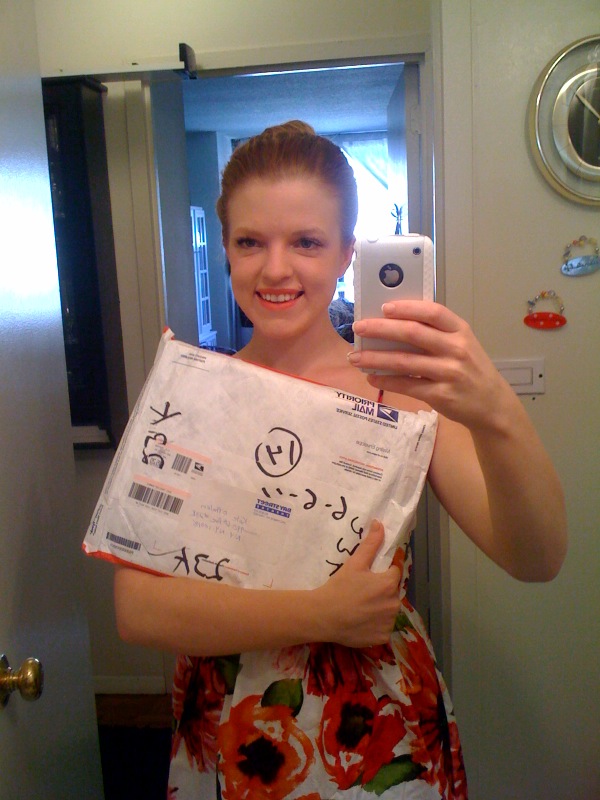
What are your best getting-seen-at-an-EPA stories?
Have you had similar success at EPAs outside the city?
Just Do It
How is your career? Are you daily fulfilling your dreams? Are opportunities falling in your lap? Do you feel like you are using all your talents? If you didn’t answer yes to all three of those questions, then congrats! You are, I’m sure, a struggling but passionate artist, doing any and every thing for the chance to achieve your goals.
My mentor has a saying that I have made a personal mantra:
“Things in motion tend to stay in motion”
What does this mean to you and me? If you aren’t doing the work you want to do, make it yourself! Well, maybe don’t quit your survival job just yet. But you can research internships; or take a new dance class! Or do something totally non-theater related, like read a book you’ve always eyed but never taken time for. The more educated, balanced, trained, and/or experienced you are, the better chance you will be ready for that great opportunity when it comes knocking.
What things do you do to stay busy and grow in your expertise? I want to hear!



 The Green Room