Wait a minute…I thought we already graduated college…
Okay. I’ll admit it: I don’t always get “Actor” things. I mean, I get most of them, and relate to actors very well having had a well-rounded education with my roots in acting [I’ve done it: rolled on the floor, talked like a whale, improv, filled the space, Alexander technique, everything that an outsider would say “what the #%!* are they doing in that class?!?”] I understand the fantastic toolbox college professors provide the actors with varieties of techniques and methods of acting. I understand that they teach this to prepare you for the “real” world, so you can pull out something appropriate from your toolbox and apply to any role you are cast in. I understand the “Theatre Games” that warm you up, get your mind in the right place, and help you discover your emotion. I also understand that this is the reason we went to college – to learn this stuff so we can apply it in real life.
That being said: please – acting and directing community – answer me this: why am I sitting in professional rehearsal watching hours pass with actors playing everything from “The Party Game” [you know… the one where you get a slip of paper saying who you’re supposed to be and you walk around trying to guess everyone’s “assignment”] to Meisner Repetition of the same lines for 15 minutes straight? Usually, these games come with half the cast super into it [usually the youngest or recently graduated ones] while the others roll their eyes along with me as if to say “Seriously??? Why are we wasting rehearsal time, I have questions about my character!?”
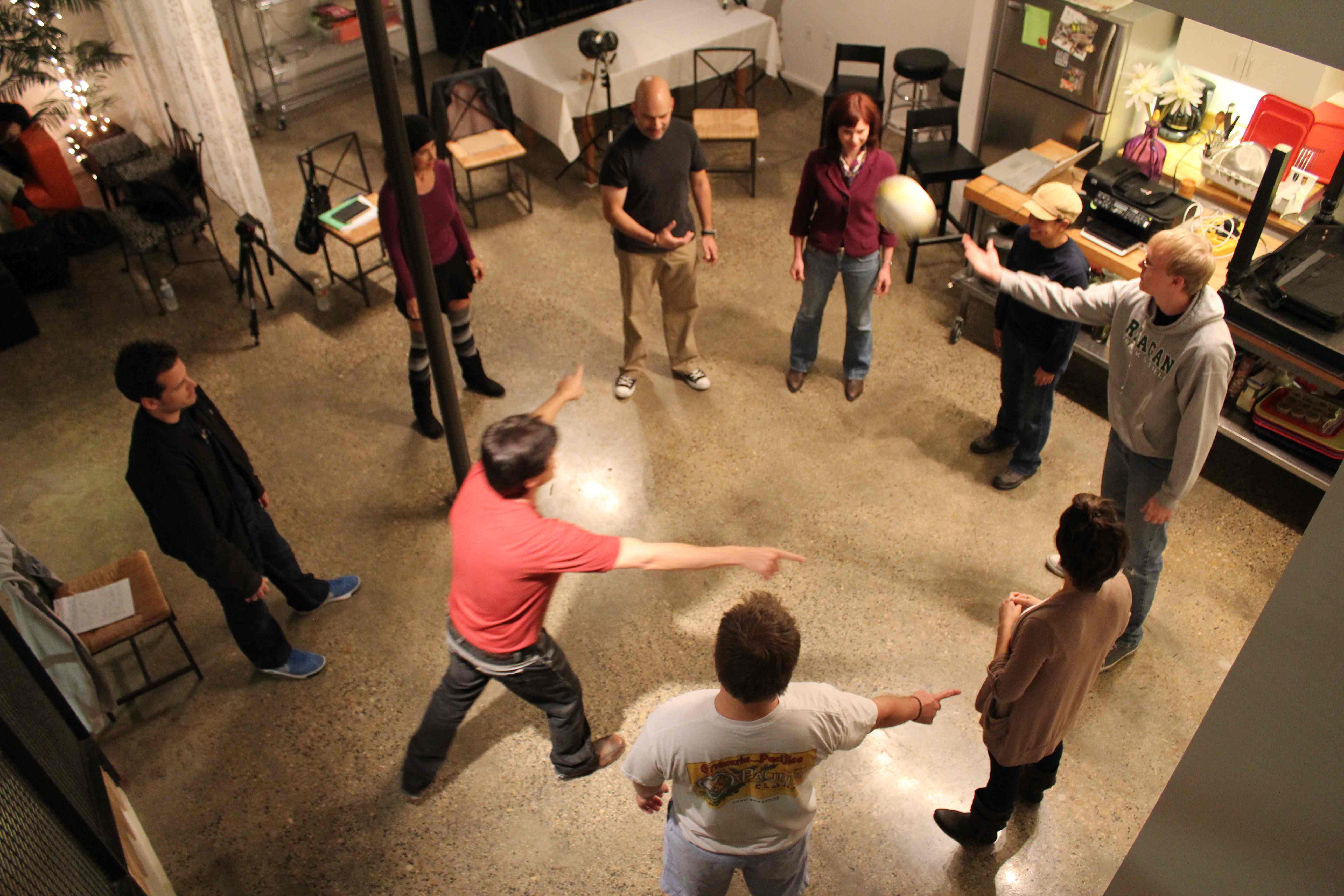
Now, I’ve done a stint with Educational Theatre [MFA level with student actors, directors, and playwrights]. Whenever one of these “Theatre Games” started, my PSM would stand up, wink at me, and say “I’m going to have a cigarette…text me when they’re done with this crap.” But I understood – the entire cast had the same training, were learning the same things, spoke the same “language” and the director knew which method the Acting Professors used to get a particular emotion out of a particular student. It’s a specific case-scenario where this works. Also, they were rehearsing in classrooms – no producer was paying for rehearsal space, and the only thing lost if the show didn’t turn out was a less-than-great grade before you’re shoved out into the real world [unless it was a disaster… that’s a different story]. But, they also had about 20 more hours of rehearsal time than the average one-act gets out here in the “real” world. I understand why these MFA students played Theatre Games occasionally.
But…out here, in professional theatre? When on some contracts you only get 48 hours of rehearsal before tech? And those hours are already broken up with Costume Fittings, Staging the Scene, and blasting through Table Work? I mean, I get an ice-breaker game for ensemble casts. And I’ve even seen where a director incorporated what the cast did in the “game” into the blocking of the show. But, why are directors forcing Meisner technique on an actor who may very-well be Method? What is the point of playing “Big Booty” during rehearsal for A Doll’s House?
I watch rehearsals. That’s what I do. My belief is that the Actor needs to do work outside the rehearsal room and come to rehearsal with several techniques from the toolbox to try for the Director, hoping to fulfill his/her vision. My belief is that the Director needs to use their skills to pull a certain emotion out of the Actor: to help them realize what tool is appropriate for this section of a scene. We all went to different schools and/or took different classes. We all use different methods [small “m”]. We don’t have to force an entire cast to work the same way [musical choreography excluded]. So tell me:
Actors – how do you feel when a Director asks the cast to play a Theatre Game during rehearsal?
Directors – other than an ice-breaker, why do you use precious rehearsal time for Theatre Games?
Help shed some light for this pencil-sharpening Stage Manager.

An apology to those who believed in me
I’ve heard it said that in order for something to really resonate, the average person has to hear or see something three times. Over the past several months I’ve heard a very similar thing from friends, or even acquaintances, that finally hit home to me. I think at first I doubted it. Then maybe I was too busy rushing to auditions or too stressed by script memorizations to listen.
This is what I finally took the time to listen to:
“Wow, she always seems to have another project to work on.”
“I am so excited for where you are going as a performer!”
“I hear you are doing great things.”
The old-me would discredit these remarks and think “If only they knew how hard I’m working and how far away I feel from my dreams!” But the me-of-today has decided that I am exactly where I need to be. And I don’t just mean geographically. If you follow me on twitter you’d see that I just moved to the crazy exciting city-of-dreams Los Angeles! But beyond that, I am so incredibly blessed to be building a life around this dream I have of being a performer. Don’t let anyone tell you that your dreams are not achievable. To my friends who knew I was already achieving mine, THANK YOU. I’m sorry I didn’t believe you earlier. Join me in counting blessings, remembering dreams, reassessing goals, and moving forward! Cheers!

Movie Musical Monday, March 12th: ‘The Kid From Spain’
Good morning, and Happy Movie Musical Monday!
Today’s movie (musical) is the Samuel Goldwyn 1932 picture, The Kid from Spain. (The reasoning for the parenthesis around “musical” in that first sentence will be explained as we go along.)

This film is a vehicle for its star Eddie Cantor, and truly little else. Cantor was a vaudeville song and dance man, who like many performers of his time would cross over to radio and movies that usually showcased these talents either in fast-paced comedic schtick, or with the insertion of a production number whenever there was a slight lag in action. As well as being a performer, Cantor was a song-writer (here’s one of his) and did a lot of charity and humanitarian work, including helping to establish the March of Dimes. This was Cantor’s third film with Samuel Goldwyn Productions, and was at the time a very marketable (read: PROFITABLE) property–as were the dance sequences of Busby Berkeley, whose work (also featured in Cantor’s previous two films with SGP) this movie uses only scarcely but well.
Kid was directed by Leo McCarey, who is in a word: awesome.

A self-made man, McCarey contributed much to the films of this era and to film history by writing, co-writing, producing, or directing some very key properties. He also knew how to handle and cast actors. He helped Cary Grant develop and hone the persona that would keep Grant working (and terribly dashing) for almost his entire film career. It’s even said that Grant pulled a lot of his on-screen mannerisms and general joie de vie from McCarey himself. Think about that. McCarey was the guy who thought to put Stan Laurel and Oliver Hardy together on film. He was the guy who co-wrote the story (not script), directed, and produced the 1939 hit Love Affair–which he would later remake into the even-bigger 1957 hit, An Affair to Remember, starring his man/creation, Mr. Grant. McCarey also stood up for his artistic integrity, going off salary at Paramount to make his dream project, Make Way For Tomorrow (which is also known as The-Most-Beautiful-And-Shattering-Film-You’ve-Probably-Never-Seen). Despite positive critical notices, a poor box office showing for Tomorrow cost McCarey his job at the studio. However, that same year he would direct The Awful Truth, the screwball comedy starring Mr. Grant where all of that aforementioned character/film persona work would happen, for which McCarey would earn an Academy Award nomination. Oh wait–and he WON. Life goes on in spite of itself.
WHAT IS THIS MOVIE (MUSICAL) ABOUT?
Racism.
KIDDING!
Actually, it’s just about ethnic stereotyping.
KIDDING AGAIN!
Well, pretty much.
But forget all that for the moment and check out the opening number staged by Mr. Berkeley, which has no actual impact on the plot whatsoever:
What did you think of that? Were you in shock and awe over all of the cleavage? Did your jaw drop to hear all those obviously veiled remarks about what fun it is to be a naughty co-ed girl? And how is it possible that a black-and-white film could be so suggestive? Well, I’ll remind you: this film was made in 1932, two years before Joseph Breen showed up and ruined everything in the name of decency and Jesus. Yes, this movie is considered Pre-Code, and that’s why the Goldwyn Girls–a stock of chorus girls used in several of the SG musicals–can have pillow fights with each other while wearing lace and adjusting their bras, laughing about the “homework” they do with the boys.
(Incidentally, if any of those chorus girls looked familiar you’re haven’t gone crazy: Paulette Goddard, Betty Grable, and Jane Wyman, future stars of American cinema, all served time on their way to the top as Goldwyn Girls. And they’re all in that number.)
Immediately after the song finishes, the matron of the girls dormitory discovers Eddie (Cantor) in one of the girls’ beds. She takes him to her office to explain, and soon one of the most nonsensical running jokes in all-of-cinema-as-I’ve-encountered is established: every time Eddie hears a whistle, he jumps up and down, hitting people while yelling at them. Never mind why (Eddie doesn’t know), he just does. The matron is unconvinced that a graduating senior who worked his way through college would risk being expelled by sneaking into the girls dormitory (even if he was drunk), and calls for the boys’ dean to visit her office in order to get to the bottom of this. The dean in turn calls down Ricardo, Eddie’s best friend and roommate to help sort this, and it comes out that Ricardo put Eddie there while he was passed out. Ricardo is expelled on the spot, despite Eddie’s protestation. Suddenly, a whistle blows somewhere, bringing on one of Eddie’s attacks. He yells at and hits the dean, and suddenly finds himself expelled, too.
As the two friends pack up their dorm room, Ricardo speaks of going home to Mexico. At this point in the film, you may not have known that Ricardo was from Mexico if you were watching it in the early 21st Century. But in 1932, there would have been some key clues to announce this fact to you almost immediately:
- His name is Ricardo.
- He has dark, thick, black hair.
- He has a mustache.
Boy, do I feel like an idiot! After writing out that list, I don’t know why the fact that this character is clearly Latin didn’t just jump off the screen and start raping my face with its total obviousness! I must have been distracted by the actor playing this role, Robert Young–who on top of being a father who knew best, is also: not Latino at all. But again, this movie was made in crazy, Pre-Code 1932, where compensations had to be made for the lack of Latin actors in Hollywood. People today, though, are conditioned out of this understanding. This is because nowadays there are enough actors of Latin descent in the industry that when roles are written to be Hispanic, actors who fit the bill get those parts. Right?
Whoops.
But I digress: Not-totally-Latin-at-all Robert Young is planning on heading back to Mexico, where his best and only (clearly: not Latin) girl is. Her name’s Anita, and he loves her a lot. Before the friends part, Eddie takes Ricky to the bank in the dean’s “borrowed” car. That’s right: he took it without permission! But he’s planning on returning it before it’s missed–because those are just the kind of shenanigans that this Eddie guy gets into. What a kook!
But OH NO HERE COMES A PLOT POINT: Before Ricky and Eddie drive up to the bank, another car rides up, and drops off some shady men with voices that smoke cigarettes. One tar-covered voice tells the driver to wait and keep the motor running. Clearly: we have a bank robbery in place. (Don’t ask me why that was easier for me to spot that Robert Young’s ethnically-telegraphing mustache, but it was.) But a cop comes along, tells that car to move, and our heroes drive right into THAT VERY SPOT. Ricky gets out (probably to exchange his dollars to pesos) and Eddie is waiting for him when OH MY GOSH the bank robbers get into the car and tell him to drive. Uh-oh! Luckily for Eddie, these criminals overlook his attempts at alerting the police and/or escaping, and tell him they’re sending him over the border to ensure he doesn’t spill the beans about the robbery. They even take him across America by train, all the way down to around where that barbed wire fence is now, to watch him get across.
You may think: “But that doesn’t make sense! Why didn’t they just kill him?” But that’s just your (and my) 21st Century mentality trying to rationalize things. Let that go. And remember: in (musical) comedies, things don’t have to make sense. Their irreverence is part of their charm (usually).
After a light vaudevillian banter with the guard at customs, Eddie gets across the border by wearing a sombrero and borrowing a child. He didn’t have time to grow a mustache, so he had to use other things to appear Mexican. And who’s the first person he runs into? Ricky! The two greet each other, and Eddie quickly explains what happened with the robbers, and that now there is a detective after him, who thinks he may be an accessory to the robbery since he was driving a stolen car. (Asteya, people.) The detective spots the two talking and confronts them. Ricky identifies Eddie as none other than Spaniard Don Sebastian II, son of the great matador Don Sebastian. The detective laughs, seeing clearly through Eddie Cantor’s outrageous Spanish accent (he must actually be visiting this movie from our own time to see through such a clever-early-20th-century-ruse) and says he’s looking forward to seeing Don Sebastian II in action on Sunday, when a big bull fight will happen. He says he expects to see Eddie in the ring, and takes off. Ricky and Eddie then drive out to crash a party.
As I mentioned before, Ricky loves a girl named Anita. But there’s a problem: Anita’s father wants her to marry Pancho (he’s Hispanic, so obviously this is his name), a rich man who is also the greatest matador in all of Mexico. Only the best for his Anita! When Anita’s father catches her and Ricky cuddling in the garden, he breaks it up, and tells Ricky: “Pancho is a great Mexican! You do not learn to be a great Mexican in the states.” (In this context that’s like saying you can’t learn how to be a great American in China, because they don’t play American football there, and it’s that the sort of thing we value culturally above all.) He tells Ricky it’s nothing personal, but that seriously, dude: it’s not going to happen. Ricky’s love has made him blind to this sort of deterrent, though. So after running into Eddie at the border-office, he heads right back to the lion’s mouth, gets let into the party with Eddie posing as Don Sebastian II, son of Anita’s Dad’s deceased best friend, and finally we get to hear another song. And it only took us 28 minutes to get here.
While Eddie is getting acquainted with Anita’s father, who regales him with stories of Eddie’s father-who-never-was, Ricky makes his move. He creeps to Anita’s balcony and in front of basically everybody asks her to run away with him in secret. But since he literally does this in front of the whole party (for reals), he gets caught by Pancho. They exchange a few blows, but Pancho over-powers Ricky, and they call the police to have him arrested for assault. Eddie again tries to come to Ricky’s rescue, but then Uh-oh: someone blows a whistle and (you guessed it) he gets arrested, too.
After a short stint in jail, Anita’s father shows up and gains the release of Eddie (who he still thinks is his dead-bestie’s son), and Eddie uses the opportunity to steal Anita away from her father’s home so she can get ready to run away with Ricky when he gets out. But he accidentally steals away Anita’s blonde, sex-starved friend Rosalie, played by Lyda Roberti, whose accent was a lot of things other than Spanish, but probably got a pass from the studio because at least she didn’t sound like a total and complete American like almost everyone else in this film. After they’ve driven away, Eddie becomes worried because it seems like Rosalie–who he’s mistaken for Anita–is making advances. What’s worse is that he likes it. But it all works out.
That is: it all works out for a moment. Suddenly, Pedro (one of Rosalie’s stalker boyfriends who is a bandit and also clearly Hispanic) appears and abducts Eddie. Another bandit named Jose (yet another Hispanic) is left in charge of killing him (because Mexican bandits have more sense than American bank robbers), but Eddie escapes and runs back to Ricky’s hacienda.
After some business about the B-storyline regarding the upcoming bull fighting, the pair go to another big party. Eddie narrowly escapes getting beaten up by Pedro and Pancho by hiding under a table. But Uh-oh: the two of them sit down at THAT VERY TABLE! How can he get out from under without them recognizing him? What could he possibly do, in a 1930’s musical, to disguise himself? Oh: I know! No one would recognize him if he PUT ON BLACKFACE.
I wish I could tell you this is the only movie (musical) with a blackface number in it. But if I did, I would be lying to you.
- Here’s Bing Crosby and cast in Holiday Inn.
- And here’s Judy Garland and Mickey Rooney in Babes in Arms.
- And here’s Judy Garland in Everybody Sing.
- And here’s Judy Garland in Babes on Broadway <–The whole finale of this movie is kind of insane, but we’ll save that discussion for another time.
I told you there’d be racism. Lucky again for us that we live in the future and this sort of representation of African Americans no longer exists in our society.*
*(I’m not even going to undercut that last statement with an external link like I did before about Hispanics being fairly represented and having equal opportunity in casting. Because really: what’s the point?)
Anyway, the next day is the bull fight, yaddayaddayadda, and the movie ends just how any movie (musical) comedy would. You can fill in that gap(s).
IS THIS MOVIE A MOVIE MUSICAL?
Good question. This movie is about 95 minutes long, and only has four songs in it. Only two of those actually comment on or advance the plot in any way, shape, or form. So the movie walks a fine line between being a musical (where you would normally expect a score to advance the story through outbursts of song from dialogue), and being a film with music. If this movie is a musical, then by that definition,so is Duck Soup (which incidentally was also directed by McCarey, with the same song writing team from this film). I don’t know if that’s accurate or fair. However, if you move toward the other extreme, saying perhaps that there isn’t enough of the organic dialogue-into-song element, and that the characters need to be actually taking action as they sing instead of just commenting on the plot, then the film of Cabaret isn’t really a musical after all. And I don’t think I can cope with that as a reality.
So maybe this is a movie musical, but just not a very good one. And also: there’s racism.
HIDDEN GEM SONGS:
To be honest, my favorite song in this movie is “What a Perfect Combination,” which could be a nice uptempo, lyric-driven, comedic song. If sung without any shoe polish or burnt cork on your face and hands, I think it would be well received.
That’s all for now. Have a wonderful, racist-and-ethnically-prejudiced free day, and Happy Movie Musical Monday!

This Little Piggy Oinked All The Way…To Broadway
I’ve done it.
It’s the hazing the lanky freshman girl endures to get into Delta Zeta.
It’s the swirly the new kid holds his breath for in the cigarette smoke polluted 8th grade bathroom.
It’s the rite of passage for any working actress.
I did …………………………………………………
…….CHILDREN’S THEATRE.
(dun dun dunnnn)

TA DA!!
Now don’t get me wrong. I don’t think children’s theatre is bad thing whatsoever. My mom loves recounting the time my lil four year old self was “skinna-ma-rink-ee-dink-ee-dink-ing” through the aisles with Sharon, Lois, and Bram during a concert for The Elephant Show…

(I. love. you.)
It just seems like it’s a cliche and requirement for any actor to partake in children’s theatre during the beginning stages of his/her career.
My experience:
The creative team was incredibly talented and wonderful to work with.
The venue was impressive – The Wild Project
See … ?


Overall, we definitely pulled it off. Success!
BUT…
Did I mention we had 3 rehearsals???
I think the general consensus was “they’re kids – they’ll love it” but personally, I felt like we were giving them the short end of the stick. It was such a great show – I would have loved to have more time to develop it further and make it even better. More rehearsal =
1. We could have made more discoveries and choices
2. We would have been completely solidified in all our notes and movements
3. I WOULDN’T HAVE BEEN SO STRESSED OUT!
_________________
In general (and this is putting this particular show aside),
I have questions about content when it comes to children’s theatre.
I don’t want to lie to kids.
I want to give them truth.
Which leaves me wondering what sort of stories we should be telling them…
For our show, I did feel a layer of insincerity in some of the work, whether it was an actor not truly taking in her scene partner or moments of manufactured emotions- times when we created what we thought the moment should be, rather than what it was.
_________________
All in all, I think in children’s theatre, it’s important to really take in the audience, be on their level, and just be honest with them. Children are amazing little people that are capable of living in a way that we as jaded adults have lost. Considering all the lessons we should be learning from them, we owe them honesty and integrity at all times. The kids did love our show, but I wonder how much more their little brains and senses could have been affected if we had raised our standards.
This post is dedicated to my favorite lil guy 🙂

Onwards and Upwards,

Teaching (Revisited)
For those of you who have been keeping up with my Dramaturgical journey, I would like to revisit a topic that had incited comments when it was brought up…Teaching. At first I had my reservations about taking jobs in schools for reasons already explained (see: To Teach or Not To Teach). However, after reading all the comments and other blog posts that were generated based off this topic, I decided to give it a try. It’s been a while since I’ve written about myself, so I thought I’d take a moment to fill you in on what I’ve been up to. I now have three jobs! All of them for schools, working with students of various ages, and all of them allow me to use my Dramaturgical theatre skills in different ways. Joy! The downfall is that most of the time I work all of them in the course of one day.
So let’s follow the progression of a day in the life of me.
From 7am to 1pm I am a Teaching Assistant at a Kindergarten class in a private day school. Duties include picking the kids up (Yea, I drive a bus), giving them snack, lunch, advice on what is appropriate classroom behavior, etc. I know what you’re thinking, because I thought it too; no theatre stuff! Well, about a week ago the Principal/Owner of the school came to me before my bus run in the morning and asked: “Don’t you do plays?” I replied: “Yes I do!” So she asked me to write a stage adaptation of a children’s book of my choosing for the Kindergarten class to perform at their graduation in June. I agreed and have been sifting through my children’s literature collection for a good fit. (In case you were wondering, the answer is yes, I do organize my personal library according to genre and then sub-classification that only I can decode from then on).
Onto my afternoon!
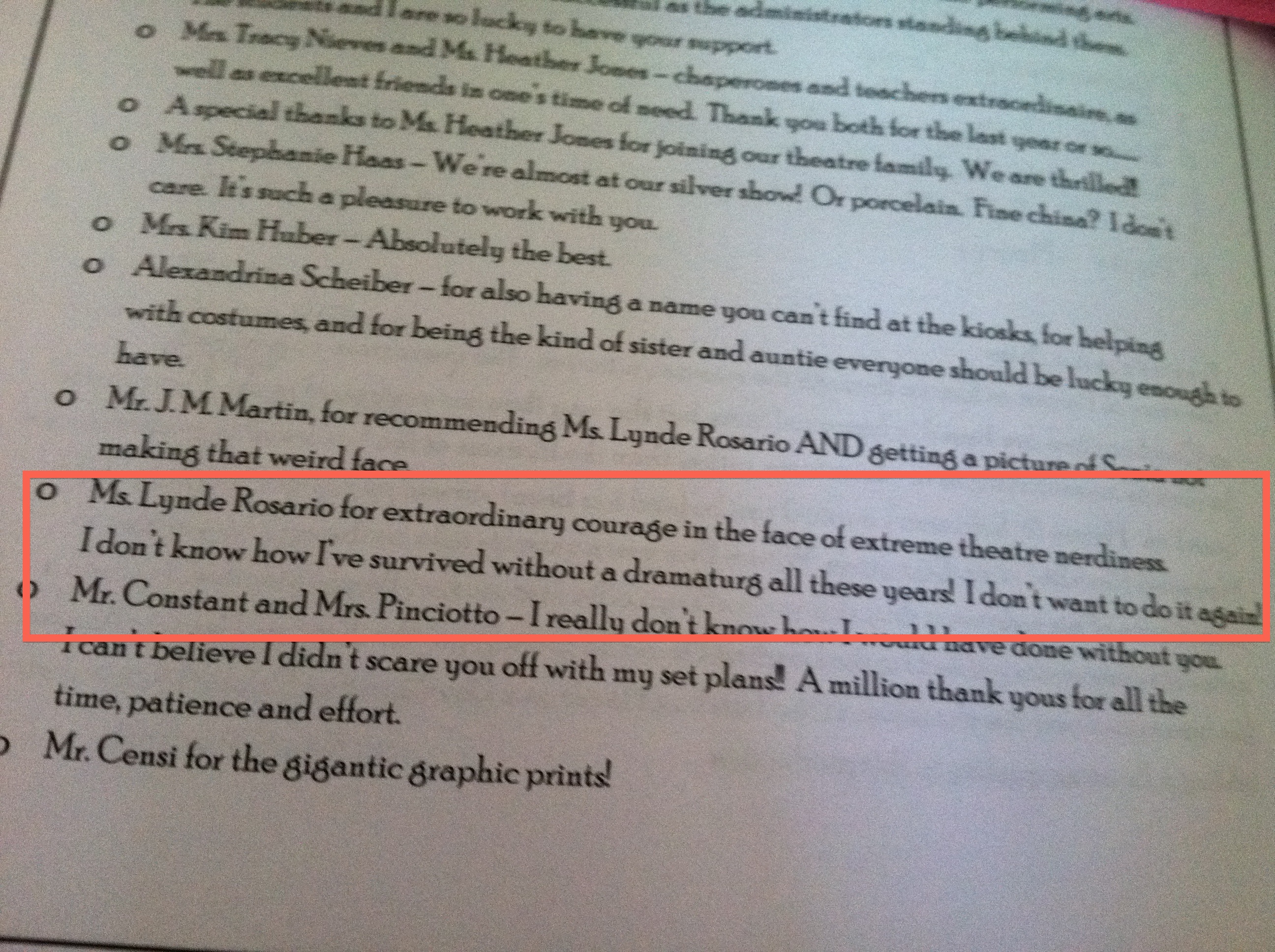
From 2-4pm I work for a High School Theatre program. In fact I have been dubbed the Dramaturg for all their productions thanks to my former teacher, mentor, and current friend. She was hired as an English/Drama teacher my senior year of high school (oh, did I mention I work at the high school I graduated from? No, well, I do). When I was a student there we did one musical and one drama that was performed by the one drama class that was offered. Since then, she has transformed this program into what I can only think to classify as a very youthful regional theatre. The program now has three drama classes, one of which is a College level drama lit class! In addition to the musical, which ran for four performances and played to a full house every night, and the drama which she commissioned a playwright to write an original work for her class this year (so excited!), she now does a Shakespeare! We could barely get our English class to read Shakespeare, let alone get the administration to allow us to perform it. So we are currently rehearsing a scene from Much Ado About Nothing to be presented a the Shakespeare festival at…wait for it… My Alma Mater!…Hofstra! So, not only do I get to work with my old High School teacher but now we get to revisit my old college professors as well. When people told me that life has a way of taking on a circular form, I didn’t think they meant literally coming back to the physical people and places you knew in your youth.
High School program acknowledgements:
And my day isn’t over yet!
From 5-7:30pm I am the Director of a Middle School musical production. I know, I know, I’m a Dramaturg. And this blog is for me to talk about my life in Dramaturgy. But when the High School director/mentor I’m working with in the afternoons called me up to tell me about a job ad she saw in the NY Times, she said: “Take it! It’s money for theatre!” She was right, as usual, and helped me to work out all those tiny details that distinguish a Dramaturg’s book from a Director’s book (oddly enough both take up the same amount of space in a three-inch binder). The dynamic is completely different, the students are completely different, but the “stuff” is the same. You know, the “stuff” theatre is made of. For me, in this metaphysical place in my life right now, that’s all that matters. Last year I had made zero dollars for theatre work. This year the dollars paid actually match the hours of work done; and it’s only February! Well, I did say in my last Green Room post that I think this year is going to be good, and so far, it has.
At this time I would also like to point out that all work times noted in this post are 100% accurate. Notice how there is only 2 hours unaccounted for 1pm-2pm and 4pm-5pm. During these times I am en route to the jobs that follow with brief stops for coffee along the way. Though it is extremely tiring, I fall asleep at night feeling accomplished. Everyone who commented on my former posts was right! Thank you for opening my eyes to a world I was unsure of. The students that I work with are amazing. When I told the Kindergarten class I was making a play for them, they all jumped up and cheered as if I told them cake was on the lunch menu from now on. My Middle School cast is so willing to make our show great that they have all asked to help build sets and costumes when they are not onstage. But the students who have really given me the greatest emotional reward are from the High School. When our musical closed, a few select students came up to me with arms outstretched and tears in their eyes. Their words were of thanks and inspiration and appreciation for the work that I’d done with them. I couldn’t help but feel that this is what I’ve been looking for all along. I didn’t get this from my professors or colleagues. But in my mind these students are extraordinary! At least three of them thanked me in their bios and have asked me to work with them on their college auditions. Getting to use the skills acquired through years of schooling is one reward I won’t give up without a fight. You see, all of these jobs are for schools, which means they all end come June. So, as these next few weeks of 12 hour work days continue, I will now have to incorporate a new timeslot: 8-10pm I am a Job Hunter.

…And became a college theatre dork
How most of us got bit by the acting bug and found ourselves standing in the spotlight was in high school, when we get cast as the lead in the musical or perhaps the time your aunt took you to go see a show and your life was never again the same. You started singing show tunes, tap-dancing in your sneakers on the sidewalk, preferring jazz hands to high fives—then you get to senior year and your last show finishes, you graduate and then what? If you’re anything like me, you do what the (title of show) song says: “So I bailed on my hometown, and became a college theatre dork”. Let me introduce myself, The Green Room Blog’s The College Theatre Dork!
I was fourteen when I realized I could major in theatre. My teacher brought me to a theatre conference at a local college where we were mistaken for a family wanting a tour of the campus, which sparked the initial discussion that people did major in theatre. When I announced my intentions, my parents were surprisingly accepting but in retrospect, my other ambition was to be a writer, so I was still going to be their penniless bum of a daughter, right? But I spent the next three years researching colleges—and wound up on the other side of the state in the best place I could possibly be right now. I’m studying Theatre (and minoring in Creative Writing) and I’ve been blogging as A College Theatre Dork since my first week of college, originally as an assignment for my freshman English class and I just kept going with it there and now here.
So do I sit around doing Shakespeare monologues and musical theatre all day? No. When I was a freshman (a year ago), I took Theatre Major Seminar, which all the freshmen/transfers have to take their first semester. On our last day of class, my professor asked us:
“So, why do you do theatre? This is a career that maybe two of the fifty-two of you here are going to succeed in. It’s what we call in this business a dead kitten; it’s cute, but it doesn’t work! There’s no money, people don’t want to see the shows anymore…we can’t even sell enough tickets for us to do two musicals a year. So why are you here?“
We had a lot of different answers. At the end of our first semester, some people realized this wasn’t the right place for them and were transferring and others decided to change their major to Music and English. I raised my hand to answer: “DEFINE SUCCESS.” I said more than that, but nothing as important. A year later, halfway through my sophomore year, I think I’m becoming the success freshman me would have wanted to be. In this past year alone, I worked as a street busker performing Commedia d’ell Arte; I wrote my first play for a 24 Hour Show; tried worked behind and in front of the camera; now I am working for the first time as an Assistant Stage Manager in two of my department’s biggest shows; learning tai chi, dance improv, stage makeup; I got a summer internship with a theatre company, an upcoming performance in a movement theatre piece; planning to produce (and possibly direct or act) my first show and now blogging for The Green Room Blog!
So that’s my part in our ensemble, that headstrong youngster who meets their Yoda and starts training to someday be a Jedi. Well, I’m majoring in Theatre and that hope of doing it in the real world someday suddenly has a date on my calendar. Join me in my endeavors of learning how to be professional?

I’m grateful for every role I get to play. And at my current age, there are actually a decent amount of them. According to many young filmmakers, my type, that is: moms, teachers and nurses are in their mid-to-late 30’s and are complex creatures.
In the radio drama writing class I’m currently taking, we have learned that character names are vital to storytelling. In fact, our teacher will send back assignments if we haven’t named the characters. Even if the character’s name is never spoken in the piece we still baptize each role with a proper name, as this gives the character an essence, a life-force, a history.
So, what am I to think, when I have auditioned for the following characters these past few weeks:
Lois, Lorraine, Shirley, and, best of all…………ETHEL!!!
ETHEL!!!!
There are people in retirement villages in Florida named Ethel. And her aqua-aerobics buddies are Lois, Lorraine and Shirley. None of these lovely ladies are 30-something moms.
People my age were born in the 70’s. We have quite “modern” names, like Stacey, Dawn, Kim, Erica, Kelly, and yes, my name, Tara. In fact, if writers did a little research, they might find that Tara was a hugely popular name for babies in the 1970’s because of the re-release (in “STEREOPHONIC SOUND”… OOOOHHH.) of Gone with the Wind. Parents in the 1970’s did not name their babies after the characters in Golden Girls (in fact, that wasn’t even on TV yet….) Babies were given, supposedly ground-breaking, often hippie-inspired (Dawn) or gender-neutral names (Kelly, Kim) in keeping with the women’s liberation movement that was in full swing.
But I suppose what is really irking me is not that the writers of these names haven’t done their research into the era. It’s that they are giving the character a name based on a feeling…as names tell a lot about the character… and well….. to the 20-something writers of these films… a mid-30’s mom is OLD. So her name must be too, because the character’s essence is all about being OLD, and I guess, in the case of ETHEL, kind of quaint and proper.
So as I said, I’m grateful for the roles people. But all I’m asking is that when you want to give the audience the right essence of a 30-something mom, don’t just come up with a random “old-sounding” name. Consider, for a moment, that this character was actually born long after World War 2, and, even though it may have been in the back of her parents’ VW van, she did see Gone with the Wind in stereo!
Though, to be honest, Went With the Wind (also from my childhood!) is my favorite:

Headset Etiquette
So, you’ve survived college, rocked your internship, buffed your resume, applied for every single job posting that you’re even remotely qualified for, and finally landed your first real-world professional gig…what are you going to do next?!
College is full of wonderful adventures and learning experiences with a tight-knit bunch of Drama Majors. When you work with the same group of people for 4+ years, inside jokes are formed, indescribable friendships happen, you learn a lot and have a ton of fun. In this “real world,” it is extremely rare – especially as you start out – that you work with the same crew of people from gig to gig. The Theatre Industry attracts the same artistic and fun individuals, most of whom were once part of a tight-knit bunch of Drama Majors at various colleges throughout the country. Yes, jeans and even graphic tees are usually appropriate attire for work; it’s acceptable to eat during production meetings; skype-ing into meetings while at another gig – or at home – is the norm; you drink with/joke with/date/marry your colleagues; but despite all of these seemingly lax practices, this is a career that requires professionalism.
It’s hard sometimes to see where the line is between being understanding/having fun while still working and being unprofessional. One of the most common inconsistencies I’ve discovered is Headset Etiquette. Now, there are no definite rules, and much of this varies depending on the lead the Production Stage Manager gives, but below are my tips for what I would consider general Headset Etiquette that’s applicable to all situations:
- If the show is too busy to give cues proper standby calls, absolutely no unnecessary chatter on headset.
- No one, no matter what, should ever use the word “go” in any conversation on headset except the PSM when calling a cue. [The most standard replacements for “go” on headset are “fish” and “G-O” as in “Fish to the dressing room and grab her wig” or “G-O to the dressing room and grab her wig”]
- No chatter between a “Standby” and a “Go” [note: PSMs, give “Standbys” at an appropriate time; about 30 seconds before the “go”]
- When necessary to go off headset, always say “[name or position] Off Headset!” and if possible wait for a “thank you” or acknowledgement from the PSM before taking the headset off. [Likewise say “[name or position] On Headset!” when you return, however listen for a few seconds to make sure you wouldn’t be speaking on top of the PSM’s called cue] Also, when you leave your headset unattended, turn the volume down and close your channel!
- Close your channel when eating/drinking/sneezing/coughing/snoring/yelling/speaking to someone off-headset…it’s just the polite thing to do.
- Don’t constantly fiddle with your microphone, the sound is unbearable.
- Don’t be on your phone [or try turning it to airplane mode if you must beat that level of angry birds]. It is fact (not fiction) that an incoming message or call – even on silent mode – may cause annoying disturbance in the headsets.
- Don’t chew gum. Please.
Anyone have anything to add to the “dos” and “don’ts” of Being on Headset?


 The Green Room


.jpg)