Acts of Kindness
This is a business known for being tough, a dog eat dog kind of world. So my suggestion may be a contrary, shocking novel idea, but can we all remember to try being kind?
As far as I’ve gotten on my own willpower and a toddler’s inability to understand the word “No”, a kind stranger here and there has helped me get the rest of the way there. I’ve seen it happen over and over again and the appreciation never diminishes. When I was auditioning for colleges, I was seventeen years old, at these strange schools that I had visited only once before when I met a student there, who was helping to run the auditions. I had a journal with me that day, so I could write down my impressions of how it went so I could overanalyze them for the weeks to come and his name ended up in that journal entry, because he was so kind and welcoming. I wanted to be there! I ended up deciding to go to college there, partly in thanks to him and incredibly happy that I did. (Later on, I did end up meeting him again officially and I thanked him for getting me here—an unforgettably priceless moment, he was so touched).
See what I mean?
More recently, I’ve been again the recipient of the random act of kindness: a stranger emailing me to say how much she liked my writing and wished more would be published. I woke up one morning to find my entire campus littered with Positive Post-It Notes. I’ve gotten into classes I wasn’t supposed to be in, because of a very kind professor. And a few weeks ago, I was having this terrible night; one of those where it seems the only thing you can do right is go to bed and get today done with. The last thing I had to do though, was help carry this extremely heavy flat across campus to where a show was going on that I had volunteered to help them load-in and my partner was late. Nowhere to be found and no response. Eventually, I gave up and put all my fury into dragging this set piece there. I passed people I knew and strangers who kept on walking until I was more than halfway there when a good Samaritan came out from behind the counter where she was working and helped me carry it all the rest of the way.
Not so recently but last October, I was doing a show, busking and bringing theatre to the people. We set up our little stage at a few town festivals and performed, afterwards passing our hats around to ask donations to support the arts. For our last show, we visited a nursing home and put on a performance for the residents! They enjoyed it immensely and we talked to them afterwards, they hoped that maybe more performers would come out and do a little show for them in the future.
Random acts of kindness don’t always need to be quite so big as a putting on a show like Mickey and Judy to entertain everyone but I don’t think it would hurt to do more good deeds throughout the day! Go out and hold a door for someone, pay for the person standing behind you in Starbucks, compliment a stranger, make cookies for your neighbor…in the meantime, I’m going to go do a good deed of my own.

Book Club For Actors: Like College, But FREE!
Please allow me to take a few moments to lavish praise on one of my new favorite people in the world — Rhonda, of Art & Soul Acting. You already know Rhonda from her lovely guest post about ways to answer annoying questions asked of actors. What you may not know, however, is that, in addition to being a beautiful, generous, and inspiring person, Rhonda also runs a genius monthly book club for actors.

The book club that Rhonda runs meets once every six weeks or so, and focuses on the work of a particular playwright or theme. Participants read anywhere from one to five or six plays, and then get together for two hours to eat delicious food and talk shop about the plays. Rhonda not only takes the time to read nearly every play we discuss and watch any available filmed versions, she also does careful dramaturgical work on the plays, playwrights, and historical context, so as to foster a lively discussion.
Frankly, my friends, if you are not taking advantage of this incredible resource, I think you’re pretty silly. Because Rhonda does such a fabulous job of selecting relevant work that is getting produced right now, I have walked into several auditions feeling abundantly prepared and connected to the material due what I’ve learned at book club. And I’ve inadvertently found new monologues and scenes while innocently plodding through my reading list, too 🙂
And although I left college feeling well-versed in the classics and the basics of what I needed to know of contemporary works, I always felt like there were large gaps in my knowledge of the body of work that’s out there that were begging to be filled in. That gap is narrowing significantly when I’m busy reading almost 50 plays a year for book club!
So, what are you waiting for? This month’s playwright is Tracy Letts, and his stuff is fantastic (how did it take me this long to read August: Osage County?). You still have three weeks until book club, so sign up on Rhonda’s site and get reading! Will I see you there? If you can’t make this one, check out the future book club dates and follow along with the discussion on twitter using the hashtag #asabc.
Non-New Yorkers: would you consider setting up something like this for yourselves in the absence of Rhonda’s wonderful guidance? Are you a part of something like this already?

Good morning, and Happy Movie Musical Monday!
Today’s film is Universal’s 1982 production of the Best Little Whorehouse in Texas.

This musical is actually (strangely) based on a true story. In 1973, the Chicken Ranch in La Grange, Texas, a brothel that had been in operation since 1905, was closed down after reporter and TV personality Marvin Zindler began a campaign to put it out of business. Larry L. King wrote an article for Playboy about the closing in 1974 and somehow decided this would be a great subject for a musical. (Go figure.) Carol Hall, a Texas girl herself, was brought on to write the songs, and King co-wrote the book with Peter Masterson. What resulted was a strangely charming musical that won two Tonys and was nominated for six, including Best Musical. The original stage production was also directed by Tommy Tune–crazy, right? For a great resource about the show, check out this killer dramaturigcal blog for it on the Interweb.
Sadly, the musical did not survive well its transfer to film. Or rather, the original through line/POINT of the musical doesn’t exactly make it to film. King, Masterson and Hall wrote a non-apologetic piece about women who are living the best they can at the best way they know how, and not making any gripes about it. The town they live by accepts them as part of life, and that’s that. Miss Mona is a business woman who pays her taxes and has a familiar detachment to her girls and her customers–she’s responsible to and for them, but she’s always an outsider, structuring her work and her actions in response to what society creates around her. She never appears deeply emotional on stage, except perhaps briefly when recalling to the sheriff the one night they shared fifteen years previous, and the final song she sings before she heads to the bus alone to leave town for good. However, the movie, which creates a tender, romantic relationship between Reynolds and Parton, undermines some of the strength and forthrightness of Miss Mona (and indeed all of the prostitutes), by ending on a damsel-in-distress note. Just wait and see.
WHAT IS THIS MUSICAL ABOUT?
In a Texas whorehouse (the hint is in the title) called “The Chicken Ranch,” the glamourous gamine and greatly endowed Miss Mona houses several girls who make their living having sex for money. (What did you think happened in a whorehouse?) Their place is called the Chicken Ranch because during the Depression when things were tough, a chicken was accepted as payment for every lay (this is actually why the true Chicken Ranch acquired its name as well). Miss Mona and the girls explain their way off life in a song that tells us its just good clean livin’.
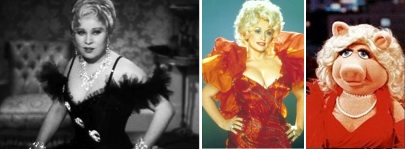
But before we get to the clip, I want to call your attention to Dolly Parton’s wardrobe throughout the film. At first I felt the costumes conjured up Mae West, but as the movie went on, I realized they were also somewhat reminiscent of Miss Piggy’s style as well. LOOK:
 Everything we do creates a ripple.
Can you really tell me, after seeing pantyhosed-toes peeking out of those shoes that you didn’t expect Miss Piggy to be at the top of that initial pan? Come on.
Miss Mona is not only the proprietor of the Chicken Ranch, she also has a behind-closed-doors-sex-only relationship with town Sheriff Ed Earl. Here’s a lovely duet that Dolly Parton wrote for the movie, “Sneakin’ Around.” There are moments where Burt Reynolds just screams Flight of the Conchords. (I wish FotC would write a song about Burt Reynolds. I bet it would be fantastic.)
- “Girl, You’re a Woman”–There are definitely some 36 bar cuts you can mine out of this song. However, it’s more of an actor’s song than a singer’s song, if that makes sense.
- “Twenty Four Hours Of Lovin'”–MY FAVORITE SONG from this show. Totally rock out, soul song. Great choice for an audition for HAIR or Dream Girls, or The Wiz.
- “Doatsy Mae”–An uneventful song melodically, but a decent choice to show off some acting. And it has a gradual climb to a belted C, so it’s good for showing that off. An easy 16 bar cut from this can show off enough of your range to let people know you exist.
- “The Bus From Amarillo”–Great choice for any country-western audition. Bonus points if you can accompany yourself on guitar. (I’m giving out the points so they’re only worth so much, mind.)
- “Good Old Girl”–I think this is a great song for anyone auditioning for Joe Boyd in Damn Yankees because it aligns really well with “Goodbye Old Girl.”

Why You Shouldn’t Skateboard
I fell off track.
I fell off the face of the earth.
All cuz I fell off my skateboard.
At the end of March, my roommate and I had our first skateboarding session of the season. Long story short, I tore part of my MCL (in your knee) in mid-air just above a quarter pipe. For the next three weeks, I could only limp and overall I could do … diddly friekin squat! So I got bummed out and developed an unquenchable thirst for booze.
It was a phase, I guess, and April snowballed into details I’m not going to share. A lot went down. But something was confirmed for me:
When you’re an artist, you don’t stop being an artist. You still see things through those oh so introspective eyes and you come out with your heart a little torn, stretched out but beating harder than before. And with it comes some excellent shiz to write about – monologues, scenes, journal entries, scribbles.
I guess my well had gotten empty, so life filled it. I felt misery and fear, defeatism and futility – one of my core values was completely challenged to the point where I could write a play about it.
And it’s all neither bad nor good. There is no bad or good – not in my vocabulary. There’s perspective and choices.
Now, I’m back “on track” (though I believe I’ve been on track this entire time – just in a different way). Life is coming together out of nowhere and its times like these – when I’m a ball of mess, trashing my health and traipsing about – when the universe pulls me out and puts an audition in my lap and a healthy night. It says, “Learn from what happened. Now here, take this. This is what I’ve planned for you to do. And you know it. So just shut up and say thank you.”
Well … thank you.
Count your stars and stay true, kids. Life is good. Even when it’s horrible it’s good. Especially when you’re an artist, everything is so win/win. Something turns out dandy so you win. Or something turns out not so dandy and you receive this incredible junk that inspires your work. That’s why we can’t complain – we can only thank our heartbreakers.

An image from the set of The Shelter Presents Art by The Shelter Theatre

Movie Musical Monday, May 7th: “West Side Story”
Good morning, and Happy Movie Musical Monday!
Before I talk about today’s movie musical, dear reader, I must offer you an apology. Last week was to be the final entry in three weeks running of musicals based on the plays of William Shakespeare–hooray!

448, and still lookin’ good…
But then I pooped out, as I attempted to catch up on some acting work and get ready for an upcoming gig (future post with greater details on the way). I was also daunted by the prospect of writing about today’s film because not only is it probably the most famous movie musical, it’s source material is the Greatest Musical of All Time. Sure, we can talk about the fact that this show did not win the Tony for Best Musical the year it debuted on Broadway. We can also (perhaps) suggest that the lyricist’s work on this piece would be later overshadowed–and possibly eclipsed–by nearly all of his future endeavors. But none of that matters. Why? Because of sequences like this:
So who cares that Music Man took home Best Musical in 1958, or that the intricacies of Sondheim’s lyrics had not yet come to full fruition(this was only his Broadway debut–CUT HIM SOME SLACK)? This is the show that makes every young, musical theatre girl unhappy she’ll never be a boy and dance as a Jet (because not even Anybodys really gets to do what the male cast does). This is the show that sends every young, musical theatre boy leaping to ballet class. Because this show does as great art does: it leaves an impression. And it does this with every aspect of its production: its book, its lyrics, its dancing, its score. West Side Story is the Greatest Musical of All Time. And there’s nothing anyone can do about it. Period.*
WHAT IS THIS MUSICAL ABOUT?
West Side Story is an adaptation of Shakespeare’s Romeo and Juliet (and I venture to say it’s better than another R&J adaptation mentioned a few weeks ago, the Lion King 2, but I’ve never actually watched that so I could be wrong. Probably not though.). Two rival gangs, the Jets–white kids from working class families–and the Sharks–Puerto Ricans, having newly immigrated to the mid-50’s and 60’s of West Manhattan–are warring over the little turf they have to live on together. Since this is a musical, they of course fight through dance.

It’s a testament to the level of visibility this film enjoys that Jerome Robbins’s choreography has become an integral part of what audiences expect from this musical. So often the first complaint you hear when someone you know has seen a production is, “They changed the choreography!” In this way, Robbins’s work is truly iconic, wrapped up with the experience of seeing this musical staged, though I’m sure it’s wrecked havoc to anyone trying to extract a new vision of the show. But who’s asking you to work so hard in that direction? Relax, and get some boys in jeans to do pirouettes. That’s what the people want.
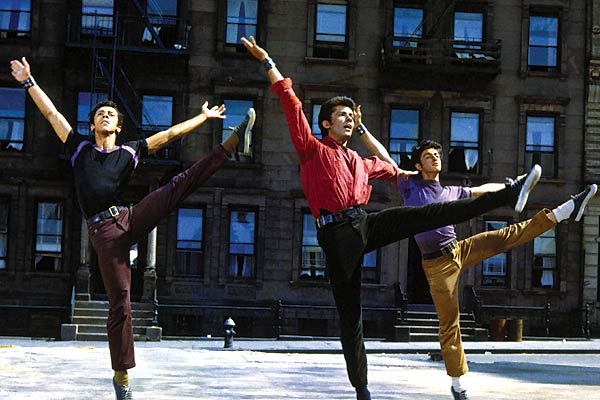
(Everyone is just waiting for people to do this pose.)
Anyway, Robbins found a way to make ballet TOUGH, by combining it with some lyrical jazz and moments of acrobatics. The result is beyond memorable. The fact that the choreography was maintained when the musical was transferred to film is due in part to Robbins being brought on to direct the musical sequences. After being fired from the film (he was on the verge of a nervous breakdown after only a third of it was shot, and the production company was worried about going over budget), Robbins’s assistants finished staging the sequences. However, their jobs were probably easier because many members of the film cast had performed in the stage musical at some point:
- George Charkiris (Bernardo) had played Riff on the West End.
- Tucker Smith (Ice) had joined the original cast of the stage musical in 1958, played a number of Jets, understudied Riff, and had gone out on the first national tour of the show. (He also dubbed some of Russ Tamblyn’s singing in the “Jet Song” for the film.)
- Tony Mordente (Action) played A-rab in the original cast of the musical and was in the West End transfer. (The Broadway production was also where he met his later-to-be-ex-wife, Chita Rivera.)
- Eliot Feld (Baby John) was sixteen when he joined the Broadway cast of the show in 1958.
- David Winters (A-rab) was the original Baby John in the Broadway production.
It’s interesting to think how much the stage production (because of the artistic staff and cast members on hand) would ultimately shape the final product of this film.
But enough talk–it’s time for another song!
So yes, the Jets and the Sharks, the Montagues and the Capulets. Riff (who is played here by the Always Awesome Russ Tamblyn), essentially stands in for the character of Mercutio–which is why he’s always the one we like the best, even though we love Romeo/Tony’s love. Here, he explains with the gang why their gang is the best gang on the whole ever mother-lovin’ street (though those lyrics were adjusted for the movie). Feel free to sing along!
Dude, if I was in a gang, that is totally the gang I’d be in.
So Riff is BFF with Tony, who has recently quit the gang and gotten a job and is looking for something else though he doesn’t know what.
That’s Richard Beymer as Tony (dubbed by singer/musician Jimmy Bryant), who beat out Russ Tamblyn (still Awesome), Anthony Perkins, and Warren Beatty for the part. Beatty had screen tested with Natalie Wood, who had opted to read with him as a favor (they had been shooting Splendor in the Grass when WSS was casting). Robert Wise liked her reading so much, that she ended up playing Maria. The moral of the story is: Do favors for friends. Elvis was also considered, but turned down the role after advisement from his management.
Can you imagine Elvis as Tony? I actually don’t think that would have sucked.
That night, everyone is at the dance in some church hall. Despite the adults’ attempt at integration, the gangs resist and have more large-scale dance-offs. (Despite it being a popular social dance of the period, I still will never understand why some white people thought it would be a good idea to challenge some Latinos to a mambo competition, but whatever.) Then Tony and Maria fall in love at first sight.
Tony and Maria just kiss when Bernardo breaks it up. Riff goes in to defend Tony, and the two gang leaders make a date for later that night to discuss terms of an upcoming rumble. Tony goes off to dream about the new girl he’s found, with one of the greatest love songs ever.
That final shot is just gorgeous, with the streaks of light behind him, making that last recitation like a prayer. “Say it soft/And it’s almost like praying.” That’s right, cinematographers–way to take a cue from the lyric!
Tony creeps back to the fire escape of Maria’s apartment building, and calls her out to the railing before ascending himself for a duet. Now, Natalie Wood thought that her singing was going to be used on the film soundtrack, and was told it would be. However, it was apparent early on that Wood could not provide the vocals necessary for the role, so Marni Nixon was brought in to dub the part. Wood was then told that Nixon would only be covering the higher notes which were out of her register, but ultimately all of Wood’s singing was substituted with Nixon’s. Here’s an interesting video featuring the two voices mixed together on ‘Tonight.’ You can tell why Wood was replaced.
The Sharks meet the Jets at Doc’s store, where Tony works, and agree to rumble the next night under the highway. Ice will fight Bernardo, and whatever gang wins will own the streets once and for all. Maria finds out about the rumble and tries to get Tony to stop it. But when he attempts to do so, everything goes wrong.
And then, of course:
Word gets back to Maria that Tony killed her brother and she calls him a killer when he sneaks through her window that night. But they still love each other, and they have sex. A few hours later, Anita comes home after identifying Bernardo’s body (she walks in with his jacket<–this is the only evidence I have with which to base this claim) and calls to Maria. She hears voices, and once Tony is out the fire escape and Maria lets her in, Anita realizes what has happened. She confronts Maria for (literally) sleeping with the enemy. Maria reminds Anita that love is all powerful, and eventually they both concur that “When love comes so strong/There is no right or wrong/Your love is your life.”
Lt. Schrank shows up looking to question Maria about Tony. Covertly, Maria tells Anita to go tell Tony that she will be late–they had planned to meet at Doc’s to run away together. But when Anita gets to Doc’s, the Jets there TRY TO RAPE HER. When she finally gets free she rages that Chino (Maria’s former intended) had found out about Maria and Tony and shot her. Doc bears the news to Tony who, broken-hearted, runs out into the streets looking for his own death and finds it. Maria is there when he is shot and tries to keep him alive, but:
The final line of the stage directions in the script for the show read as follows:
The adults-Doc, Schrank, Krupke, Glad Hand-are left bowed, alone, useless.
The Curtain Falls.
Awesome. And so ends the Greatest Musical of All Time.
HIDDEN GEM SONGS:
This is another tough musical to find any music from to audition with. Though I did leave out several songs from the above synopsis (including my most favorite forever, “Cool”), this is a hard show to mine because the music is so well known. But here are a couple suggestions that may work. Still, I recommend proceeding with great caution.
- “I Feel Pretty”–ONLY IF SUNG BY A GUY. I think that would be the only reason anyone would enjoy hearing this song in an audition, unless you were actually in callbacks for West Side Story. That’s where I’m drawing the line.
- “Maria”–If you’re a tenor and you have to show you have the notes. And you have to have the notes.
- “Tonight”–I would consider substituting the duet lyrics with the lyrics from the ensemble version of this song right before the end of Act 1 to help make this a solo. But make sure your sheet music matches up to what you’re singing–don’t expect the pianist to just go along with whatever comes out of your mouth. That’s just not fair. And again, if you intend to sing this song in the key it’s performed in, you better have those notes.
That’s all for today–thanks for dropping by and Happy Movie Musical Monday!
*This view is completely subjective and held solely by the author of this post. It does not reflect the views of the Green Room Bloggers en totale. (But I mean seriously, guys, come on.)
Please welcome our newest guest poster, Anne Woods, to the blog today! Anne is a cheerful actress in Oregon, who has plans to make the big move to L.A. soon! Today she’s sharing with us how different colors can have a huge impact on what you say about yourself without words.

Color Psychology for Actors
Do you ever notice how a bright red shirt someone is wearing affects you? Or perhaps a completely black outfit? Colors innately affect human beings psychologically, plain and simple. It’s important for actors marketing ourselves in very specific ways to understand how the colors we wear in headshots and auditions are influencing those who want to hire us. All people, including Casting Directors, Agents, Managers, and Producers, have an internal unspoken response to the colors we wear (whether they are aware of it or not).
Some of the way the below colors affect us may seem obvious, but others maybe not so much. Use this to gear how you represent your personality and market yourself in your auditions, headshots, on your website, business cards, postcards, and even resume (if you decide to go a bit bold with some color; ooh fun!). And don’t fret if you need to play around with different shades and color schemes before you feel a solid representation of you develop. We are all in constant progress and cycles, and that’s okay.
I have geared these descriptions toward how the average Western Hemisphere (North American primarily) person is psychologically affected by colors. How have different colors been working for you?
BLACK — Authority, Mystery, Intelligence
Black can be such a complex color. On one hand, it represents power, strength, and class. On another hand, black can imply evil, mourning, and mystery. Black can also easily convey intelligence, sexuality, and grace. Having so many options is where a lot of fun comes in: when you get to play with colors to figure out what best represents you. Pair your personality and the way you are marketing yourself with a color, and a very unique person emerges.
WHITE — Purity, Innocence, Cleanliness
White is based in goodness, innocence and youth. It is considered to be wholesome, noble, and honorable, full of humility and simplicity.
GRAY — Timeless, Security, Modesty
Gray is a color that can be easily utilized to represent one who is practical, conservative, and mature. Be careful to use it in a way that doesn’t suck your energy.
RED — Romance, Intensity, Energy
Red is very bold and distinctive. It is the very essence of our life, our blood. It can signify romance, excitement, and love. Different shades, for example lighter reds and pinks, can suggest flirting or teasing, and deeper reds like maroon generate comfort and warmth.
ORANGE — Vibrance, Enthusiasm, Courage
Orange is such an expressive color. It reflects lots of energy, excitement, and happiness, and when used in the right way, can signify sophistication.
YELLOW — Radiance, Laughter, Idealism
Yellow just bursts of joy and optimism. It’s a perfect way express hope, happiness, and an overall positivity about life.
GREEN — Renewal, Health, Generosity
Green is definitely my favorite color. It is so cooling, calming, and harmonious. It is also the color of growth, i.e. trees and grass. Use this color to show wealth, health, and your coolness factor 🙂
BLUE — Serenity, Truth, Unity
Blue is a very calming, sophisticated color to wear. It indicates loyalty, wisdom, and tradition. In addition, blue is characteristic of the focused and confident.
PURPLE — Respect, Wisdom, Exotic
Purple is an age-old representation of royalty, wealth and prosperity. It is often a color of ceremony, spirituality, and respect.
BROWN — Security, Friendship, Warmth
Brown is very earthy and natural. This is for people and characters who are very stable, reliable, and value simplicity.
I have recently been doing a great deal of research and learning in regards to how I want to market myself, with color psychology in mind (Hehe). I have found bright blues to really compliment and burst forth the color of my (blue) eyes. Blue also uncovers my calming, focused energy; a wonderful comparison to my current headshot. In my next headshot session, I plan to have more of a focus on the colors I know work for me.
The shirt I wear in the headshot I use most often, included in this article, is a bold orange with a hint of red. This is a super fun, accurate representation of my excitement and positivity toward life, and it shows that I am able pull off bold choices easily. Perhaps a similar affect could be pulled off with yellow, but I have noticed for some reason that lots of yellow, for example a solid yellow shirt, doesn’t jive with my energy as well as other colors. And that’s okay! This is where we actors get to try on different outfits and feel what works best, what we discover (through trial and error) reflects who we are and what roles we are targeting.
Find more about Anne Woods on Twitter, IMDB, and YouTube.
Thank you so much for sharing your insights, Anne! Please be sure to leave her a comment below sharing your thoughts on color psychology, and how you use it to your advantage.
In a Word, Vulnerable
I’m not one to ignore coincidence. When my professor was describing the performance I was working on and why I was the one who had to sing it, he used that word. Vulnerable. That same word another professor uses to describe my ability to bring out a certain pathos to all characters. The same word I used this week to describe how I am typecast to a fellow actor.
According to my thesaurus: susceptible, sensitive, exposed, tender, naked, impressionable, open, perceptive, tenuous. Vulnerable, an adjective. “Capable of or susceptible to being wounded or hurt”.
In short, not a word I’d use to describe myself. I like to think that I’m fairly self-reliant and capable. But when it comes to the characters I play, they are all vulnerable! They’ve been shy high school girls, abused, mental patients, children, rejected Hamlet and Babe Botrelle and all of them vulnerable. And now, I’m playing a character of myself, my vulnerable character.
I never had a “type” to speak of in high school. One show would cast me as the quiet, dutiful mother and in the next I’d be one of the Silly Girls in Beauty and the Beast. I picked up little clues, from comments made at theatre conference, the choice of songs given to me for solos but I remained without a definite type until I hit college.
I actually think it started earlier than that; it must have been when I was researching plays and songs to find audition material to take with me to college. I wasn’t the funny character actor—on the contrary, I am more suited for drama than a farce. You are definitely getting no “Dance: Ten, Looks: Three” from me. Yet, I don’t sound or look like a typical ingénue. And of late, now that I’m hitting my way out of the teen years (even if I do look like I’ll be playing a high schooler for a while yet), I’ve been playing with my actual appearance. Hair, once so very long—cut short! Added a bit of hair dye to bring out the auburn and cleaning out the wardrobe to update my look, gaining a little bit of maturity maybe? And somewhere along the way to finding myself, I stumbled across this definition, vulnerable.
In some ways, it’s actually quite nice. I can breeze through a play and pick out the characters that would be good for me. But there’s the trouble of finding a play with a vulnerable character in the first place. They are a rare breed and it complicates auditioning—I could have the best audition, but how can they cast me if there’s no role I would be suitable for? Then again, there are those rare, wonderful moments when a director creates his vision around my abilities to give me my own solo moment, a moment that requires my vulnerable type. Needless to say, I’m excited to start rehearsing that scene for my upcoming show!
Anyone else come to an epiphany about their own type or how changing your look changed how you were typecast? Has your look changed dramatically as you got older? Do share!
Things I’ve Learned From Being Married To A Casting Director
Being married to a casting director has a lot of advantages when you’re an actor — although they may not be the ones that you think. So far, I don’t often land roles that he’s casting (which is fine!), but I have gained some invaluable perspective on the business from watching his struggles and successes at such a personal level.
There are a hundred things I could have added to this post, but I tried to limit my advice to things I haven’t heard other casting peeps write about a dozen times before (and keep it slightly humorous!). I hope you find it helpful!
- Don’t send nude photos at any time, for any reason. It will make you look like a nutcase, it won’t get you a job, and it might get you an enemy in the form of that casting assistant’s wife.
- Make sure you read audition notices carefully and research details you don’t understand. If you go to the wrong Ripley-Grier because you thought the address was a typo, and then proceed to get mad at the casting office about it, you just look like a n00b.
- Don’t send a Happy Passover card to someone who’s not Jewish. Nothing against Passover, but if this casting pro isn’t Jewish and has a very Irish-sounding name, you just look…odd.
- You know how casting directors always say cheesy things like, “we want actors to succeed in the room!”? Well, I know it might sound far-fetched sometimes, but those cheesy lines are usually true. Casting directors are often juggling many expectations and are, above all, trying to please their employer, the producer/director. When you come in and knock it out of the park, the casting director looks goooooood.
- Don’t ever be bitchy to your audition monitor, even if you are annoyed because the audition is running late. You never know when that audition monitor girl might be married to the casting director. And I promise you that when you berate her, it does nothing good for your chances of landing the role.
- Sincere thank-yous, both in person and in follow-up form, are almost always remembered and appreciated by whomever is receiving them.
- Have I emphasized that you *have* to do your research before the audition? If you walk into the room and that’s the first moment you realize that you went to college with the casting director, you aren’t prepared enough.
- Just because you’re not right for this role, does not mean that you didn’t do seriously bangin’ job at your audition. Sometimes, people just don’t fit the project for reasons beyond their control. But if you do great work, you will get remembered and it will pay off.


 The Green Room
