
This week on the blog, we’ll be running a series of posts by The Practical Artist all about how to manage industry relationships as a stage manager, and what individual relationship expectations between various other professionals entail. Please feel free to weigh on with your experiences, and to thank The Practical Artist for her hard work in putting these posts together!
Some Words On Rehearsal Room Etiquette
Well, good morning and happy Monday!
Instead of discussing a Movie Musical, I’d like to follow up the British Dancer’s post from last week regarding audition do’s and don’ts by discussing how to conduct yourself after you’ve gotten the job, specifically in the rehearsal room.
I have spent the last month rehearsing six days a week for three shows that will run in rep, opening this Thursday. It is the first time I’ve had an experience with this kind of rehearsal period, and I’ve spent more time in a windowless room these past weeks than…well, in quite a while. As such, I’ve observed many habits on the part of myself and others which have either supported or occasionally distracted/detracted from the creativity that’s meant to happen there. Below is a list of things to take into consideration when in the rehearsal room. (Disclaimer: I have been guilty of all of these at one time or another, so please don’t think I’m a prude inciting stricture.)
- Be on time. Remember: to be early is to be on time, to be on time is to be late, and to be late is to be fired. Showing up late for rehearsal holds everyone up. You may miss some vital information that is addressed at the beginning and will waste time having to be informed of it later. Every now and then disaster strikes in the true Murphian sense and we can’t help but be late. However, those instances should only happen occasionally. Make a habit out of being late and you show disrespect for the production, your colleagues, and yourself. Doesn’t your work deserve all the time you can get at rehearsal? Of course it does! Show up on time. And if you are running late, let your stage manager know.
- Warm up. Always a good idea. Everyone has their own idea of what a warm up is and what they require. This can change given the show you’re in, and that is nothing but appropriate. The demands of a classical play are different from a piece of circus performance which are different from a Neil LaBute play. Do what you need to do in order to get your head and body in the right place to truly deliver. If anything, you’ll feel better simply knowing you put the work in. The only actor I’ve heard of who doesn’t warm up is Brian Dennehy, but given the length and steadiness of his career, his whole life may have been one long warm up, and perhaps he has stayed warm because of his consistent employment. But if you’re not Brian Dennehy (and not many of us are), I highly recommend giving it a go.
- Respect the process of others. What you do to prepare your character may not be what someone else does. Does that make either of you right or wrong? No. As such, refrain from making detracting comments about your fellow performer’s process, like how they would be better off if they were doing some other kind of actor work instead of what ever trash they’ve decided to occupy their time with. You don’t know what works for them, and have no right to prescribe. If you see someone struggling–and especially if it’s affecting your performance–you can always offer help by suggesting to meet and talk about your characters’ relationship. Verbalizing certain things may help clarify action for both of you. But be mindful: do not direct your cast mates. Unless you are actor-manager on the production, that is not your job and will only breed animosity and ill will towards you for stepping out of your role. It may also undermine the director’s voice in rehearsal, and throw the show out of whack: suddenly your colleague’s performance is what you’d make of it, and that may not be a thing that fits with the director’s vision of the show as a whole.
- Take the note. We’ve all been in a notes session where an actor gets into an argument or debate with the director about a note they are given. On top of responding in a way that may be construed as haughty (by insisting the director is wrong and telling them so in front of the entire cast) it wastes a lot of other people’s time that are in no way affected by the note that’s been given and probably don’t give a damn. If you do receive a note that you do not agree with, acknowledge the note, and ask the director if you can speak to them about it afterwards. They will most likely say yes, you won’t waste anyone’s time (including your own) and the space will be clear of conflict. Lovely. Also, don’t lay down during or sleep through a notes session. It sets an ill precedent.
- Don’t apologize, just do. When receiving a note, either after rehearsal or when in a scene, don’t stop to apologize profusely for having done something wrong, and explain to everyone in a brief thesis why you did that. Nobody cares. Just–again–take the note, incorporate the change as best you can, and reset to try that moment once more. Stopping rehearsal to apologize kills the momentum in so many ways–you’ve broken character, you show embarrassment sometimes to an extent that your castmates may feel embarrassed too, and (once more) it wastes time. Some days are long, and everyone will get to go home faster if you quietly fix something instead of drawing out the time telling us all how very sorry you are. To an extent, you also fluster yourself more if you get worked up in this way, which will make it harder to actually achieve what is being asked of you. If you feel the need to apologize, a brief “Sorry” will suffice. If you feel you owe a colleague more than that, seek them out after rehearsal.
- Make choices. Someday the sun will explode, rendering all of our lives insignificant. In the meantime, enjoy yourself and try some things out. The hours spent in the rehearsal room should be used for exploration, and then later, refinement. If you don’t bring something in initially to work with, your character may never be as fleshed out as possible. This doesn’t mean you must bring your whole character in on the first day, but bring something and commit to exploring it. Set an intention at the beginning of each rehearsal: “Today I will focus on my character’s need for ____,” and whatnot. Give yourself permission and room to grow over the process. If you take anything too far, your director will let you know. Cast aside doubt and play–and play BIG. So long as you don’t endanger yourself or others, it’s all good.
- Respect people and the space. This one should be simple: when other people are on their feet working, be quiet. If you must speak, speak softly. And when you leave the room, restore it to the way you found it. This includes throwing out your trash.
- Stay positive. The rehearsal room is a sacred space where people are very vulnerable. Don’t underestimate the impact of a groan at a piece of direction, declaiming the author of the piece, or criticizing a colleague’s work sotto voce. These shows of negativity tend to linger, and may cause people to act self-consciously and stifle their creativity for fear of looking stupid. Actors are sensitive enough and generally don’t need any help feeling horrible about their work–they can do that well enough on their own. It’s such a help when people are kind and considerate in the space. If you do loathe a colleague or their work, discuss this with sympathetic friends at the bar afterwards, not during their scene or at a break. And remember: stay positive not only about others’ work, but your own, too.
- Be economical in your life outside of rehearsal. This has been a major influence on my success in rehearsal during my current festival. When the days are long, there is an obvious temptation to let the nights be equally long–you work hard, and you want to play hard because of it. But when you get released at 10:30PM and need to be back in the space at 8AM, staying up all hours of the night into morning make your job harder. You don’t listen as well to people on stage or off when you’re half awake. Not getting enough sleep, drinking too much, eating insane things at mad hours can also incite illness. I don’t advise giving up all pleasures of the senses, but be aware of your own limits and manage your priorities, of which rehearsal should probably be tops.
- Listen to your stage manager. Your SM is there to help you. They are the keepers of time, givers of line notes, and track every prop you need. They are also in the space well before you and will leave well after you. There’s a reason actors and stage managers share a union. Respect them as an equal, contributing to the piece just as much even if in a different function.
What do you think? What other things would you add to this list?

Behind the Table — Do’s and Don’t’s of Auditioning
Imagine you attended an EPA in the city. Regardless of how well your personal audition went, is there not some part of you that wishes you could have seen what everyone else did in the room? Do we not ponder over whether we should have introduced our song, whether we could have chosen a better outfit, spent longer with the accompanist or stood closer to the table?
I always jump at the opportunity to sit behind the casting table, whether it be as a legitimate casting associate or just as company for the artistic director. There is so much you can learn from watching what is essentially, the competition….both good and bad! As auditionees, we plan our whole day/ week around preparing, traveling and waiting for audition slots and yet we have such a short amount of time to make an impression in the room.
Having recently sat in on an EPA in Chicago, I can share a few of my personal thoughts on the Do’s and Don’t’s of auditioning and making the most of your 3 minutes:
DO your research. Know exactly which role/s you are suitable for. When choosing a song in your book, use your attitude and style to make it relevant. The easiest decisions for callbacks were those who were obviously singing with a specific role in mind that was relevant to their age, height, build and voice.
DON’T wander off if your appointment slot is approaching. The casting panel does not want to be kept waiting.
DON’T wear heels that stop you from walking like a normal human being. My college vocal coach would not let us into class unless we were wearing make-up and a pair of heels. However, unless you are Tyra Banks, I would rather you wear your La Duca’s than hobble precariously in 6 inch heels, nearly falling into the piano.
DON’T dress like your granny just because the musical is set in 1942. I swear I don’t know where they even make some of the dresses I saw. Unless you want to be known as ‘carpet-dress girl’, find a flattering silhouette that highlights YOUR assets and doesn’t look like it needs a dry clean and a steam iron….yes, even if you’re auditioning for Oliver.
Men, DO wear a pair of pants that FIT YOU NOW. Ankle swingers are highly unflattering.
DON’T enter the room with your back to the table. The impression starts as soon as you enter the room. SMILE!
DO pretend you’re having a great day even if you’re not. You may have been sitting on a holding room floor for the last 6 hours but there is nothing worse than someone with a dull, fed-up attitude….especially when the casting panel have had to sit through 80 girls singing the same song and still manage to appear friendly!
DO have your music ready, in a folder and in the correct key. Set the tempo with the accompanist and ask for your first note if you are worried. The director wants you to do well and the pianist wants to help (most of the time).
DO remember that your body is attached to your head. I’m not saying you should even have to move your feet or make grand gestures but so many singers stand rigid with their arms stuck levitating in an unnatural stiffness. Relax!
DON’T stare at us when you sing or stand too close, it’s kinda freaky.
DO make yourself available and DON’T make excuses. Read the casting notice and make sure that you can attend callbacks. We’re trying to get you a job!
Audition procedures and etiquette differ between cities but a casting director is ultimately looking for a cast of talented professionals. There are parts of the process that are completely out of our hands. However, it is all too easy to sabotage your own audition before you’ve even begun to sing. Are there any bad habits that you have had to change when auditioning? Or even better, are there any good ones that have raised your callback count?

Sometimes No Means Yes
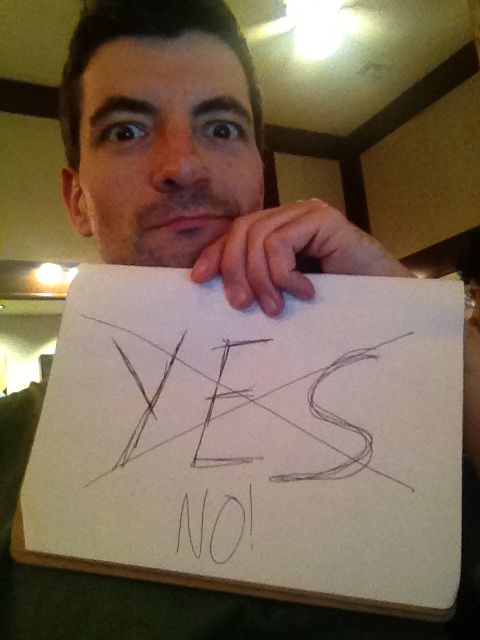
I hit a point within the last two years where I realized the power of “no.” Starting out, I think we actors need to do pretty much anything we can. We need to do student films, non-union, non-paying theatre and crazy performance art. We need to make connections with new young filmmakers (even though most of them won’t pan out). We need to be on stage and learn about theater lingo, curtain times and not to touch props that aren’t ours. We need experience in a business where there really is no right way to do anything. We need to become “professionals.” So the question is, when are you a “professional?” Are you ever? What the heck does “professional” mean anyway? Is Charlie Sheen and his ridiculousness a professional actor? How about Jeremy Piven and his sushi “allergy?” Is Lindsey Lohan a pro because she gets paid to, uh what does she get paid for nowadays exactly anyway?
I said yes to everything, because, well who was I to say no? But now, now I say NO!. I don’t say it that often and I probably still don’t say it often enough, but I have reached a point where I can really look back and evaluate if a project is worth my time and if there is anything in it for me. No one is the same and I feel that every one of us has to make this choice on his/her own, so please don’t think I am setting up any kind of criteria for which to measure your own career choices. I am simply saying that for me, I don’t blanket-ly accept any offer I am presented with. Perhaps it’s due to my getting older or just that I value my talent and time that much more now, but it is quite empowering to really take control of my career, rather than letting it run me as I did for the previous 5 or so years. Here is a vague-ish rundown of my process.
1) Does it pay?
2) Is it a role I want to do?
3) Is it a project that is new or exciting to me and could be groundbreaking?
If I say yes to any of those I probably say yes to the project. Of course this isn’t set in stone and sometimes I’ll still turn down a paying gig (albeit rarely), but for instance if it takes me out of town for too long a period (I am getting married and have two cats I can’t live without more than a week at a time). Or if the role is great but the commitment takes me away from other opportunities or takes up too much of my time. The big key here is realizing that saying NO to one project keeps me open to other opportunities that may come up during that time. It’s great to work and always be doing something, but lately I have found if I am going to work for free (which is often the case) why do someone else’s showcase production when I can work on my own webseries and/or solo show. Of course, if you don’t write or have any interest in it, this post may be irrelevant all together. But I believe all of us in this business have stories to tell, and I have found I am beginning to prioritize mine over others. Course maybe I’m just turning into more of a writer than I thought I was? Oh well, I’m not complaining, after all saying “no” this past winter to two things may have been what’s gotten me to this post in the first place.

I am a work in progress (and other advice)
I like to fill the inside cover my acting journal with bits of advice, words of wisdom and similarly catchy phrases with brightly colored markers. This week, I found two quotes to be particular useful:
- You are where you are at (from last semester dance class)
- I am a work in progress (freshman acting class)
Let me back up a bit first though; this past week, I was busy registering for classes and I had my hopes set high to get into one particular class and I went directly to the professor. And he told me, “You’re not ready for this class”.
I’m the girl who can’t be told no; but I accepted this and said “Well, that makes scheduling a bit easier at least”. Apparently, I can be told “Not yet”. Maybe I am not ready for this class next semester but he did tell me to look out for another class I should take in the spring. I trust that this professor knows what he’s saying, having seen me acting/studying/asm-ing for him for the past year and I appreciate that he didn’t exaggerate my abilities. I’m not ready—I’ve got more to learn.
I may be a college student now but I don’t think I will ever be done learning. Because you can’t rush progress: I was presenting a showing of a one act play for my class this week and we’re getting our critique back from the class to use before our next showing when my professor (a different professor) adds in a little aside to me that I’m doing things that I couldn’t have done when I started here. Since this is the professor who has had me from Day 2 of college, I think I can trust his judgment too on where I’m at.
My final and third piece of advice for this post:
3. “I learn by going where I have to go”
That is from a lovely poem, The Waking by Theodore Roethke. I didn’t know when I registered for my classes this year, what ones were going to affect me absolutely and what I would learn the most from. Clearly, I’ve become a better actor by going to college and majoring in theatre, yes. But I didn’t know that by the almost-end of my sophomore year, that I would have also worked busking a Commedia show, written my first play, learned to stage manage, become a Green Room blogger or that I would be singing onstage again for the first time in a few years. I didn’t know I could do all that until I did it.

The Tony Awards – the musical theatre lovers equivalent of the Super Bowl.
Neil Patrick Harris hosted the evening with the effortless charm and wit we have come to expect. There are not many entertainers with such mass appeal that can be an Everyman’s man and blur the divide in America. Basically, people think he should host everything and I’m inclined to agree.
Couple NPH with Christian Borle and I am glued to the screen. After watching him in ‘Legally Blonde’ as Elle Woods’ right-hand man in the classroom and potential love interest outside of it, I was a little obsessed. He ultimately became my favourite character on ‘Smash’ and won the Tony last night for ‘Peter and the Starcatcher’ which has been added to my epic list of ‘reasons to get back to New York’.
If you want me to cry, just make an emotional, heartfelt speech about your mother dying (Steve Kazee) or play the Les Miserables commercial. Seriously, I hope it’s as beautiful as we have been led to believe.
The cast of ‘Hairspray’ on Royal Caribbean controversially performed live from a cruise ship. To be honest, despite the obviously empty seats in the audience, I thought they did a great job and felt entertained.
James Corden made us Brits proud, humbly and adorably receiving the award for Best Actor in his hilarious one man farce, ‘One Man, Two Guvnors’.
The highlight for me was, of course, the choreography in ‘Evita’ and ‘Nice Work If You Can Get It’. I literally wanted to jump onto the stage and dance with them.
So there it is, another year of Broadway’s best. Now I just need a spare $1000 to see all these amazing shows!
Movie Musical Monday, June 18th: ‘Neptune’s Daughter’
Good Morning, and Happy Movie Musical Monday!
Today we’ll be watching MGM’s 1949 film, Neptune’s Daughter, starring Esther Williams, Ricardo Montalban, Red Skelton, and Betty Garrett. You remember Esther Williams, don’t you? Competitive swimmer turned movie star?

MGM built a swimming pool on the lot just for her. Incidentally, she’s one of the prettiest people I’ve ever seen on screen, though probably not the best musical actress. But boy, can she swim. And she designs swimwear, too, of which there is plenty in this film:
You may have noticed one of the song clips in the trailer as being “Baby, It’s Cold Outside.” Frank Loesser sold the song to MGM to use in the film, after having initially writing it in 1944, performing it at parties he’d host with his wife to let people know it was time to go home. It would win that year’s Academy Award for Best Song.
The movie also features Mel Blanc in the character role of Pancho, a Latin stable hand, using a voice similar to the one he would use a few years later for Speedy Gonzalez. No joke.
WHAT IS THIS MOVIE MUSICAL ABOUT:
This is a story about “a guy, a girl, and a bathing suit.” Esther Williams is Eve Barrett, a beautiful business woman who is a former competitive swimmer, focused solely on the success of her bathing suit franchise. (That’s art predicting life right there.) Her sister, Betty (Betty Garrett, the best Celeste Holm look-alike you’re liable to find) works for her, but has other interests, namely: Catching a Husband. Lucky for her, the South American polo team is in town for some big cup match (I don’t know anything about polo, so your guess is as good as mine). She intends to go after any member of the team because Betty knows–like everyone else in 1940s Hollywood–that Latin men are the best lovers ever. Eve is worried about this overzealousness, and tells Betty, “You’ve got to stop throwing yourself at men, you’re only going to get hurt.” Betty, however, is undeterred: “Not if my aim is good.”
Enter/Ride-in-on-a-horse Ricardo Montalban as Jose O’Rourke, captain of the South American polo team. He’s athletic, dashing, and of course (since he’s Latin), one hell of a lover. Which is good, because he’s around to give advice to massage therapist Jack Spratt (Red Skelton), who has no idea how to get a girl. Jose tells Jack how to hold a woman, and how to talk to her–in Spanish. “It is the language of love.” After an incident of physical comedy, Betty finds Jack unconscious, mistakes him for being Jose, and gets him to agree to coming over to her apartment that night for a date. I don’t know if you should proposition people when they’re unconscious, but it’s a movie musical, so never mind.
That night, Betty makes sure that Eve is out of the house, adds extra hot sauce to the h’orderves (“They like it hot.”), and waits. Jack shows up, ready to play off being Latin to the hilt, and attempts to woo Betty with a Spanish for Beginners record.
After putting out the fire in his mouth, Jack takes Betty to a Spanish Club that Xavier Cugat and his orchestra play at. Jack accidentally talks his way into playing with the band, and Betty sings a song about how much she loves men who play percussion instruments.
The next day she tells her sister all about how the captain of the polo team took her out. Eve is convinced her sister is being took and decides to nip this whole business in the bud. She sends for Jose, and of course the real one shows up and is taken by Eve’s unreal beauty. She asks him not to see her sister again. He consents, never bothering to explain fully that he’s never met her sister, but makes the condition that she go out with him instead. She reluctantly agrees, and spends the evening being as platonic and boring as possible. Finally, Jose attempts to woo her by singing “My Heart Beats Faster” at the stables. Here is some of the most awkward couple dancing I’ve ever seen in a movie musical–Esther Williams is more graceful in water than on land. Sadly, there is no Youtube clip I could find of this. But trust me, it’s true.
The next night Eve ends up back at Jose’s apartment looking for Betty, who she’s heard is on another date with the man. Of course, she is–but with the wrong Jose. After a thorough search of Jose’s apartment ending in the discovery of a full bar, Eve begrudgingly accepts that Betty must not be there, and consents to having a drink with the man she’s wrongly accused. She decides she should really go, but Jose works to persuade her in a very well directed “Baby, It’s Cold Outside.” At Jack’s apartment, he and Betty sing the song as well, but with her in pursuit:
Jose gets Eve to a club, which gives the producers another excuse to throw the contract they had with Xavier Cugat in our faces:
At the club, Eve and Jose encounter many other women on the dance floor who seem to have known the man before. Eve doesn’t feel so special, and leaves. But it all works out, obviously. To be honest, aside from the extended water ballet number at the end of the film (which is not the best one ever) and a BRILLIANT sequence where Red Skelton tries to get on a horse, there’s not a lot of substance to the film. Jose’s character never really tries to figure out why he’s being mistaken for having taken out Betty, and for some reason the writer of the film thought the best way to button this whole thing up would be with a kidnapping subplot. Yes: kidnapping.
HIDDEN GEM SONGS:
There are really only four songs with lyrics in this movie, and since one of them is “Baby, It’s Cold Outside,” your options are pretty limited. In fact, I’d say the only thing that is worth looking at is “My Heart Beats Faster,” for any Frank Loesser/musical set in the ’40s male-lover role. And it looks like you may need to get that song transposed, because the sheet music for this song is very illusive.
That’s all for now. Stay cool, and Happy Movie Musical Monday!
My Shiny Happy Survival Job

I’ve worked in too many crappy jobs to mention, but some highlights include telemarketing, dog walking, as a waiter at an awful Times Square theme restaurant that might rhyme with Gubba Bump. It was the worst (almost) two years of my life. Kissing European tourists butts for 10% tips, dealing with managers 10 years younger than me and being in Times Square for it all are three things I never want to do again. I once was propositioned by two very large Black men who thought I would “host” them for a crazy threesome (after repeatedly telling them I was straight) because they left $9 on 65. But believe it or not, my current survival job (which has been pretty good to me), sometimes has me longing for that again. I think it comes from the fact that for the last 7 years I’ve been my own boss. I’ve made decent money, I work my own hours, get tipped before my performance and don’t have to ever worry about getting a shift covered. Maybe it’s because of the fact that I AM IN CHARGE that I pine for the days of peddling Forrest Gump influenced seafood dishes to Italian tourists that don’t know the difference between 2 and 20 (%), or care. Maybe that’s the thing that makes me sometimes wish I had some 20 year old telling me how to properly “approach” a table of Midwesterners that want to tell me how great Mamma Mia just was.

See, I am a living statue/robot/mime/silver dude/street performer. I started doing it for fun, right out of theater school and after a bit I was making more money at it than I was waiting said tables. I still do it and that’s often the most frustrating part. Why, after 7 years, must I still paint my face silver and stand on a box? Because this business is tough, that’s why. One day I know I will not have to rely on the kindness of strangers who want a picture with a tin man or to give him a buck to pinch his butt (yeah, it’s happened), but for now, I know it’s easier to do if I embrace and cherish this period of my life. I have seen a good deal working the streets, I’ve learned a lot about people, had some good times, some bad times and made a few friends (mostly homeless people). I wrote a solo show about my experiences from it that won “Best One Man Comedy” at a festival last year and is FringeNYC bound this August. If you really wanna hear some stories, please check it out. The quick version is, yes I have dated another mime, I have been kicked in the balls, and I am not friends with the naked cowboy. I won’t make a million off this job, and I won’t be able to do it much longer, due to mental and physical breaking points. But this “thing” that started out as fun, has led me to paid acting work, brought me to Russia and given me material that I currently do and will continue to mine in my writing for years to come. Having a survival job can suck sometimes. But it keeps you real, it keeps you fresh and it prevents you from taking things for granted. I’ve worked with some actors who haven’t had one for years, who seem to have forgotten that most actors need them, they seem to forget that if not for that one lucky break they got, they would also be slinging shrimp, picking up poop or miming the streets. I’ve heard these same people complain about an (acting) job they have to do, or some audition they have to go on to please their agent. People who are at a level I can only dream about and still they are not happy. So as frustrating as it may be to ask, “why am I still doing this crappy survival job?” I think it’d be even more frustrating to get to that place of being a working actor and then not appreciate it.



 The Green Room