Green Room Bloggers Ornament Exchange 2012!
This year, the Green Room Bloggers participated in an ornament exchange much like last year, but the instructions were a little different: make an ornament commemorating your pick’s favorite project from 2012.
Check out everyone’s awesome creativity!
The Growing Artist —> The Redheaded Actress

“The Crucible”
The California Triple-Threat —> The Passionate Performer

“Super Knocked Up”
The Practical Artist —> The California Triple-Threat
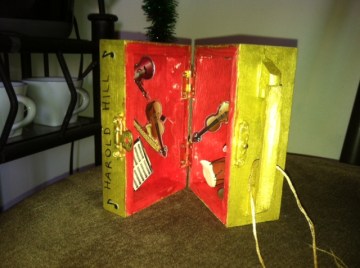
“The Music Man”
The Passionate Performer —> The Growing Artist

“Paul’s Day in the Park”
The British Dancer —> The Political Theatre Maker
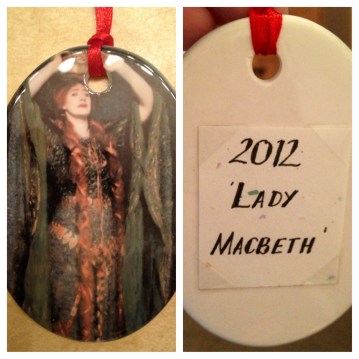
“Lady Macbeth”
The Political Theatre Maker —> The Granted Actor

“Call of the Tapir”
The Granted Actor —> The British Dancer

“Scrooge” at Fireside Theatre
The College Theatre Dork —> The Reflective Artist

“The Liar”
The Redheaded Actress —> The Crazy Theatre Artist
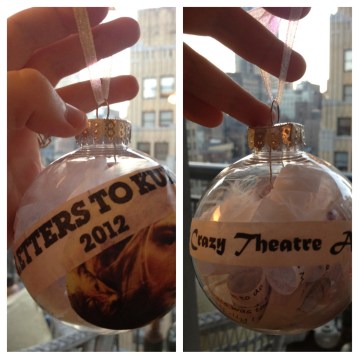
“Letters to Kurt”
Hope everyone had a lovely holiday season this year. Here’s to another year of creativity, friendship, and community here at the Green Room Blog!
The Power of Theatre…It Never Ceases to Amaze
Over the past few months I have been off the stage and settled into the role of audience member. Now, normally that would frustrate me, but it is actually exactly what I needed. After 5 years of seeing theatre through a critical, analytic, student point-of-view, it’s nice to just enjoy theatre for myself for once. I spent my Christmas Eve Eve in Manhattan where I got to experience an astounding volume of people starting first thing in the morning on the New Haven Line. It was busy, cold, and transit was not having its best day, but I had a great day of theatre ahead. And it was more than great. I not only had the pleasure of seeing a few good friends, but I experienced two extremes in theatre: simple, adorable, and wholesome to spectacular, ridiculous, and offensive (in the best way).
I should explain.
A former cast mate and now dear friend of mine is currently performing in the Off-Broadway production of the Berenstein Bears LIVE up at the Manhattan Movement and Arts Center, which I finally got a chance to see. It is an adorable child-oriented show that bring the bears from the story books I grew up with to life. It is probably the most wholesome piece of theatre I have ever seen and it was just great, especially since I got to see a friend performing. What I loved about it was the simplicity of the set as well. Design-wise, it looks like three-dimensional versions of the picture books on the stage. The actors do all the set changes and it is all choreographed so the show runs like a well-oiled machine to cater to the brief attention spans of small children. Simple, adorable, and wholesome.
Meanwhile, over on 49th, another friend of mine was waiting in line for standing room only tickets to The Book of Mormon which I have been wanting to see FOREVER! Without spoiling any plots or story lines since it is such hard show to get tickets for, let me just reiterate the three words from earlier. Spectacular: some of the most amazing scenic and technical elements I have seen on a Broadway stage – The closing number of Act 1 in particular had some moving lights that were just dazzling. Ridiculous & Offensive (in the best way): If you have seen the show or heard the music, you understand where I am going with this – The book and lyrics are just brilliant in the way they use comedy to shine a spotlight on pertinent issues.
I may or may not be making a clear point, and if you are still with me, that means maybe you are as confused as I was on the train home tonight. Through theatre, we as artists have this amazing power through the material we are given and connection we are then allowed to form with the audience. Theatre is this amazing tool that can use dancing bears to teach values to little kids, maybe using tap-dancing Mormons to spark up some conversation about suppressing thoughts and feelings about faith, sexuality, or the state of the poorest parts of the world. Anyway, I was standing in the back of the orchestra watching the curtain call with all its flashing lights and laughter and just thought about all the messages that had been suggested to me through theatre throughout the day, and felt blessed to be in on the secret.

My First Bad Show
My first year as an actor has been filled with remarkably good experiences. Even the auditions that did not yield a role were positive experiences where I received helpful feedback and left feeling that I had accomplished something in my acting journey. But I did have one bad experience this year, one so comically bad that I cannot even look back on it with anger. Rather, it was an unintentional farce.
After two small roles last summer, I wanted to broaden my scope a bit with a larger part. I saw an online ad for roles in a one-act play festival, with the possibility of a major role in the company’s next big production if successful. I thought a one-act would be a good next step, so I contacted the company.
I had some hesitation about writing here about a bad experience, since I do not want to get a reputation as a complainer, but absolutely everybody in the D.C. theater community who I’ve discussed this company with had bad things to say, so I feel I am burning no bridges. For the sake of this piece, I’ll call the company Lightningbolt Productions.
The artistic director, producer, and all-around poobah of Lightningbolt turned out to be a 60-ish accountant who has been running the company for years but who has next to no interaction with the broader theater community. It took me a while to reach him, since Lightningbolt has a 1998-era website, no Facebook presence, and no Twitter feed. The contact number is his accounting firm, and he has an old answering machine, not voicemail.
Once I did reach this guy — I’ll call him Mel — he immediately offered me the lead in one of the three one-act plays to be put up. This seemed very strange. I told him I had very little experience, and that I was just calling to arrange an audition, but he said he did not believe in auditions and just liked to pick people after talking with them. I protested that I was not necessarily the best bet for a lead, and he said the other men who had contacted him had even less experience.
All of these were warning signs, but I was naïve and eager to get more experience, so I said I would take the part. Within a couple of days, before we had even had a rehearsal, I was getting emails from him with the header “Call Me!!!” and no other information. It turns out this is just his way of leaving a message; none of these were desperate. The first one assumed that I would also take a major part in a second one-act, and the next that I was certain to sign on with the next major production. I made it clear to him that I was committing only to one one-act, and that I would only reply to his e-mails if they said what it was he wanted to discuss.
Mel had no role in the three one-acts. Mine was directed by a first-time director who had appeared in his last show, and the other two by two of his protégés. The three would be performed and judged by a panel of three — of which Mel would be one — and the winner would advance to a regional competition.
The rehearsals took place in the director’s living room, with her parents sitting in the next room and a big dog wandering through every so often. The director hesitated to make any real decisions and tended to leave everything up to consensus. The other male actor in the show — who never got off-book and who was using index cards with his lines until tech — would offer advice and criticism of other performers. He wasn’t a bad guy; he just did not know any better. But the director did nothing to stop him.
We lost the lead female actor halfway through rehearsals. Mel had invited her to a meeting of the Lightningbolt board to discuss future projects, then ambushed her by announcing her as a “new member of the board” and assigning her projects. She got up, walked out the door, and severed all ties with the company. (This, I learned from others, was pretty standard Mel behavior. At one wrap party, he singled out everyone for thanks except his producer — whose house the party was at. He actually skipped over her while going around the room. Another female actor advised me, “Don’t leave your female friends alone with him.”)
The role, intended for a woman in her 30s and originally cast with an actor in her mid-40s, was recast with a very talented high school student. (There were actually a few talented people in the cast, like me working with Mel for the first time.)
About two weeks before the show, Mel dropped by for what was promised to be a 10-minute preview of what to expect on the nights of the show. I had told my director that I needed to leave by 8:00, and Mel got there at 7:40. He talked for the better part of an hour, again making all sorts of assumptions about everyone carrying on beyond the show. He made it all sound like a horrible chore — he had a way of making theater utterly joyless. He declined to shake my hand and never addressed me directly, and never did after that — I assume because I had made it clear I was not interested in becoming a Lightningbolt regular. If not for my personal sense of commitment and my respect for my fellow actors, I would have quit on the spot.
Mercifully, the show itself was only set to run for two nights — it was about all the company could afford. Outreach efforts were absurd — Xeroxed posters hung up in grocery stores and Laundromats, inviting people to pay $17 a ticket for three short plays they had never heard of, performed by strangers. I asked my director if a Facebook event had been created, and she said no, and asked me if I could make one. I did, and sent the link to Mel and everyone else involved. He refused to use it, and no one else did either, not even adding themselves. I was the only “yes” on the thing for a week, and after that, I decided I did not really want my friends and peers to see this disaster in the making, so I just deleted it. No one noticed.
(This was not the only odd Facebook episode related to this show. About midway through the rehearsal process, I sent my director a friend request. She accepted it, then unfriended me about five minutes later, apparently unaware that I would be able to see that she had done that. My name is not a common one, so she knew who I was. It made rehearsals even more awkward.)
We had one night of tech in our performance space, and most of that time was spent rigging up an odd curtain apparatus that Mel had designed that cut off about half the useful play space and concealed very little. It was held in place by bricks and free weights that we all had to haul in. We finally convinced him to abandon the thing, which was about the only concession he ever made.
The night of the first show was chaotic. The producer was another Mel protégé who had actually written one of the three plays — a 10-minute sketch as compared to ours and the third, which each ran about 45 minutes — and she failed to make any decisions, going through the set-up in panic mode and fussing with lights and wiring. The cast of our show and some of the others were helping, though two women from one production refused to lend a hand, with one saying, “I don’t DO wires.”
But time was running short, and as we stood around offering ideas and suggestions, important tasks were not getting done. Whenever anyone would ask the producer for a decision, she’d say, “I don’t know!” as if it were not her job. Finally, I, seething, raised my voice among all the chatter and said, “I think someone in a position of authority needs to make a decision and then we should all do what that person says.” There was silence, and then the chaos resumed. (Mel, meanwhile, was only interested in setting up a concession stand to sell fruit punch and chips at a dollar a pop.)
The third show had been abandoned. The young director — another person Mel had anointed without any sort of vetting — had held two or three rehearsals each week, but had failed to get his cast or himself off-book. One actor was actually show-ready; the other four were about as far along as most actors after a week of rehearsal. It was done as a staged reading, but was pulled from the competition. (The director of that show spent all his time backstage making jokes and acting goofy, even though the “wall” was a curtain and the audience — what there was of one — could hear it all.)
But here comes the bright side. After all of this mayhem, and with the lack of clear direction, four of the five people in our cast went out and did a good show, and the fifth — index-card guy — was pulled along by the rest of us without major incident. I remembered all my lines, hit my marks, did a bit of physical comedy, and essentially achieved the goals I would have set for my first lead role in a short play. We did two good nights under extremely trying circumstances.
Our 45-minute show was easily the favorite of the audience, but none of us were too surprised when the 10-minute sketch by the producer of the festival was awarded the win. Mel sent an e-mail around offering special praise to everyone who had appeared in it — some of them for two minutes — while ignoring everyone in our show, except the young woman who had agreed to work with him again.
I hit “delete” and went on to my next role.

Broadway or Bust…or Not.
Most of the performers I know, including myself, have inherited the unfortunate curse that always seems to accompany an artistic career choice: skepticism coming from every direction. Skepticism that anyone can actually find success as a professional artist, judgment that many actors have to work part-time in odd jobs, cynicism that an actor will ever amount to anything worthwhile. Personally, I’ve dealt with years of anxiety, constant struggle, and countless mistakes finally to settle on a very calming conclusion.
When I was much younger and new to the theatre scene, I was in a show with an older performer whom I looked up to as an artist and as a person. He talked of nothing but attaining his dream as a professional actor, how he simply couldn’t live with anything less than a prestigious role on Broadway, how nothing else would legitimize his career choice. As a young, starry-eyed, aspiring performer, I hung on every word he said, but being the pessimist that I am, came to the conclusion that I would never be talented enough to make it on Broadway. This, in my young mind, meant that I would never succeed in the field of theatre and should find another career path.
Years down the road, I attended a production of my favorite musical at a black box theatre, in the middle of no where, with dirt cheap seats. To my awe-struck surprise, the lead actor in the show was the same boy who had pledged every essence of his being to making it on Broadway. He had certainly done a wonderful job in the show, and though the theatre was not well-known, he landed a very coveted role in a show not often produced. Yet I couldn’t stop myself from feeling sorry for him. Here he was in this painfully small theatre, close to his hometown and lifetimes away from his dreams of Broadway.
To my disappointment, I did not find him that night after the show but happenstance would have it that several years later our paths crossed again. We fell deep in conversation until I felt comfortable enough to ask, as politely as possible, why he had given up on his dreams, if he was disappointed with the direction his life had taken, if he was giving up on his acting career due to his lack of success?
His answer affected me more than he knew. He explained that as he matured and experienced all that life had in store for him, he realized that there is so much more to discover as an actor than just Broadway shows or National Tours, there are so many different paths an actor could grow in and thrive in that don’t involve an Equity card. He simply didn’t want to do Broadway anymore, he found that he preferred small theatres with intimate audiences, landing parts that some actors never got to play, living close to friends and family in his hometown. He laughed at his youthful self who lived by the phrase “Broadway or Bust”, a teenager who felt that if you didn’t have the prestige of a Broadway credit, you couldn’t call yourself a real professional.
As someone who hates New York, finds classic theatre slightly dull, and never wants to stay in one place for too long…a career on Broadway might be somewhat of a nightmare for me. Yes, I realize what a paradox this seems like; an actor who doesn’t want to be on Broadway. But while it lacks the prestige that some actors yearn for, I’m much happier performing in a theme park show if I get to play a vivacious character with killer songs. Similarly, I’d rather be in a low-budget show if it allowed me to live in an interesting new place and I’d rather work at a theatre that no one recognized if it gave me opportunities to perform in ways I felt proud of.
Despite a lifetime of my peer’s Broadway ideals, my family’s unyielding skepticism for my risky career choice, and a myriad of classes that measured artistic success by equity points, I’ve collided head first into a most reassuring reality. Success to me is waking up absolutely ecstatic to play my part, feeling alive on the stage, and having a deep-rooted pride in the performance I put on. I don’t need fame, prestige, or riches…and I definitely no longer need the approval of others that I’ve become successful. I just want to live a life I find worth living, and I think I’ve found it in the non-equity, unconventional shows I’ve stumbled upon all over the world.
Success looks different to everyone, only you can define it for yourself.

Theatre for Social Change
After the Sandy Hook tragedy, it made me think about all the massacre’s that had taken place this year and within the past decade or so. Since the Columbine Shooting in 1999, there’s been 31 school massacre’s that had happened. Yet not once in this time had there been any change in the matter’s of gun control laws.
To add insult to injury, the media makes these situations more about the killer than the poor victims. We are going to remember the names Adam Lanza and James Holmes (from the “Dark Knight Rises” shooting over the summer) more than remember the names of ANY of the victims. Even if they take their own lives like Adam did, they will be remembered as the monster who murdered poor innocent first graders, than him going out unknown my the masses, or even as a kid who has a form of autism that his mother thought it would be a good idea to take her mentally disabled son out shooting and to own an extensive gun collection with him in the house.
My point being: the American focus on massacre’s needs to change. The fact we keep HAVING these massacre’s need to change. The fact that within the gun control laws, you can buy a gun at Wal-Mart in certain states just by being 18. And much more needs to change.
So, I realized after a weekend of reflection, that I’d like to create a devised theatre piece, connecting all these massacre’s together along with some of the one’s that aren’t famous, and the fact that people DO exist out there that see it as okay to even poke fun at these things (I’ve witnessed “massacre gags” and found them all to be absolutely appalling). In other words: I’d like to create something that reflects the fact the US current gun control policy, these massacre’s, and the American media’s approach to these massacre’s are wrong.
One of the things that I love most about theatre is how much we can inspire people to promote social change by utilizing the theatre; our art; as a tool to make the world a better place. One of my goals for 2013, is to now have a devised theatrical production that will help promote awareness on how these things need to change.
I’ll keep everyone posted on my process as much as I can, although the first step I need to take is to generate enough interest to get it going.

Vision Board Party
I’ll start with a brief update:
Spending 3 months doing a show in the Mid-Country has had a surprising effect on me.
• I now knit…on a loom…I’m a knitter of scarves!
• I tried cross-fit…and couldn’t walk the next day.
• I found a book on ‘Feng Shui’ in the cast house and am now a budding ‘Feng-Shui-er’…. in theory!
Suddenly we are having ugly Christmas sweater parties, doing Secret Santa and drinking mulled wine, signaling the fast-approaching topic of New Year. I started thinking a lot about what I want to accomplish in 2013 and how I would create my set of goals and resolutions.
A few of the cast are doing ‘The Artist’s Way’ and although I have never read the book, it became clear that I had found similar exercises to envision my goals. I read ‘The Secret’ last year and liked a few of the ideas which seem to crop up in many life-improvement articles.
After nabbing an impressive amount of free magazines, quotes and postcards from friends, thrift stores and waiting areas, we set up a date one afternoon to create our Vision Boards – a great way to picture your lifestyle design.
Vision boards allow you to define and explore what your desired lifestyle looks like.
We simply looked through all the magazines and cut out the images and words that resonated with us. By making it a social task, we were also able to find pictures and words for other people in the group too. As we were all musical theatre performers, some of us added pictures printed off from the internet at the library as another resource.
We reviewed them (some didn’t seem as relevant after an hour) and organized them into sections of our life:
Eg,
• Career
• Health and Fitness
• Relationships,
• Family
• Finances
• Home
• Spiritual Beliefs
• Aspirations
• Hobbies
We then glued them onto a large sheet of poster board (I found that yellow is a positive color and read that it is a good idea to put a photo of yourself looking happy in the center of your board to relate all these visions to you.)
We found that even though we had a long session creating our Vision Boards, we are still adding to them days later. Ideally you should place it in a spot you see every day and believe that this vision of your life will become reality. Alternatively, you could create a Vision Scrapbook that can be easily added to as time goes on.
The exercise really helped me get to the core of what I want in life. This, in turn, determined what I want to achieve in 2013 and made me think about how I can make smaller goals as part of a grand PLAN.
It helped to look back on the goals I set for 2012 and see which I actually achieved. It is funny how I had attained and surpassed my main 2012 goal that had seemed so impossible at the time, even though I wanted it so much. So. I leave you with some quotes to think about when making your Vision Board/ Life Plan/ 2013 Goals:
“Reach for the moon, even if you miss, you will land among the stars”- Brian Littrell.
“Once I make my goal this year, I’ll achieve it no matter what, as long as I am grateful to my life now.” –Lemy Yusento
“What the mind of man can conceive and believe, it can achieve”- Napoleon Hill
“A man is but a product of his thought. What he thinks, he becomes.” – Mahatma Gandhi.
“Visualization is simply powerfully focused thought in pictures, and it causes equally powerful feelings.” – Rhonda Byrne.
Do you have any techniques on how to set/ achieve your goals?

“Line!” – Memorization Tips
- Don’t panic! Even though the lines looked overwhelming at first, I didn’t panic. I made myself a cup of tea, sat down, and began breaking down the large paragraphs into smaller, more manageable pieces. I also highlighted my lines, and marked any directions that were given.
- Repetition, repetition, repetition. I repeated each line over and over, until I felt comfortable with them. Then I moved on, tacking on a new line when ready, and then running through the old lines with the new line added on – creating a sort of pyramid effect.
- Do your research. I took a break and used the time to research the project, look up any words I was unsure of, and read the script. This gave me a better knowledge of my character and how she would react to the people and situations in the scenes I was given.
- Use a reader. I had my roommate read over the sides with me that night, but I also took an extra step and called a reader to meet with me the next morning, just to give me another perspective and some added preparation before the audition. I put the sides to rest that night so I could get a good night’s rest, and aimed to get a fresh start in the morning.
- The audition… After doing everything in my power to make the audition go well, I went into the audition room feeling confident. It was out of my hands. In conclusion, the audition went very well.
- Leave the audition in the room. This is sometimes a difficult step for me, but in the end, you have to just leave the audition in the room. As long as you did your best, there is nothing else you could have done. Whether you are cast or not doesn’t always have to do with your performance. They may already have someone in mind, they may be searching for a different look, maybe you are too tall/short – who knows! Whatever it is, it’s out of your control. Don’t stress over it!

Reasons to be Reckless
I am reckless.
A couple of years ago you may not have recognized me; a systematic physics major at a private school in California with an office job and a meticulously organized schedule. Yet upon a subsequent realization that my true passion had always been the performing arts, I decided to change my major accordingly…and move to a different continent…on a whim…without telling anyone.
So began my recklessness, which fortunately translated into an artistic freedom on stage that has landed me career opportunities in the most unlikely of places. I’ve swung over audiences in stunt shows, twirled in a lyra 30 feet in the air, sang with tech crews who didn’t speak any English, and undergone pyro training so that I could dance with fireworks exploding under my feet.
I’ve had to utilize the phrase “I’m lost” in ten different languages, lived on three continents, and found my unyielding search for adrenaline rushes becoming a part of my daily routine. Through this madness I’ve earned SAG membership, worked as a musical director, obtained a university degree, become an accomplished classical pianist, and gained a fervor for life that takes me on adventures I’d never dreamed of.
I’m thrilled to currently be singing and dancing in a rock show on a resort island in Southeast Asia where I have to cross over an ocean every day to get to work. I look forward to writing about ways to freely live life to its full potential by filling it to the brim with what you have passion for: the arts.
Caution: philosophical side note story (….there will be many throughout this blog)
When I ran away to London, I walked 40 minutes everyday to get to a beautiful, out of tune grand piano, secluded in a dark concert hall that seemed to go unused. I need the piano. I’ve played everyday since I was four, and often I “play” my feelings better than I can speak them. It seemed there was only one other person in all of London who knew about this hidden gem in the East End, and often traversed through the foggy rain to get to it: an Italian medical student also studying at my school, with broken English and an obsession for Chopin comparable to mine.
One night, with half-frozen fingers, I was playing Chopin’s Premier Ballade when I heard rustling behind me…apparently this Italian student was also planning to commandeer the piano that night to practice. He tried to ask me about my music but a language barrier between us was preventing most successful communication. I got up and gestured for him to play the piano if he wanted to, mostly because I didn’t know what else to say. And with that, suddenly, I could understand everything he wanted to convey.
We met up often at the piano until we finished classes that year and parted to different countries. Fortunately modern-day technology allows me to stay in pretty close contact with my Italian pen pal** (see below footnote). Several weeks after I moved to Asia on my new contract, he wrote me an email in his broken English and stereotypical, overly romantic Italian verbiage informing me that “something in my soul had changed” over the past several weeks. This was not due to my change of country, my new job, or my isolation from everyone back home…it was because I hadn’t played the piano in weeks. I had not told him that I was in serious need of a piano-fix, he just new as a fellow artist, that if you remove my means for creating art, you remove a piece of my soul.
I broke down later that week and spent my first paycheck on an electric piano that has successfully restored my soul to its full art-producing potential. Suffice to say, I tell this overly emotional, dramatic tale to convey that art is a crucial part of our being. Don’t let anything keep you from doing what you love; be it monetary constraints, social pressure, or uncertainty in this challenging career. For me, I need my daily dose of Chopin to settle my soul, for others it could be a decision of what to major in or whether it’s time to pursue your “backup” career because things aren’t going as planned. Keep going, your soul depends on it.
**I have an affinity for different languages, this is fair warning to all my readers that you may occasionally need to keep Google Translate handy when divulging into my blog.


 The Green Room