Union for Interns!
Something I’ve been saying for the past five years is that we need a union for interns. For most college students, recent graduates, and early career individuals (early/mid 20’s) one of the things we tend to strive on is to obtain an internship. These opportunities while usually gives you some of the experience that helps towards an individual’s career goals, however often times you do tend to have do things such as make copies, make coffee runs, or stock supplies more than anything else. It’s incredibly rare for interns to ever get paid, and when they do get s stipend of some sort they are often treated more like slaves than anything else. What’s worse is that sometimes interns do the same exact work as employee’s yet are not only treated as lesser individuals but aren’t paid for equal work which I’ve seen happen on a number of occasions. This is the reason I’m glad that the Black Swan Interns has had the ruling in their favor for equal pay for equal work.
For those who don’t do, the interns that worked on the film “The Black Swan”, not only didn’t get paid for their work but did the same exact work as their employee’s. So two interns who worked for an Oscar-winning film and filed a lawsuit against Fox Searchlight (the production company of the film) in September 2011, claiming it violated labor laws by not paying them. Finally this month, a judge ruled in favor of the interns, saying that the internship on the set of Black Swan was not educational and merely served the benefit of Fox to have more production crew members providing free labor, therefore they deserved to be paid as regular employee’s.
How to Successfully Fail – Again and Again and Again
As the third of four children, I should be an expert in not getting my way. As an actor and writer, I face so much rejection that I could give workshops in not getting your way. And certainly, as a mother, I often coach my child through dealing with not getting his way. And yet, not getting my way still stings the tear ducts of my inner child and can send her stomping off to the corner, not willing to play anymore. Not getting your way is a fact of life, but sometimes not getting your way again and again and again can begin to feel like you are on a one way ticket to Failstown, population: 1.
With all the clarity that hindsight brings, I can see places in my history where a different choice may have netted a more desirable outcome. There was my first professional audition, where I got a callback – score! – and screwed up my song – fail! – then blamed the accompanist – epic fail! There was the lucrative 10-month job offer that I didn’t take because it ended in between seasons and I feared I wouldn’t find work during the lull. Epic Fail. Or there’s the audition I totally rocked, then blew the interview by over-sharing. Epic.Fail.
There are less-epic fails I could enumerate: monologues way outside my type, songs I learned in one key but brought sheet music in another key. My friends, short of disrobing, if there is something you should not – ever – EVER do in an audition, I’ve probably covered it.
Overbooked and Overwhelmed: How to Prioritize
Is there any peace to be found in the world of show business? When you’re not getting work, you’re miserable. You start to question every life decision, from choosing the right agent to not saving enough money during your last show. You feel inadequate, dissatisfied, and conflicted as you become consumed with finding any suitable work.
Conversely, when it rains…it pours…it blizzards….it tsunamis! You get finally get one gig and then the work comes crashing in all at once! As successful as you may feel, the fact of the matter is that you may be in an equally distressing position. Say you’ve got a decent job that pays the bills and gives you constant work, but then you’re cast in a fantastic show that you could really use on your resume. Problem is it conflicts with your job that pays the bill. Lucky you, you’re landing gigs left and right, but suddenly becoming double or triple booked. What do you give up? How do you bow out without ruining your rep or causing damage to your career? Is it possible to take on all the opportunities while still finding time to eat, sleep, AND maintain your vital relationships?
I don’t know the answer to any of these questions.
A Friendly Community?
Independent arts consultant and self-described “theatre pundit” Howard Sherman, late of the American Theatre Wing and scads of regional theaters, recently mentioned on Twitter that a Huffington Post piece he wrote in September 2012 is again making the rounds. The essay, “Theater the Theater Community Disdains,” is worth your time.
What is this hated form of theater? It’s community theater, of course, the place where most of us get started, the dusty small town that we turn our backs on and vow never to visit again once we make it big. This is an attitude for big egos and small minds.
Sherman wrote that “those whose lives and careers take them away from the arts, but whose love of performing doesn’t abate, become part of a maligned yet integral part of the theatrical ecosystem which, when spoken of by most professionals and media voices, is summarily disparaged.” He concedes that “a great deal of the work done in community theater likely doesn’t measure up to professional, or perhaps even collegiate, standards,” but that it is ” a hobby, a passion and an outlet for people who truly love theater.”
Sherman argues that community theater practitioners are likely to be professional theater patrons and also “parents who encourage creativity in their own children. In some cases they may even provide the only theater their community gets to see. They are the people we need.” Certainly community theater does aid in arts education — Sherman notes that playwright Sarah Ruhl has credited her parents’ community theater experiences with helping to turn her on to the stage.
Comrade in a Borrowed Gown-AEA at 100
I was once in a bar in Savannah, Georgia, chatting with a young couple, who were both union pipe-fitters in the Local. The young woman explained to me that her father was in the pipe-fitters union, and got her in right after high school. She met her husband at work too.
“I totally believe in unions,” I exclaimed, in an attempt to bond with them. “I’m in the Screen Actors’ Guild and Actors Equity Association, so you know, we are comrades…. solidarity people!!”
Either because they were good natured, inebriated or a combination, they actually didn’t slap me for being so patronizing and instead continued to engage with me. They were really nice people, luckily, because I was getting stupider by the minute.
“So,” I asked. “What do union pipe-fitters do?!”
“Uh,” the young man replied. “We fit pipes.”
Indeed.
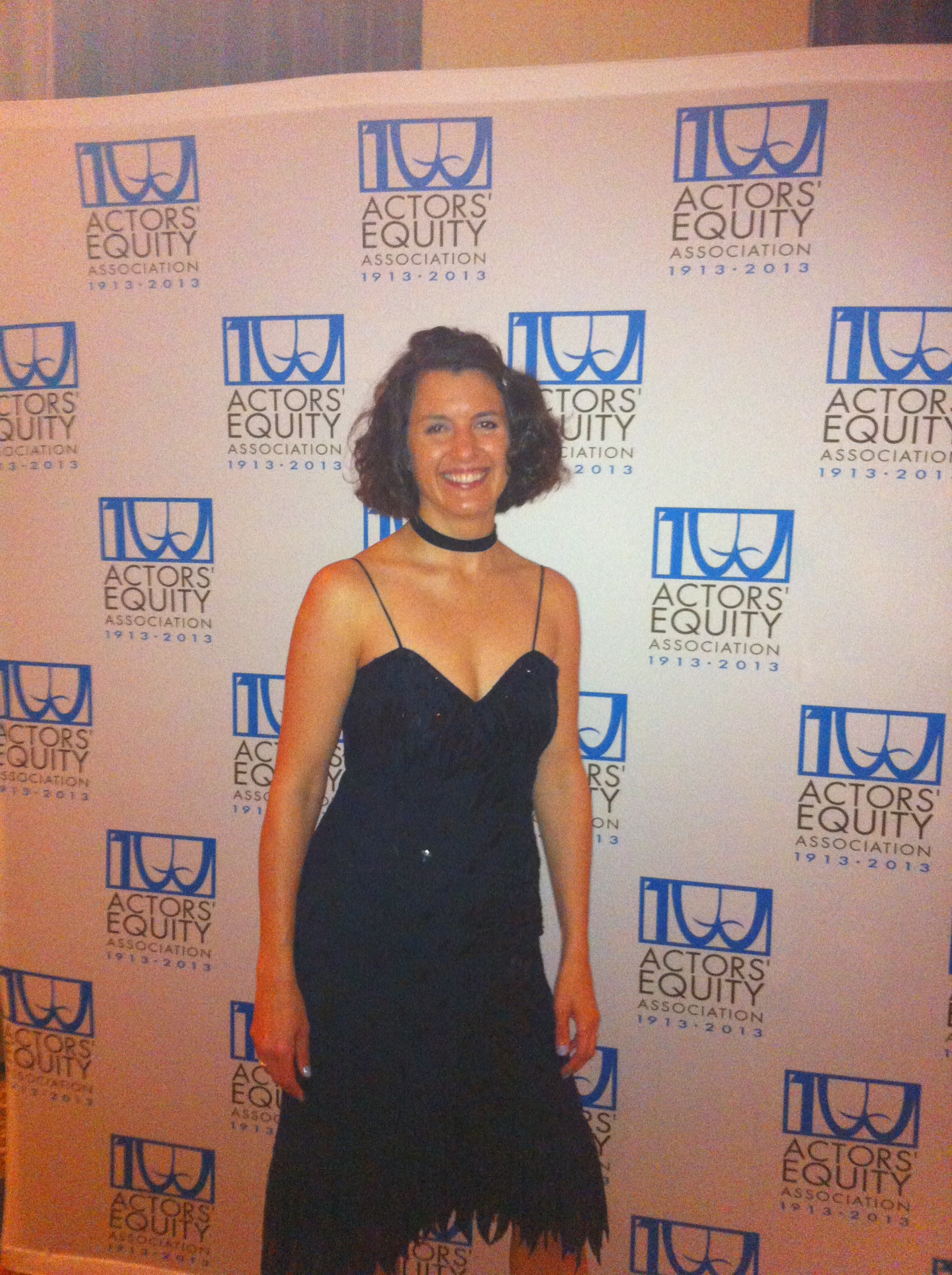
And that is just one difference between performers’ unions and other guilds… After all, there is no one task, no one job, that we members of AEA or SAG-AFTRA do. This became evident to me at the 100th Anniversary Gala of Actors’ Equity Association on Monday. At my table of “rank-and-file” members there was: a stage manager who worked for a decade on Cats; a young lady who did national musical tours; a Malaysian gentleman who got into Equity when he got a job on the Broadway production of Miss Saigon; and a woman who started as an actor, then taught theatre at Carnegie Mellon, and now is returning to her performing roots. We were a diverse group and it occurred to me that I ought to give the union a break. While it’s far from perfect, AEA does a pretty good job of protecting and representing a large and you might even say rag-tag group of theatre professionals, who would never be able to agree on a single task we all do…
So while we can discuss the union’s finer points in another post, today, in the spirit of good will, pride and solidarity I am bringing you a short report from the AEA 100th anniversary gala, which I attended, in a borrowed gown.
Need help Learning Lines? My Review of LineBuddies.com
I’m definitely not someone who feels the pressure to be completely off book for an audition. I’m of the Margie Haber school of thought that it is okay to hold and use the script. However, I do get very bored working on scenes by myself in my apartment and my husband, although he has numerous amazing qualities, hates running lines with me.
Rehearsing or running a scene is always helpful! I have a friend who for “big” auditions always rents a studio for an hour and has a friend rehearse the scene with her. Ideally that would be perfect but isn’t an option for me financially, given that I’d need to pay a babysitter too. For more challenging audition material I’m also a fan of doing a coaching session, I love Roz Coleman, but again this is rarely an option financially.
A Bi-Coastal Casting Director recently told me that the biggest difference between NYC actors and LA actors is that in LA actors always memorize and in NYC they don’t. She really felt that a script should be memorized. I don’t entirely agree but can clearly see the difference in tapes where an actor is buried in the script compared to another whose eyes are off the page with the freedom to behave and inhabit the character.

I was excited when given the opportunity to try out LineBuddies.com for Green Room Blog! It struck me as a less expensive and very intriguing way to learn lines/run a scene. I scheduled my 30min appointment for 9am and emailed my sides to them the day before – though you can do it up to 15min before your appt. I choose a 2-page film side that I was going to use at an upcoming workshop.
Please welcome Emma J back to the blog! Emma is an actor and model who previously guest posted with us about whether or not to do nudity, and she’s back posting with us again after reading The Growing Artist’s great post about how to decide when to turn down a role.
Dear Growing Artist…
After reading your blog post, which was very well written, I found myself with so much to say and share that l had to put it in writing.
First of all you are not alone in having some kind of frustrating experience creatively. I am sure most actors have, I know I have. However out of your three bullet points it struck me that you seemed to overlook the bigger picture. So I ask you, as I have asked myself. What is your vision for your career? Why are you an actor?
Before deciding to be an actress I had to first make sure I knew myself inside out and what I wanted out of my acting career. What excites me. What challenges me. I think before considering any job it is vital that you know your type, how you are seen by the industry and most importantly how you want to be seen? Not one bullet point was based on the actual work. Even new experiences you based on a skill set, green screen for example and not the story, the quality of writing, the character? I think that is where the continued frustration lies. Yes good pay is very important, I mean we have to pay our bills, but good pay has to be combined with fulfilling roles.


 The Green Room