If The Boat’s Not Afloat, Get Outta the Moat
There are some things I’ve just never been good at:
1. Knowing the right lyrics to popular songs. (You mean, Adam Levine doesn’t think it’s “hotter to breathe?” What? My world is now upside down.)
2. Refusing ice cream. (I’m sorry, “no thank” you has currently escaped my list of usable phrases.)
3. Read below …
This weekend I jumped at the opportunity to be an actor for Gary Ploski and team Flipmeover’s film in New York City’s 48 hour Film Project. I have no film experience, but I was confident about the challenge and really wanted to be a part of the project, especially considering that Gary works with the best, his projects are quality, and with over 1,600 followers on Twitter, this winner of last years’ New Haven 48 hour film project has quite the reach.

Little did I know, this experience would become an addendum to my current list of things I’m bad at.
#3 …. FILM!
Acting for Film 101 (Commentary courtesy of the Newbie)
1. Use the same energy and intention as you would on stage, but “condensed.”
Come again?
2. Always be thinking something so your eyes are engaged and active.
Ok … What the hell is my line? I can’t act to the umbrella lighting – why do they want me to act to the umbrella lighting? Do my arms look fat? Why are there six people in my personal bubble? I’m sweating.
3. Keep movement to a minimum especially during close-ups.
This is my impression of a corpse.
And to add insult to injury:
-
I didn’t know the lingo
-
I didn’t know film set etiquette
-
I forgot I was miked and the sound guy told me he could hear me talking to myself while off set. #oops #embarrassmentparade
Bottom line – I am a stage actress. When it comes to theatre, I know I’m going all the way and I can contend with the best. Fifty auditors can all pass me up and it won’t discourage me. But film. Oh man. I sucked so bad it’s funny!
A lot of people would be telling me not to publish this post right now for the sake of my career. “You’re discouraging film makers from ever casting you again!” Good! Jesus Christ, I care about the quality of work we put out there. For the love of God, don’t cast me. Until this chick gets a few film classes under her belt, avoid her like a prostitute with herpes!
If you’re in the same boat (and the bow has crashed into an iceberg, 1,517 people are about to die, and Jack has “let go”) …. Get help. Check ’em out:

Snapshot after wrapping the shoot.
From left to right: The Newbie Actor, Gary Ploski (director), Rafaella (actress)
Onwards and Upwards (STILL!),

A few evenings ago I spent 5 hours at an event. I wore a pretty dress. I did some dancing. I ran into friends I hadn’t seen in months and even years. I met and networked with some really talented performers. I reconnected with directors and music directors I’ve previously worked with. I left refreshed, encouraged, and happy.

Movie Musical Monday, June 4th: ‘Hit the Deck’
Good Morning, and Happy Movie Musical Monday!
Today’s film is an MGM feature from 1955, Hit the Deck.
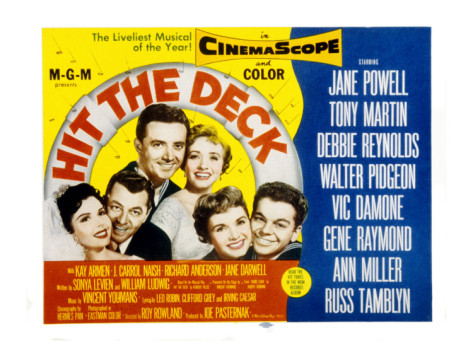
This movie is based on the 1927 stage musical of the same name, which in turn was based on a play called Shore Leave. This is the second film based on the musical, the first produced by RKO in 1930. However, there is no trace of the RKO feature, as the last known copy was destroyed by a fire at the studio in the 1950s.
WHAT IS THIS MOVIE MUSICAL ABOUT:
The movie opens upon our heroes, three sailors–
“Wait,” you cry, “Isn’t this ‘On the Town’?”
“No,” I reply, “for many reasons. Although Ann Miller is also in this movie, the city in question is San Francisco, not New York, and even though the production numbers are pretty great, the songs are very typical of the era they were written in (the 1920s) as opposed to the one ‘On the Town’ was written in (1940s). Okay?”
“Okay.”
Great. So, as I was saying: there are these three sailors, Tony Martin, Vic Damone, and the boyfriend I wish I had as a teenager, Russ Tamblyn (before he rumbled enough to bulk up and become the leader of the Jets–I ❤ RIFF 4-EVAH). They’re all friends in the Navy, and they’re trying to get home to San Francisco. The movie starts with them up in the North Pole, participating in Operation Ice Cream. It’s cold, and Vic and Russ don’t want to do their swimming training in the freezing water. Luckily for them their pal Tony shows up and tells them that two volunteers are needed to bake a cake for a higher-up-in-rank’s birthday. Tony’s plan is to present this senior official with a cake and capitalize on the sentimental feelings of the man to get sent home to his girl, Ginger. He figures that the two people who bake the cake and follow him in to the presentation will get shipped home, too. The boys get the job (obviously), and sing our first song in the kitchen of the mess:
Tony leaves Russ and Vic to bake the cake. Even though they have no experience in cooking, they figure it should be pretty easy since “women do it all the time.” Vic has the great idea of filling the cake with rum–and I do mean FILL. (Men may not know anything about cakes, but they sure know about alcohol.) When they present the cake to the higher-up, it explodes into flames when he blows out the candles. Clearly, these are boys are sometimes rash in their action to get what they want.<–KEY CHARACTER TRAIT THAT WILL AFFECT THE PLOT.
After another horrible assignment, the boys eventually make it back to San Fran, where Tony immediately heads off to see Linda, who, as it turns out, is less than happy to see him:
This role may have been the closest Ann Miller ever came to playing Miss Adelaide. But I digress.
It turns out Ginger and Tony are engaged. That’s great! BUT WAIT. It gets less great. They’ve been engaged for SIX YEARS. You can imagine why a baby turtle from the South Seas is just not interesting to a girl who has been waiting six years FOR A DIAMOND. Some things just can’t compare: diamonds are forever, and baby turtles are for as-long-as-the-disease-they-picked-up-in-Chinatown-will-let-them-live-for. Ginger tells Tony she’s engaged to a man named Herman and shoos him out of her dressing room. He goes, pissed off.
Our other heroes have returned to their own homes to find things not as they left them. Vic’s approximation-of-an-Italian mother is dating the owner of the flower shop down the street. But when he sees that her son Vic is a fully grown man, he gets upset by how old it makes him feel and leaves the date. In the meanwhile, Russ has gone home to see his father and sister. His father is an Admiral in the Navy, and it seems that Russ comes from a long line of seamen (no aural pun intended<–that one was). He’s expected to go to Annapolis like so many of his male relatives before him, and his father is keeping him at a distance emotionally to help him prepare for this career path–or perhaps that’s just what the Admiral tells himself to justify the fact that he was never hugged as a child. Who knows? In any case, it’s clear Russ wants his dad to be proud of him, and it’s clear his dad is not all that interested in keeping track on what his son is up to–he’s actually going out of town for a meeting while his son in on leave for a forty-eight for the first time in a year. Fortunately, Russ has an understanding older sister named Susan (Jane Powell, for whom this movie was meant to be a vehicle for), who he adores so much that he brings her home a life-sized, motorized toy penguin. That is a way better gift than a baby sea turtle (but still not as good as a DIAMOND). She dances with the penguin while getting ready for a date.
(That number is so kitsch, I love it.)
Jane/Susan is getting ready for a hot date with a man named Wendell Craig. Craig is an actor-manager type, starring in a new show called–WAIT FOR IT—Hit the Deck. It opens the next day. When Russ finds out that Susan is asserting her own sexuality by going on a date with this man in that hot little red dress, he disapproves immediately. Susan goes all Act 1 Ophelia on him, and is like, “It’s 1955–can we get over the double standard yet?” But of course we can’t, or we wouldn’t have a movie. Russ finally lets up when Susan tells him that she’s auditioning for Craig’s next show, and that she hopes to marry him. At least her intentions are honorable.
Later that night, Russ decides to head over to the theater (which sets, I am almost certain, are reused from Kiss Me Kate) to watch his sister audition. When he shows up, he sees Carol Pace (Debbie Reynolds, three years out from Singing in the Rain) rehearsing a number on stage with three male dancers dressed as sailors, and naturally joins in. Even though Carol is a professional and has been rehearsing the number earlier, the sudden addition of a fourth, unknown partner does not cause her to stop singing and dancing. And Russ seems to pick up the steps quite well. This is the magic of the movie musical.
It also may be noted that Russ is being just as promiscuous as he was making his sister out to being. But he’s a man: this sort of thing just comes with the territory. As a woman, she doesn’t know her own mind, or how men (like him) can take advantage of a girl in certain situations. Russ meets up with the boys again, and they lament the fact none of them have dates for the evening.
That set is so obviously the one used in “Brush Up Your Shakespeare” with a wall put in back instead of an alley.
The boys realize the only thing they can do is help their buddy Russ find his sister and save her from Wendell Craig, who had been confirmed as a heel by Debbie Reynolds after the kissing-sailor dance number. Russ goes back to the theater and Carol tells him that Susan’s “audition” will be held at Craig’s hotel room. Russ grabs Vic and Tony (who don’t have anything better to do) and the three of them barge into the hotel to find Carol kissing Wendell on the couch. The kiss is clearly consensual (although Carol may be more emotionally driven) but the sailors start a huge fight and destroy the room anyway, and leave Wendell with a black eye. The rest of the film tracks our heroes adventures as they try to hide out from the shore patrol–like cops for sailors–while the women in their lives try to pin them down long enough to get them to commit (how typical).
The movie also includes this AWESOME dance number with Debbie Reynolds and Russ Tamblyn:
There is a lot more music and plotting to this film, which, while not being the greatest movie musical of all time, is strangely impressive in its structure. It feels reliable and steady, and is a good, easy film to pass the time on a summer Saturday afternoon while doing laundry or lounging around the house generally. Give it a looksee if you have the time–or an iTunes account (you can rent it).
HIDDEN GEM SONGS:
The music in this movie musical is actually really good, despite the fact that I don’t think I’d heard any of it before seeing the film for the first time recently. And since no one really knows it, clearly you should steal it for your own devices.
- “Keepin’ Myself For You”–Yet another great Adelaide song, and possibly Lois Lane in Kiss Me Kate.
- “A Kiss Or Two”–A cute, presentational song. Maybe a good choice for Ellie in Showboat, but would set in a slightly higher key.
- “More Than You Know”–GREAT baritone ballad. Check out Tony Martin killing it in this clip.
That’s all for this twenty-four. Say “thank you” to any servicemen/women you may see, and Happy Movie Musical Monday!

GUEST POST BY THE VOCALIST: On How to “Crash” an Equity Audition When You’re Non-Equity
Today we have a very special post to share with you, a contribution by our anonymous actor / guest blogger, “The Vocalist,” all about the specifics of how to “crash” an Equity Principal Audition when you’re Non-Equity. Since this is a question that gets asked a lot and frequently lands google searchers on our blog, it seems especially useful! Thanks so much to The Vocalist for sharing her insights (and cute little drawing below) with us today.

How to “Crash” an Equity Audition when You’re Non-Equity
WARNING: this is not a blog about how TO audition. Learning how to audition takes endless practice, practice, training, practice, practice, and much more practice. People will always tell you how to audition. They will tell you what to wear, what no to wear, what to sing, what to say, how to stand, how to fidget, how to smile, how to say your name, how to pick your nose.
This is not that blog.
This blog is specifically about how to crash an equity audition at the Actors Equity Association Audition Center in New York City. Just as a disclaimer, this is all from my personal experience and I do not speak for the association itself. In other words, anything that may prove false or misguided is completely my fault and not the association’s, so please don’t call them to complain…but feel free to call and ask questions, because I’m sure they can get you on the right track faster than I can!
Step one: Sleep. Sounds like a no brainer, but it’s actually kind of a challenge in the face of intense humidity, stress, and/or insomnia.
Wake up at stupid o’ clock in the morning. If the numbers on your clock look a little unfamiliar to you and you feel both annoyed and tired, you’re doing it right.
Groggily eat breakfast. Just DO IT.
Bring your stuff: keys, wallet, phone, Metro card, music, clothes, shoes, makeup, hairbrush, food, a book/music/something to keep you entertained. At stupid o’ clock in the morning, it’s hard to remember these things, so I recommend pre-packing them.
Drag your self to the subway.
STAY AWAKE on the subway.
Get off the subway.
Walk through Times Square. This part’s pretty cool. It’s probably the least crowded it will ever be and a person can actually appreciate all the pretty lights and billboards and junk.
Find the Actors Equity Association Audition Center and get in line.
Wait.
Wait.
I like to read while waiting in line, but it’s also a good time to write, draw, or do other artistic things that keep you sane and happy when you’re not busy being employed.
At 8:00am the doors open. Show the gatekeeper your EMC or Equity Card, or photo ID
Walk up two flights of stairs. Stay in line.
Show the second gatekeeper your EMC or Equity Card. If you are neither, sign the list in the hallway.
Note: There are EPAs (Equity Principle Auditions) and there are ECCs (Equity Chorus Call). If you are attending an ECC, and you are non-eq, sign the list in the hallway regardless if you are EMC or otherwise.
Wait.
9:00am, the monitors will start taking cards and giving Equity members time slots. If you are EMC, you will be put on a separate list with the hopes of being seen. The monitors are very nice, very professional, and are willing/able to answer your silly questions. They do it with a smile and deserve mad props.
Put on makeup.
The monitors announce whether or not EMC/noneq will be seen.
If yes, put on clothes, fix hair. If no, go home or try to crash another audition.
Wait.
Wait. Sneakily take a bite of your apple.*
STAY IN LINE! Sometimes when you’re really nervous, like I get, it may be tempting to bail at any given moment. Personally, I have never been so anxious in my life as when I was in a room filled with professional dancers about to go into enter something completely out of my element. My chest was tight and breathing was a chore. But it’s important to stay. Otherwise it raises the question, “Why did you move to New York?”
Wait.
Monitors call for headshots.
Wait. Get put in line! Yay! Exciting!
Monitor explains who is in the room, what they are looking for, and good luck! Auditioning for the artistic directors is fun because they give energy back—they’re looking for something to fit their personal vision. Auditioning for casting directors can be a little less fun since they’re looking for something to fit someone else’s vision.
AUDITION TEIM IS NAOW?!
And you’re done!
Go see a show! No really! You’re in New York, so you should see a show. There are many ways to get a hold of discounted tickets (I typically pay around $30). Try broadwayforbrokepeople.com for tips and tricks. Or drop by Broadway Dance Center for a class. Or visit the Metropolitan Museum of Art (It’s FREE). Or visit the library. Or you know…work…I mean, if you like eating. Which I do ( I couldn’t bear to be a starving actor. A homeless actor, sure. A naked actor OK. I’ll be a sunburned actor, or a bruised actor, but a starving actor…no thanks).
And that’s how you go to an audition!
* Food and drink are not permitted inside the Audition Center
Thanks so much to The Vocalist for shedding some humor and light on this topic. Fellow non-eqs, do you have anything to add?
On Being “Pushy”

This might surprise many people who know me in real life, but I hate having to be pushy.
Sure, I’m driven and motivated and like to get shit done, but when it comes to having to stick up for myself to get things accomplished in my career? I’m often intimidated.
I hate to “bother” people or be irritating or feel like I’m “harassing” someone to get things done. I’m not sure where it comes from, but when I’m dealing with other industry professionals, I definitely tend to err on the side of not following through enough because of this fear of offending someone (I think this is a pretty common fear among actors).
So it was very out of character for me to show up unannounced at the office of an agent whom I’d met with twice and never heard back from with only baked goods and a smile. I thought I might be sick on the sidewalk right before I walked into her building.
Sure enough, two hours later, she was calling me to ask if I was interested in signing with the agency.
So I guess all of this to say: sometimes it really does pay off to be “pushy.” Although we actors live in constant fear of offending people or stepping on someone’s toes, we can’t expect to achieve what we want to without bugging people every now and again — constructively and professionally, of course.
I took a huge leap outside of my comfort zone by doing so, but look what I gained.
What can you achieve if you commit to being a little more pushy?
P.S. Yay! I’m signed with a legit agent! 🙂

Movie Musical Monday, May 28th: ‘Summer Stock’
Good Morning, and Happy Movie Musical Monday!
Today’s film marks the easing in of a new season with 1950’s Summer Stock.
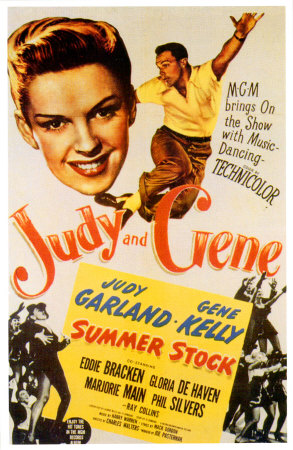
This movie musical would be the final film Judy Garland completed with MGM. Later in 1950, she would work on Royal Wedding with Fred Astaire, but fired from the film because of personal/health reasons (we all know, so I won’t go into it). Her contract with MGM ended upon mutual agreement in September of that year. Summer Stock would also be the third and final time she appeared on screen opposite Gene Kelly, who has been noted for his extreme patience in helping Garland rehearse and shoot this film. Kelly’s compassion seems expected for two reasons:
- Garland was a key figure in getting Kelly his first film, starring opposite her in For Me And My Gal.
- Everyone knows that Gene Kelly is a terrific guy.

Can you feel the warmth and charm radiating from that smile? I can.
WHAT IS THIS MOVIE MUSICAL ABOUT?
Judy Garland plays Jane Falbury, a young woman who runs her family farm all by herself–with the help of Marjorie Main, obviously. The film opens with Jane in the shower singing about…singing.
How strange, that a girl who loves singing, and clearly sings so well should be stuck on a farm in overalls. She has so much talent that she is apparently unconscious of. Clearly, this must mean something.
Esme (Marjorie Main) enters and tells Jane that Zeb and Frank, the last remaining farm hands, are downstairs in their Sunday clothes. BUT IT’S NOT SUNDAY. Jane braces herself for the Shit That is About to Go Down, and starts off. Downstairs, the men tell her they’re quitting. It seems the farm has fallen on hard times, and it’s been a while since either of them have been paid. After failing to convince them to stay, Jane wishes them well and gives them car fare. She and Esme go into the kitchen and fret (because that’s where women do their most effective fretting–aside from bathrooms) about all of the manual labor they will be unable to perform (because they’re women, and that is of course beyond them). Then Jane spies a picture on a calendar and it occurs to her: If they had a tractor, all of their problems would be solved! She runs off to buy one on credit, for you see: even though the farm is possibly in debt, and a tractor is very expensive, Jane’s fiance of FOUR YEARS, Orville Wingait, works at the general store. In fact, his father owns the place, so Jane is pretty much set up.
However, Orville is not necessarily the man-of-your-dreams-type (and is played very convincingly as such by Eddie Bracken). He’s a very timid man, who worries quite a bit, and is constantly sneezing from chronic hay fever.
Allergies = Not Sexy.
When Jane requests the tractor, Ovrills’s a bit agahst, and tells her he’ll have to ask his father’s permission.
A Fiance of Four Years Asking Permission From His Father to Give His Affianced a Present That She’s Depending On For Survival = Not Sexy.
Orville’s father, Jasper (Ray Collins, who is really great in this part) is also initially shocked by the tractor request. He reminds Jane that since she’s Orville’s intended, they could just get married and all her debts with the store could be cleared. Their families are the oldest in the area, and it’s about time they converged. But Jane doesn’t want to (marry Orville) be a charity case, and is determined to get in her crops and pay off her debts herself. Jasper magnanimously tells her she can have the tractor, then has to yell at Orville to help her pick it out.
Having to Be Told By You Father How to Court Your Own Fiance = Not Sexy.
So that’s three strikes against Orville, and we’re all ready to move on with our lives. Jane drives the tractor home and celebrates with a song. Because if you feel like singing…
Did you see her face of exhaustion after that final note? I know that was a “moment” they decided to put into the film while she was lip synching, but if I had to belt for 20 beats straight over and over again, I’d probably need drugs at some point, too.
When Jane returns to the farm, all of these people are there. But not just people: SHOW PEOPLE. Actors everywhere are unloading props and scenery, and causing a general ruckus. But this a farm, not a theater–What’s going on?! Suddenly someone runs into her. It’s Joe Ross (Gene Kelly), the director of this whole shebang, who is taken aback by Jane’s wholesome looks and fresh country face when he first sees her. She asks him what they’re all doing there, loading scenery into her barn that still has livestock in it. And wouldn’t you know: Jane’s sister Abigail is in the show as the leading lady, and she told Joe that they could use the family barn as a performance space to try out the show for backers.
(NOTE: I have performed in a barn before, and trust me, it is no place to try out a show for backers. Aside from homicidal mother birds, there are bats that will upstage your performance at dusk. You haven’t really acted until you’ve worked in a barn. But if you care about your career, leave the barn circuit as quickly as possible.)
Now, Abigail has no idea that the farm is in trouble. Jane doesn’t bring it up, to save from upsetting her little sister, who is the opposite of Jane in that she’s all sex and shallowness with no heart. But then, no one else will ever find out that the farm is in trouble. Why? Because that seemingly significant plot point goes unmentioned FOR THE REST OF THE FILM. But don’t worry about it: there’s plenty more to see and look at.
Jane initially tells Joe he has to go, because this is just ludicrous really. Joe was under the impression that Jane knew this was all happening. Jane confronts Abigail, who very selfishly says, “Our barn was just sitting there, so DUH–of course I told my fiance we could rehearse in it. I am the star, you know.” Jane tells her that “This is a farm,” and that “these people just won’t fit in here.” Jane sees Joe and tells him to get out, but decides to let them spend the night after he delivers this speech to her:
“What makes you think that putting on a show is just a lot of laughs? You oughta try it sometime. You ought to try rehearsing all day, knocking yourself out in the same routine so you’re doin’ ‘em in your sleep. That’s what these kids have been doing for weeks. In empty warehouses, garages, any place they can find.”
Then Abigail throws a fit at dinner, and tells Jane she doesn’t want to run a farm, she wants to make something of herself. Apparently running a farm is beneath Abigail. Jane, acting as sudo-mother/big sis relents and tells Joe the company can stay, on ONE condition: the actors have to help out with the chores around the farm. Joe accepts, and reminds everyone (with the help of Phil Silvers) that you have to pay your dues in order to succeed in this business:
Gene Kelly is the only man who can really pull off loafers, socks, and high-hemmed chinos.
The actors don’t turn out to be great farm hands (big surprise there), and Phil Silvers is pulling some shenanigans when he wrecks Jane’s brand new tractor. Joe and the piano player/handyman are trying to fix it during a dance held for the town’s historical society–hosted by Jane in her barn, and supervised by her intended-father-in-law–when some local boys run in, see the busted tractor, and run out to ask Jane if they can have the tires. Joe runs after them into the barn, and to keep Jane from talking to them begins to dance with her. Pretty soon, all the show people, who had been relegated to the hay loft, get into it. What follows is probably the best dance duet of Judy Garland’s career, where she is step for step with the ever brilliant Gene Kelly:
After the number, Jane gets into an argument with Jasper and tells him he can have his stupid tractor back. But then she sees the busted thing and cries, running off and leaving Joe alone to feel guilty about disappointing the girl he is falling in love with.
The next morning, Jasper has a meeting with Orville and Jane and reminds Jane that her own ancestor past a law in the 1500’s saying that no theatre folk were allowed ’round these parts. She promises that they’ll be gone soon. When she gets home, there’s a brand new tractor waiting there to greet her. It seems that those lowly theatre folk had all chipped in and bought her a new one, with Joe Ross putting in the most by selling the one asset he had: his station wagon. Jane is moved, and starts really falling for Joe a few scenes later when he lets her sniff some grease paint while he explains his love for the stage:
“Go easy, that’s very potent stuff. You smell that once too often and it gets way down deep inside of ya. Oh, you can wipe it off your face alright but you’ll never get it out of your blood.
Joe tries to explain the show by singing a number and dancing with Jane, after which they TOTALLY START MAKING OUT. Jane breaks it off just in time to run into the house where Orville and his father are waiting. Jasper demands that Jane settle on a wedding date. She consents by saying she will marry Orville once the actors leave. Then she sings this awesome song that I did not know existed until I watched this film:
Isn’t that an awesome pan to Gene Kelly, all angsty in the rocking chair? But she doesn’t know he’s there, loving her. It’s AWESOME. Hearing this song also makes me realize that the detail work on her dress are not snowflakes, but stars. But they look like snowflakes, right?
The next day, Abigail throws a fit in rehearsal and Gene Kelly lays into her. Judy Garland runs to her defense, and Joe says he’ll lay off (because he is in love with Jane). At the end of the day, he dances this amazing dance on a bare stage, reprising the tune he had sung to Jane earlier in the film:
The following day, Jane is helping Abigail rehearse her lines where the Dame throws another fit, and Jane sees just how difficult she is. Then she runs off with the male lead to New York and the show is in crisis. Sure, Joe is confident he could play the male lead himself, but what about the girl? WHAT ARE THEY GOING TO DO FOR THE GIRL?! But wait–Joe had danced with Jane earlier in the film AND heard her sing. Surely she has what it takes to do it! Jane reluctantly agrees, and starts on a stringent rehearsal schedule, which puts a definite if not final strain on her relationship with Orville.
Finally, the night of the show comes. It’s a real variety show, with different costumes and sets and a space that looks nothing at all like a barn (whoops). The best known number from the finale is “Get Happy,” where you will see Judy Garland at a different weight than she was for filming the rest of the movie–she had taken a few weeks of between finishing the film and sooting this sequence, and had gotten back down to about 90lbs here. She did this in three takes.
The show is clearly a hit (we don’t actually have that validated by any source, but it’s probably true), Joe and Jane end up together, and the farm is SAVED (probably)!
End of musical–and of Judy Garland’s career at MGM. She had been with the studio for fifteen years. She was twenty-eight years old, and out of a job.
HIDDEN GEM SONGS:
- “Dig Dig Dig Dig for Your Dinner”–A good, easful jazz song. A great choice for some Cole Porter shows, possibly some Richard Adler.
- “Friendly Star”–A great song for Margy in State Fair, or basically any character pining away for love in a mezzo key.
- “Howdy Neighbor”–A good song for an Annie Okaly uptempo, since it shows off that range well and has a country feel to it.
That’s all for today. Have wonderful Memorial Day picnics, and Happy Movie Musical Monday!
GUEST POST BY ZACHARY: On Becoming a Talent Agent
Please welcome Zachary to the blog today! Zachary is an intern at one of New York’s most well-respected talent agencies, and he has big plans to become a respected talent agent himself. Today he’s sharing his path to becoming a talent agent and why he loves his chosen career.

MUSINGS OF A FUTURE TALENT AGENT
As much as I hate to admit it, there is not one concrete way to become a talent agent. Sometimes, you’re an actor working for an agency as a day job and you fall in love with it. Maybe, you’re working as a casting director or casting assistant and want a change of scenery. Or, you could be like myself and start as a performer and realize that performing isn’t the area of theatre you wish to concentrate in and you end up as a talent agent or an aspiring one.
As a rising Junior in a competitive conservatory program, making the transition from actor to (aspiring) talent agent has been quite an interesting one. Since there isn’t a degree offered to become a talent agent, I have had to – in a way – create my own major consisting of assistant directing several of my programs straight-plays and musicals, being a part of the casting process of those shows, being the monitor for “mock auditions,” and shadowing almost all of the senior class’ Senior Showcase preparation.
Yes, it sounds like I’m training to be a casting director versus an agent but, in a way, agents wear the hat of the CD when they are deciding which clients to submit when an audition arises. They have to use all their knowledge of the casting process to select the best talent available for the job at hand. Also, you have to remember, an agent’s top priority is to look out for their client’s best interest. They do this by becoming an advisor on all things show biz, ranging from the best headshots to choose from, to wardrobe choice, and even interview demeanor.
Hands on experience is, by far, the best training for anyone in any field. But for me, a student who has chosen an occupation not taught in school, being an intern for one of New York’s finest talent agencies has been graduate school. You really are “learning the ropes” each and every day. On that note, when speaking with a variety of New York based agents and casting directors it seems that one of the most common ways to succeed “behind the curtain” is to begin as an intern, move up to front desk, then from there become an assistant to an agent or CD – respectively, and then get promoted from there. Like anything in life, timing is everything and, of course, how strong of a candidate you are.
For me personally, the drive of wanting to fight for the clients I believe in and make the strongest positive impact in their lives, negotiating their contracts, submitting them for auditions, and being their personal fan-club is what I know I am meant to do. Plus, I love talking and – if the occasion calls for it – arguing on the phone. Representing artists who love what they do is what I will be doing in the years to come. That is something you can count on.
Thanks so much for sharing your insight, Zachary! Check out Zachary’s blog for more about his agenting journey, and follow him on twitter. And, as always, if you liked his post, leave a comment below!
Dateline: Curitiba, Brazil
Last month, I returned to Southern Brazil, where I spent part of my youth. It was magical to catch up with my former Brazilian schoolmates and the little side trip to Ipanema Beach wasn’t too shabby!
While planning my trip, I realized I’d be near the city of Curitiba during the annual theatre festival. Over the past two decades this festival has grown exponentially to include all kinds of live performance. I like to call it Brazil’s answer to Edinburgh, so I had to check it out.
Though I could write several blogs on the experience of watching Brazilian theatre, I’ll try to synthesize a few ideas, which I hope will be thought-provoking for the Green Room Blog readers.
1.) Diction, Diction, Diction: Those of us who trained in a theatre-oriented environment will remember the constant harping from our voice teachers to improve our diction, no matter what the character, accent or situation. Of course, I still try to remember to do my diction exercises regularly (cram them in before big audition…) But never before was the importance of diction more to evident to me then while watching a play in my second language. Though I’m fluent in Portuguese, there were times when I lost my way during speeches by some of the dictionally-challenged actors I watched. Overall most of the players were superb and crystal clear. But when they weren’t, it confused my non-native brain.
Remembering how many of our audience members in the United States aren’t first speakers of English, I now vow to work the tip of my tongue, the lips and the teeth like crazy.
2.) It’s not all about the diction: What? Didn’t I just spend the last 151 words extolling the virtues of good speech? Yes, I did. But I have to admit: at the same time that I was mentally critiquing the actors’ speeches, my theatre-watching companion, who does not speak Portuguese, just sat back and took in the action, the tone and the mood. And guess what…. in most cases, he knew what was happening in the play without comprehending a single word. Dropped r’s; popped p’s, lazy t’s or not, he got it.
This reminded me to relax a bit and remember that theatre is a whole-body/mind experience for both the actors and the audience. Of course, we need to be understood, but there is so much that happens besides the words.
3.) English and American theatre is not the end-all, be-all: Theatre in Brazil can seem a little weird to us from Anglo nations. It doesn’t always look and feel like theatre we know.
Brazilian theatre grew up slowly, starting with the religious-oriented plays by Jesuit missionaries, through European-imported comedy-of-manners to finally breaking free from colonial influence in the 1960’s with the radical, subversive, brave and ground-breaking Theatre of the Oppressed, led by Augusto Boal. Because of this unique development, Brazilian theatre has an unusual style. I won’t pretend to be an expert in reasons, but practioners use a lot of clowning and mask technique, employ archetypes and slapstick, often use dark sexual or violent undertones, champion the underdog and, following Boal’s inspiration, involve the audience much more than we do here in the US or Europe.
Because of all this, it can sit a little uneasy for those not used to the Brazilian style of theatre. One play we saw (where there were children in the audience) had an actor onstage wearing a dildo (outside of his clothes) that represented a ticking bomb. It was strange, yes, and full of metaphor and, well, a bit disturbing. But you can’t critique Brazilian (or theatre from any other country) with American norms. Their theatre history is so wrapped up in their struggle as a nation to break from colonial influence and the current problems with the huge socio-economic divide, that we can’t possibly begin to understand it from our point of view. And that’s totally cool. Because we aren’t the final word on global theatre… we are just one part of it.
Have you even seen some “foreign” performance that taught you something new about your own technique? I’d love to read about it here! Obrigada!


 The Green Room