Improv: But Is It Art?
During the several years I was taking acting classes, I attended a lot of plays and connected with scads of D.C.-area theater artists via Facebook. Like a lot of people who are drawn to the stage, I’m an introvert at heart and find social media very helpful in building relationships. D.C. has a very nurturing theater community, and I was able to make friends with several established professional theater artists even before my first audition.
But before I moved from study to stage, I got involved in D.C.’s improv scene. Many performers use improv as a bridge between study and scripted performance, or as an ongoing practice tool. This leads some to conclude the improv is not really an art form — this was a lifelong debate between Second City founder Bernie Sahlins, who thought improv was best kept backstage, and mercurial improv guru Del Close, who trained performers including John Belushi, Stephen Colbert, Tina Fey, and Bill Murray.
Like most of my short theater career so far, fate intervened. In the summer of 2011, I was at the Capital Fringe Festival, where I learned of an experimental effort to create a theater company that would exist for exactly one year. Eight people showed up, but the project never went anywhere — the differences in experience, goals, and interests was too great. But I met an independent improv director (by which I mean someone not affiliated with either of D.C.’s two big improv schools) and auditioned for her next set of shows. This was a key moment for me, since I was working closely with a strong director with a defined direction. (In my half-dozen shows/films so far, I’ve learned how important a strong director is, which I’ll discuss in a later post.)
In quick time, I built on the skills I had learned in two years of improv classes and added more, becoming comfortable with getting out on stage, thinking on my feet, reading the cues of my fellow performers, engaging physically with other performers and the stage space, handling mental lapses, and turning around flailing scenes.
I also learned how to tell a story through improv. I later took a master class with Matt Besser of the Upright Citizens Brigade, an improv veteran who also studied with Close. Besser says it is not possible to tell a story through improv, and that the goal is just to find funny in a scenario. My director and I emphatically disagree. She has created a form of improvising a one-act play — not just 30 minutes of improv, but an actual story — and has improvised several acclaimed short films. (I made my debut in one of these.)
Improv can be an art form on its own. The argument against this is that improv is inferior because an improvised show cannot match a scripted and rehearsed piece for narrative and flow. This is usually true, but it misses the point. The best part of watching improv is watching minds at work, coming up with the show as it goes. It is akin to a sporting event. The drama in a World Series game is due to the fact that it is happening on the spot, with no one knowing the outcome. It is not dramatically interesting in itself — few people like to watch reruns of old games — but it is compelling because the participants are putting their skills to the test for the audience.
I have started doing scripted shows now, and my improv training has helped considerably in both auditions and performance. So yes, improv has been a “bridge” for me. But it is also an art form of its own, one I will return to.

Sunday Summary — October 14, 2012
Another busy week on the blog! Catch up on what you missed:
The Granted Actor shares more details of her previous grant success, and what she learned about not having a small-town mindset.
The Crazy Theatre Artist confesses that she’s *gasp* dating an actor and explores the pros and cons.
The Growing Artist lets us in on what she learned from her latest seminar with a casting director.
The British Dancer opens up about how major life milestones affect and inform career goal-setting.
The Passionate Performer shares what she learned at a recent Broadway master class.
Audition Master Class Recap: Booking The Room
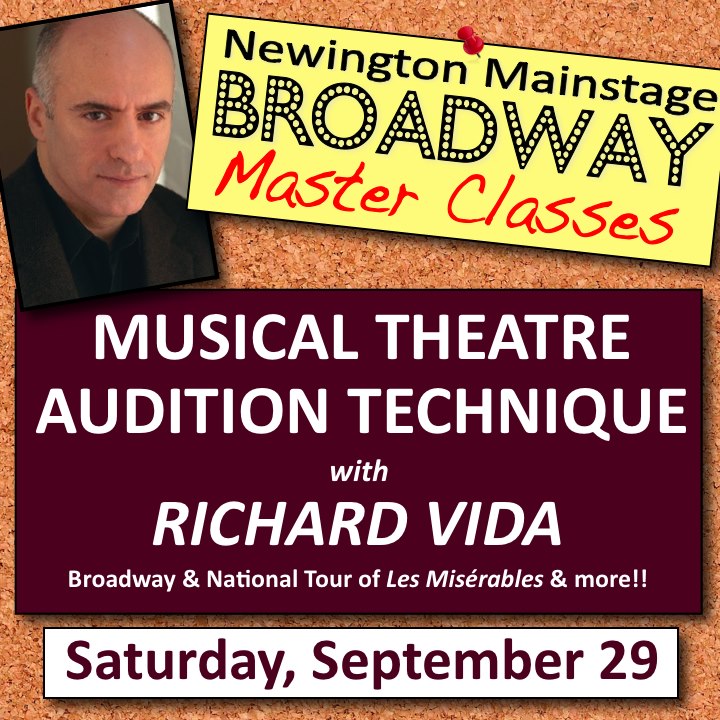
With new jobs, gigs, and life going full speed just after graduation, it can become challenging to find the time to get into a classroom. I was able to take some time this past Saturday to visit my grandparents and attend an Audition Techniques Master Class led by Richard Vida, fresh of his year on tour as Thenardier in the 25th Anniversary Tour of Les Miserables. I grew up hearing Richard’s name because he is somewhat of a celebrity in Newington, CT-having gone to the local high school (with my mom) and making a name for himself on Broadway. Not only was he a delight to spend the afternoon with, but he also provided us with a lot of valuable information to be applied to auditioning and performing, which I have summarized for you!
“Visualize The Goal” -Richard started off by asking to write on an index card what we wanted to take away from the class. I wrote, “In this class I hope to learn where the roadblocks appear in an audition setting. Where/when/how does tension crop up? Can I breathe through it and stay connected to my material and still deliver?” I then freaked out because I thought, “OH GOD! Now I have to reveal this personal thing that I struggle with to this group of people I have never met before!,” but he saved the day when he told us to fold it up and put in our pockets. He said everyone will learn something about themselves today, and hopefully it will satisfy what we wrote down. Phew.
“Book The Room” -A lot more rides on the initial impression we make when we walk through the door than we realize. Richard called this “Booking The Room.” He asked us to think of three words that describe how we would like to be perceived. He then asked us to each leave the room and re-enter as if it were into an audition room, keeping the words in mind. We then provided feedback by guessing what the adjectives or qualities were based on our perception of the person. My three words weren’t were poise, honesty, and “to be in the room,” and I am proud to report that my feedback support those choices! My acting coach and mentor always told me to think of three things to bring on stage in a performance, but I never thought of bringing them into an audition room before. So simple!
“Be Prepared” -The preparation technique discussed next is more applicable to a “callback” situation where you will have had some time to look over material. But you never know when you have to be ready to read sides cold. To prepare for these circumstances, Richard introduced “The Twelve Guideposts” from Audition by Michael Shurtleff (GREAT book). They are the Relationship, the Conflict, the Moment Before, the Humor (not jokes), the Opposites, the Discoveries, Communication and Competition, the Importance (or stakes), Find the Events, the Place, Game Playing and Role Playing, and Mystery and Secrecy. Of course if you are handed a side and given 5 minutes to look it over, you won’t have time to run through all twelve guide posts, but they are a valuable list of qualities to help authenticate a performance. Not only are they applicable to sides and monologues, but audition songs as well.
“Be Specific” -Specificity seems like a given in any performance or audition, but it can also be the most enigmatic because it has to do with changing your audience. In an audition room, you are not always going to have the full, undivided attention of everyone at the casting table as you would in a performance setting, BUT you can certainly grab attention by adding specificity to your audition. Here’s my example from class: I was using “Pulled” from The Addams Family, and in that song Wednesday is going back and forth in what is essentially a contemporary musical theatre soliloquy about her new-found love. She is asking herself why on earth she is feeling the pulls on her heartstrings which is something I definitely can relate to. When you really ask the questions put forth in the lyrics, and then really answer them, the game changes. You grab the attention of the room and they come along for the 32-bar ride.
“Be Yourself” -Being yourself is probably the HARDEST part about auditioning and performing because we are becoming a character, but it is arguably the most important part. You have to know who you are, what you bring to the table, and what you can bring to the character, because YOU are the one who will be acting, singing, and dancing in the role. The audition scene can be brutal. You feel like a face in the ground or a number on an endless sign-in sheet, but you have something that the others on that list don’t. It could be a secret talent, a compelling story about your past, or a weird quirk, but it’s YOURS. Take that into the audition room with you as your little glowing light and it can make a world of difference.
I could go on and on about the amazing experience I had in the presence of one of my childhood idols, but I won’t bore you with the play-by-play. I will leave you with one last thing: I learned on Saturday that what makes a good audition is not necessarily booking the job, it’s booking the room. Because let’s face it, you could nail every audition, but you won’t be right for every part you show up to read for. But by remembering these 5 things: Visualize the Goal, Book the Room, Be Prepared, Be Specific, and Be Yourself, you will be sure to leave an impression.
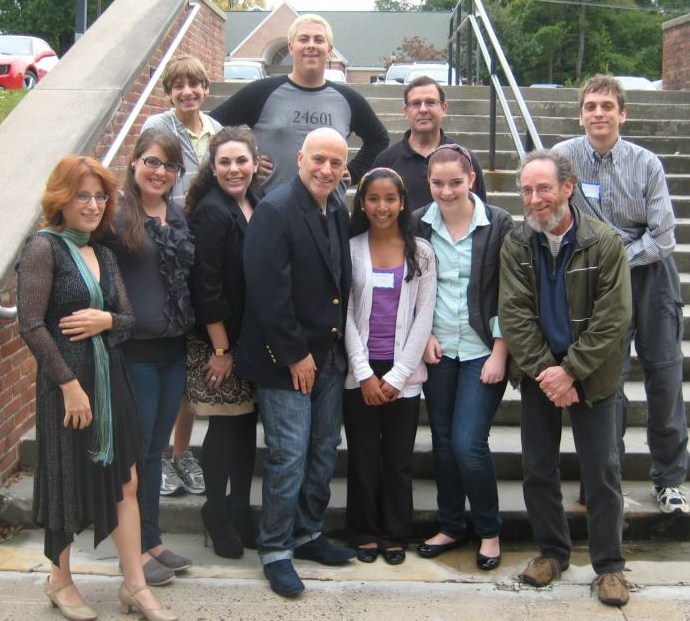
I know how I will prepare for my next audition, and I am confident it will be a success! Do you have some go-to audition tactics?

Defining Your Future
There are certain times in our lives when we suddenly feel forced to define ourselves and our future. Weddings are one such example. Relatives and friends that you don’t see or communicate with very often, naturally, want to know what you have done, where you are at and, most importantly, what your plans are for the future.
Somehow, the truth doesn’t always sounds as good out loud when talking to your great Aunt who doesn’t have the slightest idea about the struggles of a performers reality. Instead of admitting that I see myself on Broadway in the future, I found myself waffling on about how I hadn’t really thought about it and then veered towards discussing my husbands future as a producer in LA. Afterwards I thought about why I felt the need to do this.
Perhaps it was because most ‘civilians’ may think that getting on Broadway is something you just decide to do and then it happens (if only). They could be mistaken in thinking that it’s just like having an interview and then being offered a contract. Then they would wonder why it was taking me so long.
The flip-side would be that they would realize exactly how extremely difficult it is to get on Broadway and wonder why I was still spending so much time, energy and effort trying to pursue an impossible dream when I should be focusing on a ‘real’ career, especially considering my recent marriage. When not on Broadway (yet), the profession rarely offers any job security, benefits or even reasonable pay plus there’s the issue of the unglamorous, soul-destroying survival job. Not many 20/30-somethings would want to admit to those: ‘So you like waiting tables/ stacking shelves/ telesales/ wearing a padded suit as Mickey Mouse in Times Square?’
Maybe, I wanted to keep my dream a little more secret for fear of it not becoming a reality. Maybe, it was a blatant exposure of my own fear of failure and the slew of possible disparaging remarks.
Perhaps it would have been easier if I hadn’t been so close to realizing my dream in New York. Don’t get me wrong, I am very happy with my career successes so far. However, I do believe that only people ‘in the business’ can appreciate them. I do not feel ashamed by anything I have done but somehow I feel like I have to justify being in musical theatre as more than just a hobby to those outside the game.
My goals at the beginning of this year was just to get a part in a musical theatre show, have my headshot and bio in a Playbill and get a job from a New York audition. At some points it seemed so unattainable, and yet, I am about to start rehearsals for my 2nd Equity regional theatre production from a New York audition, having had to turn down another due to overlapping schedules. So here I am again, putting it out to the universe. I will be on Broadway.
Have you ever felt intimidated by a question about your career? How did you deal with it? How far away do you feel from your career goals and how do you intend to reach them? Did you use any tools to ‘ask the universe’?

“We are all failures; at least, the best of us are.” – J.M. Barrie
I recently had the opportunity to sit and have a discussion with an active theatrical casting director from a well-known agency here in NY. I was able to ask her some questions and get her opinion on a few things. In the 11 years that I have acted professionally, I have seen many changes in the casting trends. When I first began, everyone had b/w, vertical headshots. Now, everyone has color headshots – and there are so many various styles! Also, it used to be that agents mailed headshots or sent them by messenger. Now? Everything is electronic, and most CDs don’t even accept hard copies anymore! I wanted to meet with this CD to discuss the ever-changing trends and techniques. Some have changed drastically, and some seem to stay the same. I found our discussion very helpful, and I thought I would share it with all of you, in the hope that you may also find it helpful. I would like to hear your opinion on the topics we discussed as well – after all, this was just one casting director’s opinion.
Q: What is the current trend for headshots?
A: The days of b/w headshots are definitely over, so there is no doubt that your headshot must be in color. Otherwise, pretty much anything goes. She said she prefers shots that show just a little more torso. She doesn’t like shots that are too close. Try to pick a photo that looks like you, and makes you pop! Remember, times are changing. Hardcopies aren’t in demand as much anymore. It’s all about speed and efficiency now. Casting directors are going to be skimming through a bunch of digital headshot submissions, and your headshot needs to stick out. As far as smiling or serious – you should do what is comfortable for you, but smiling seems to go over better. She said if casting directors see too many shots of you not showing teeth, they are going to start to think there is something wrong with your teeth. Plus, the whole, “I’m in theater, so I should be serious.” thing is kind of a cliché – as is, “I’m selling a product in a commercial, so I should be smiling.” in the commercial industry. Just be yourself! It’s probably best to go with solid colors and no patterns – however, texture is good! If you can throw on a jacket for your shot – that’s great. If possible, chose a photographer that works with a stylist – they can help you look your best wardrobe and (for the ladies) makeup-wise. You still want to appear natural, though. Don’t do anything too crazy. You want to look like you would when you walk into that audition. You should have a couple of photos ready for submissions, but you don’t need a lot. There was a trend going around a little while ago to have “character shots” taken. I am guilty of having them taken – luckily I didn’t spend a bundle on them, because I was able to work with a fair trade photographer. Have a couple good headshots that look like you – that’s sufficient.
Q: What is the protocol for audition wardrobe?
A: This answer relates more to the ladies, but gents, you can still relate to this in some ways. She said one thing she doesn’t care for is when women wear “cocktail-dresses-gone-wrong”. Also, the idea of dressing “as if it were a job interview” is out of date, however you don’t want to look frumpy. Dress like your character would if they were going on a first date. So, you are hinting towards your character in an attractive way. For instance, if you are going for a tom boy role, you could still wear capri pants or whatever you think your character may wear, but dress it up a bit. Also, if it’s for anything based before the 1960’s, wear a skirt or dress. You will feel and look more in character.
Q: Has the audition process changed? Are the directors/writers/etc. expecting more from the actors?
A: Just make sure you are always very comfortable with the material you are given. Have an idea of how you are going to portray the scene when you go in the room, BUT be flexible enough to make corrections that may be given. If the CD asks you to alter how you are portraying the scene, alter it, but DON’T completely discard how you were portraying it. She said it’s much easier to alter how a scene is being portrayed when the actor already has an idea of how he/she will play it, rather than the actor coming in with nothing, and she has to start from scratch. However, she has often asked an actor to slightly alter a scene, and they have completely discarded the way they were originally portraying it – which is not what she wanted them to do. Always ask for the script when you are given sides. Unless it’s TV or film, and for some reason the script is unavailable – you should be able to get it, and it will help you immensely. Gain as much information as possible! CDs can tell when a person has done their research and when they haven’t. If it’s a well-known show – find the script online or at a bookstore. Also, I’m sure we have all heard this one before, but she reinforced this – go in there, do the best job you can, and LET IT GO. Don’t dwell on it.
Q: (This has always been a topic I have been curious about) Do CDs expect actors to have sides memorized at open calls?
A. No, they don’t expect actors to have the sides memorized. Just be as comfortable with them as possible.
Some extra tips she gave me:
1.) Check out ActorRated.com. It’s a site where actors can recommend things, such as classes, photographers, etc.
2.) Never use audition material (monologues, etc.) about “auditioning”. She said when an actor comes in and does a monologue like, “I had the worst audition the other day! The director was such a jerk”, it’s very awkward, and the casting personnel does not want to hear it.
I think most of these tips and techniques are pretty commonly known in the biz, but it’s always good to stay up-to-date. I would love to hear your opinion on these topics!

Theatre Relationships
I would say I’m a very fortunate theatre lady. I’m working on some awesome shows, I go to an awesome theatre grad school, and the miraculous one of the bunch: I’m dating an awesome actor. Of course as typical as possible, we met from working on a show together, and so far it’s been nearly a year of “post-showmance.” However despite both being theatre people, we have VERY different perspectives and approaches on theatre.
As a start, we have different theatrical tastes. I love playwrights from the late 19th/early mid 20th century. Ibsen, Wedekind, Chekhov, Odets, and Williams are my five favorite playwrights of all time. To me, if I can direct “Spring’s Awakening” (not the musical, the original play), “Hedda Gabler”, “The Glass Menagerie”, and “Waiting for Lefty” in this lifetime, then I would be incredibly happy with my theatre life (although I’m assistant directing/stage managing 2 of them so I’m on my way). The types of plays I love I call revolutionary plays (which I feel these playwrights have created), since it’s plays like Ibsen’s “A Doll’s House” and Odets’ “Awake and Sing!” that had paved the way for theatre we have today, that were so controversial back then. Whereas my boyfriend loves classic plays (Shakespeare in particular), Contemporary plays (Mamet in particular), and also loves doing sketch comedy scenes whenever he can. Which also means we always work on different shows at the same time.
We also have a VERY different perspective on theatre training. As shocking as this may be (especially from my last post), I’m a HUGE believer in educational training. I feel it opens more doors for growth and opportunities. Getting the training in a classroom from a professional with your peers is something that all theatre artists can benefit from, and in a school setting you are more likely to experience things you haven’t done before to grow as an artist (example: being a dramaturg for the first time at NYU really made me appreciate and understand theatre in a way I haven’t before). Whereas he feels that it’s better to just go out into the theatre world and gain experience by doing.
However we make it work since we not only find the time to spend together, but we appreciate each other’s interest and opinions. We talk about how his rehearsals in Shakespeare’s “A Winter’s Tale” is going, I talk about how “Waiting for Lefty” is going, and we move forward. We also aim to see Broadway and Off-Broadway shows within the other’s interest. For my birthday in July, we saw “A Streetcar Named Desire” and for his birthday we plan on seeing “Glengarry Glen Ross” so we can appreciate the other’s interest more. We also find we have some common ground in that respect as well. We both love Ibsen and Mamet and along with that, I tell him about the things I learn in my class ALL the time, and he always enjoys listening and even is looking into taking classes at a studio next year. So we have our mutual ground somewhere in the middle.
Plus a good thing about dating someone who is in the theatre world with you is that they understand the craziness of it. We both get when the other has a rehearsal or a show going on (although it does suck when we both have different shows up at the same time), so it’s comforting dating someone who not only understands the craziness of your schedule, but also can appreciate it and have their own crazy schedule as well. But more importantly than that even; we respect and appreciate each other for who we are, with all the differences and similarities, which is my favorite part even over our theatre backgrounds.

Advice from Lady Chablis/Apologies to the Howards
A few years ago, I received a grant from a foundation based in my small hometown in Pennsylvania. It was for a theatre project I was doing with local school kids in the area and was backed by two other grants already (a state and national grant.) This local foundation grant, though was, the icing on the cake… allowing me to make sure we had awesome costumes and props, and pay for our gas as we drove from school to school.
The foundation is a well-respected institution in the area and always publishes in the local media, news of their grant recipients. I was honored and proud to work with them, and thrilled to stand in that awkward way, smiling as they handed me a check while a news photographer snapped pictures.
But being a small town, I should have guessed what would happen next….
“Well, it must be nice to know so-and-so, on the foundation. She only got that grant because she knows so-and-so,” is what I heard some people said.
Yes, in full disclosure, I do know some people on the grant committee. Did I mention that it’s a small town? Everyone knows people on that committee. I don’t think a single grant recipient could be free from that “stigma.” But did I get the grant because I know people? No.
First of all, like with nearly all grant-making bodies, the grant-requesters remain anonymous during voting. Secondly, it was a darn good project, that had already had received grants from state and national foundations, so I know this wasn’t a fluke.
But did that accusation sting? Yes, it sure did. Did it make me feel ashamed, even though there was no truth to it? Yes. And though it was a couple of years ago, I still think about it, and feel bad.
I have a friend who, when I am obsessing about things that mean nothing, quotes Lady Chablis from the “Midnight in the Garden of Good and Evil.” “Two tears in a bucket, mother-f*&k it.” Indeed, good advice.
But what I think I need more is a little dose of my own medicine… I mean, instead of worrying about what other people have said about me, I will worry about what I say about others, and try to catch myself from doing the same small-town gossip mongering that I encountered.
For example, I was recently at a film festival, where a short no-budget film I star in was screened with a short huge-budget film made by Bryce Dallas Howard (ie, for one shot they mounted the camera to a helicopter.) What did I find myself saying, “hmm… must be nice to be Ron Howard’s daughter so people will give you all the money you want for your film.”
Ouch. Not cool. And not even true…I know she has to work hard. Why did I say it? Frankly, I was jealous of her film and wanted to disparage her because of that. Attractive quality, right? Nice.
When you think about it, I was doing the same to Ms. Howard as Small-Town-Gossip-Mongers did to me. (except, I doubt the Howards lost any sleep over it!)
But I guess what I’m saying is that in pursuing this career, we will always encounter people who are jealous of our success…… and guess what…. We will also find ourselves jealous of others.
So for me, I am making a pact to try to catch myself from having a small-town mind when it comes to others’ success, and celebrate the fact that success exists! And in the meantime, I hope that helps me shake it off when people are jealous of mine.
And finally, darn it, I’m going to apply for another grant from that foundation because I’ve got a pretty brilliant idea for a local radio play. Mother-f*%k it.
For further atonement, I give you the Bryce Dallas Howard film. Darn, it is really beautiful. You go girl!

Sunday Summary — October 7, 2012
Another great week with five posts and getting to meet two new bloggers! What did you miss?
The Growing Theatre Artist told us about her unique survival job working in a haunted house.
The College Theatre Dork shared the “secret to her success”: special skills.
We met The Crazy Theatre Artist and learned about her journey with educational theatre.
The Political Theatre Maker regaled us with her latest audition story and what she learned from her mistakes.


 The Green Room