Business Books Don’t All Suck!
Somewhere along the way I got a clue and was lucky enough to come across a few people in cyberspace who are farther along the clue-train than me. One such lovely lady is my favorite tranquilista, Kimberly Wilson, who hosts a podcast entitled tranquility du jour. Through her “featured tranquilista” interviews, she has introduced me to all sorts of really groovy gals who are helping me get my mojo moving.Her second book, Tranquilista: Mastering the Art of Enlightened Work and Mindful Play, covers some of her philosophy about the path of the creative entrepreneur.
Michelle Goodman was the first author of a business book that doesn’t suck I came across thanks to Kimberly. Her book, The Anti 9-to-5 Guide, which I devoured, began to open my eyes to possibilities I hadn’t before considered. I also love her other book, My So-Called Freelance Life.
I don’t remember now how I first learned of The Boss of You by Lauren Bacon and Emira Mears, but I am so glad these two women came into my life via their lovely book. Truly, it’s fantastic. They helped me overcome my fear of budgets and phrases like “start-up costs” and “occupational license,” which, incidentally, I have come to know intimately.
I have an ongoing relationship with the beauty that is Lisa Sonora Beam’s The Creative Entrepreneur. Not so much a book you sit and read as it is a workshop for yourself, as a creative business person, and your business aspirations. It’s a beautiful book chock full of nuggets of gold to be mined for your own entrepreneurial success.
These ladies got on the clue train much earlier than I, and I am so glad to have these virtual mentors. Like my own Harriet Tubman, these ladies of the Women-Rock-Creative-Businesses Railroad are leading me to the promised land of milk and honey…or in my case, Pinot and dark chocolate (70% cacao or higher, of course). Oh, and dudes will like the books, too.

“A Child Is Waiting” (1963) Review
On Saturday afternoon I was channel-surfing, looking for something interesting to watch. I landed on a black and white film starring Judy Garland and Burt Lancaster, and it quickly caught my attention. This was a very different film, especially for the time period. It was an American drama called “A Child Is Waiting“. It was released in 1963, written by Abby Mann and directed by John Cassavetes.
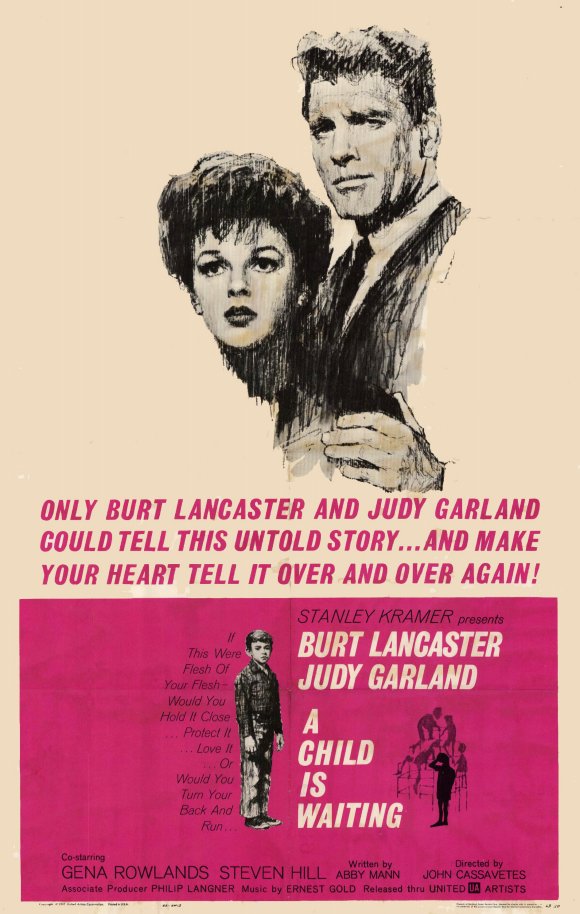
The film takes place at the fictional Crawthorne State Training Institute, which was modeled after the Vineland Training School in New Jersey. The producer wanted to bring new light to the struggle of educating mentally challenged children. Though the way of conduct represented in the movie was somewhat dated, the concept of the movie is still true in today’s age. Burt Lancaster was cast as the director of the institute, Dr. Matthew Clark. His character believed in maintaining strict and repetitive training methods to gain results. However, he was not able to make any progress with Reuben Widdicombe- one of the boys at the institute, portrayed by Bruce Ritchey.

Bruce was the only actor among the children in the film, the rest of the students were actual mentally challenged children from Pacific State Hospital in Pomona, California. I was amazed at his performance, and felt he captured the role beautifully. I had to actually look up the movie on IMDB to make sure he was really an actor. He played the role very realistically. The other students at the institute, portrayed by actual mentally challenged children did an amazing job as well. It was interesting watching their performance and thinking about how challenging it must have been for them. It must have also been an interesting experience for Judy Garland, Burt Lancaster, and the other actors. The producer, Stanley Kramer said, “They surprised us every day in reaction and what they did.”. Burt Lancaster commented, “We have to ad-lib around the periphery of a scene and I have to attune and adjust myself to the unexpected things they do. But they are much better than child actors for the parts. They have certain gestures that are characteristic, very difficult for even an experienced actor.”. I thought both the actors and children in the movie did a very convincing job, and it was very inspiring to me as an actor!

Judy Garland portrayed Jean Hansen, a teacher who has just joined the staff at the institute. Her character develops an emotional bond with Reuben, and she tries everything to help him. Judy’s performance literally had me in tears. Especially when her view on helping Reuben is changed after visiting an adult institution with Dr. Clark. There is a scene near the end of the film where Judy sits at the piano surrounded by the children. She teaches them a song for an upcoming Thanksgiving play. The emotion Judy conveys in this scene is simply heart-wrenching. Her determination to help Reuben as well as the other children has never been stronger. Judy Garland had been going through some very difficult personal issues during this time, and the previous director of the film, Jack Clayton thought being involved in a project would help Judy. I don’t know if some of the emotions shown on the screen are personal to Judy, or if it is simply her terrific acting skills- but she was amazing in this film!
I definitely recommend this film, especially as an actor. The classic actors in this movie gave an extremely touching performance, and by the end of the movie- I definitely felt more informed. However, you may want to watch it with a tissue box by your side!

Balance, Motivation, & Self-Employment
Many of the bloggers & readers here are well versed with the challenges of balancing an active Thespian workload with inconsistent offers or non-industry side jobs. But what about the other end of the spectrum: if you’re lucky enough to get consistent work, how do you maintain any grasp on reality while juggling the amount of projects necessary to pay your bills?
Recently for me, the ratio of Stage Management offers to Production Management offers have completely flipped. I’m comfortable in both positions – but the lifestyle change that accompanied this was unanticipated; though in hindsight makes complete sense.
As a Stage Manager, during rehearsals my “process” is to respond to email work before I leave for rehearsal [about 1 hour], attend rehearsal [6-8 hours depending on contract], break down rehearsal room, answer all time-sensitive emails, & type reports before heading home [about an hour or so]. Days were scheduled, set, predetermined by rehearsal room availability or the AEA-allowed schedule. Sure, there were odd-hour questions and work, but the bulk of my day time-wise was in the rehearsal room.
As a Production Manager [or Technical Director or Designer, there’s a few that fall in this category], there are no set hours. Sure, the Producer’s emails come in during business hours, and the dialogue created can give the illusion of a “work day.” But, ultimately, outside of Tech and a few choice Production Meeting dates, you’re kind of on your own to get the job done. The ultimate telecommute.
When I first looked at my January calendar – usually peppered with obligations to be at this place & that – I was shocked at the 6 lonely dates that were blocked off [of course my luck would have it, 1 of these dates was when a bunch of the Greenies were meeting in-person… alas, next time]. My reaction to the seemingly sparse work was “oh shit, I have no work this month,” and I began scrolling the pages of Playbill & BackstageJobs. The more I thought about it and laid out my projects’ to-do lists, the more it was apparent that I really did have a month’s worth of full-time-plus work. But with the seemingly void calendar and the distracting and dangerous telecommuting lifestyle, I knew I needed to realize three necessities in getting through this career-curve: BALANCE, MOTIVATION, & SELF-EMPLOYMENT.
BALANCE.
I’m a workaholic. I’m as bad as they come [no really, during tech my husband has been known to unplug my computer keyboard so he could replace it with a hot meal]. Sustaining a career as a Theatre/Film Freelancer while maintaining my own Company requires workload hours I’d rather not count. I love what I do, my motto in life has always been, “nothing is really work unless you’d rather be doing something else.” But, we all need breaks. Life needs balance. A few days of “just wake up and sit at the email helm and put out fires until emails stop coming in” made it clear that this wouldn’t work. Emails never stop: FACT. It’s important to set “office hours” for yourself, and even “days off” if your project isn’t in crisis or tech. While maintaining several projects for several producers, it’s necessary to set work times for each individual project – and not allowing yourself to neglect one project for the other. Just remember that it’s just as important to make that second cup of coffee, take your dog for a walk, read a book, and do household chores. Working from home presents a ton of challenges, but time management and allowing yourself to have breaks will provide your life with great BALANCE, making your “office hours” that much more productive.
MOTIVATION.
The opposite trap working from home can spring is that of procrastination. Any little thing starts to look like an excuse to not read those piling up emails: laundry, facebook, baking, reading the archives of The Green Room Blog… Only you know what motivates you. I’m a sucker for the simple schedule vs. rewards program – i.e. respond to all starred emails while maintaining incoming emails for 2 consistent hours without opening multiple tabs of social media sites = one chapter of my book with the phone on silent. I lay out a detailed schedule – breaks included – the night before [::cough cough:: STAGE MANAGEMENT IS A WAY OF LIFE ::cough cough::] and do my best to stick to it during the day, forgiving myself for any adjustments and mildly chastising myself when I am sucked into distraction. Find your own recipe to cure procrastination and be sure there is plenty of motivation stored up when you need an extra boost [motivational quotes, or a 10-minute workout help for me].
SELF-EMPLOYMENT.
“Isn’t that what we’re talking about?” Yes, I am an Entertainment Freelancer, a fancy name for “Self-Employed in whatever type of job I book this month.” There are months when I’m mostly a theatrical electrician or film PA, and have very little telecommuting jobs. There are months where I have one day of field work and spend the rest telecommuting. That’s my life. That’s what it means to be a Freelancer. And, Self-Employment is a reality [sometimes amazingly surreal; sometimes terrifying depending on the month]. Especially if you cross departments or mediums like I do, you should be completely aware of the time & effort required at any given time in the process for a gig you accept [the “Gig Arc” as I call it]. It’s important to know when the downtime is for each job, so you can line up that next job in a timeframe you can handle it [while maintaining BALANCE]. Remember to set up that next interview, next job, next contingency plan – or you may find yourself unemployed when you’re ready for a celebratory drink at the end of a difficult month. Remember you are Self-Employed: if you don’t find the work, you get a vacation… only Freelancers don’t get paid time off.
Do you have any secrets on maintaining Balance, Motivation, & a Self-Employed lifestyle? I’d love to hear them.

Intention Inferno
I’m tardy to the New Year’s party but I hope this post serves as a reminder that 2013 is still young and there’s plenty of time to make this your most fulfilling year yet.
If good intentions pave the road to hell, I’m on the fiery path headed to the ninth circle.
About a month ago, as I was considering my resolutions for the new year, I came across Craig Wallace’s thought-provoking article in Backstage on New Year’s intentions for actors (http://www.backstage.com/advice-for-actors/backstage-experts/5-new-years-intentions-actors/) . I’m taken by the concept of creating a list of intentions, as it’s active and vivid. This speaks to me as an artist as it’s using the language I’ve been taught (ie: creating intentions and objectives) and taking it beyond script analysis. Over the past month I have compiled my own list of intentions for the 2013.
I’m not new to writing out my goals. Over the past few years I’ve been very methodical, bordering on obsessive compulsive about it. Each year, from January 1st to January 9th (my birthday) I work on solidifying my goals, objectives and dreams for the year. This is the big picture. With each new season, winter, spring, summer and fall, I take a few of the goals off the list and work on making them happen.
– I intend to move beyond creating theatre that starts conversations and into creating work that leads to action. I’m certain we can make lasting change if we stay committed, allow ourselves to make mistakes and document/share/build off of successes and failures.
– I intend to write more about and document said journey.
– I intend to expand upon my understanding of theatre in terms of space, audience and political/social power. Part of this will include committing myself to curating a series of plays in my apartment in conjunction with Co-Op Theatre East including Eve Ensler’s Vagina Monologues (February), Suzan Lori Park’s Top Dog/Under Dog (April) and My Name is Rachel Corrie (September). All three of these (very different) plays tackle significant social/political topics. I want to see how we can use previously published work, on a very low budget to move the needle on issues beyond just starting conversations (though I’m not suggesting conversations are not important).
– I intend to write about and document said journey.
– I intend to continue working hard and setting audacious goals for Girl Be Heard (formerly Project Girl Performance Collective). We have some big new projects coming up, including the creation of a piece about gun violence and adaptation of Marat/Sade set in a juvenile detention facility. We are also working on bringing our show about child exploitation and sex trafficking back to NY for a longer run. Additionally, we are continuing our Girl Be Heard: Unplugged (open mic series) and weekly writing/performing workshops. Check out our new page (after January 28th) at http://www.girlbeheard.org.
– I intend to bring Girl Be Heard to the Jersey shore this summer. As you may know, my home town was hit badly by Hurricane Sandy and the girls are in need of a safe space to write/create work and blow off some steam. We have the space and logistics ready to go but we do not have the funding in place.
– I intend to continue training and taking regular acting class.
– I intend to have a completed reel by the last part of the year.
– I intend to join AEA by the last part of the year.
– I intend to launch “In Trouble With the King” with my genius photography partner in crime and roommate Patrick . Though this (and even outside of it) I intend to take more photos and use them as a tool for activism and social justice. I have lots of ideas for photo essays and projects.
– I intend to turn my apartment into a place for living and performances.
– I intend to learn to play the ukulele and sing. I don’t know if this will be together or separate or only in the privacy of my bedroom but it will happen.
– I intend to take dance class.
– I intend to start developing a body of choreography.
– I intend to start/continue the documentary theatre pieces I started outlining in 2012…
– I intend to write 10 short plays and/or monologues
– I intend to do a reading of some of my short plays with the hope of working to get something published.
– I intend to write 1 full length play.
– I intend to begin writing (or at least outlining) a TV pilot and/or web series.
– I intend to begin writing (or at least outlining) a young adult novel. (The Girl Be Heard company members truly believe I will write the next great “banned book”)
– I intend to be a present and supportive partner. (Are you familiar with my boyfriend’s theatre company Eagle Project?)
– I intend to shut off my iPhone and not “work” when I’m at home.
– I intend to have more fun and spend more time with friends.
– I intend to learn a practical skill (like herbal therapy, holistic medicine, identifying birds/wildlife/trees and astronomy)… In retrospect, I’m not sure how practical these skills are but I find my birding is always an interesting conversation starter.
– I intend to take at least 1 or 2 random classes at Brooklyn Brainery.
– I intend to spend some time studying psychology.
– I intend to act like a “grown up”. That means: communicating better, do my dishes right away, brush my teeth before bed, watering my plants regularly, doing laundry regularly. It may also mean other things too…
– I intend to travel to at least 30 places I’ve never been before, whether in my building, NYC, within the USA or abroad.
– I intend to see more film. You know, the films that are cited in pop culture and that everyone should apparently see… I intend to see these films … Malcolm X (1992), The Godfather (1972) and The Godfather Part 2 (1974), Shawshank Redemption (1994), Pulp Fiction (1994), Sunset Boulevard (1950), Inception (2010), The Dark Night (2008), Memento (2000), Gladiator (2000), Requiem for a Dream (2000), Braveheart (1995), Psycho (1960), Lost in Translation (2003), It’s a Wonderful Life (1946), Rain Man (1998), A Few Good Men (1992), Apocalypse now ( 1979), Alien (1979), Back to the Future (1985), Casablanca (1942), Clockwork Orange (1971), Die Hard (1988), Fargo (1996), Fight Club (1999), Lord of the Rings (2001), The Wrestler (1998), Trainspotting (1996), 2001: A Space Odyssey (1968), The Great Dictator (1940), Cinema Paradiso (1988), Some like it Hot (1959), Rebecca (1940), The Terminator (1994), Twelve Monkeys (1995), Gandhi (1992), The Graduate (1967), The Gold Rush (1925) Citizen Kane (1941), WALL-E (2008), Airplane! (1980), Monty Python and the Holy Grail (1975), Goodfellas (1980) and The Social Network. Any other suggestions?
– I intend to read the Harry Potter series.
– I intend to spend more time outside. I love nature. I could move to the mountains, live in a cabin and be perfectly content…
– I intend to read more fantasy and fiction. Last year I developed an affinity for dystopian novels. I intend to keep exploring this interest.
– I intend to improve my use of social media and to maintain my professional online image (ie: sending a monthly newsletter via Mail Chimp, learning how to use Twitter.
– I intend to maintain a healthy lifestyle to the best of my ability and not beat myself up if I slip up.
– I intend to add about 10 more things to this list before the month is up…
So, 2013 is busy.
Like Dante, I hope to escape 2013 by going through the center of the earth and coming out the other end to a clear and starry sky (there is a metaphor here… I think?) If not, accept my good intention.

Rating the Bard
I recently completed a long-term project: I have now read, seen, or listed to all 39 canonical plays by William Shakespeare, in many cases in more than one medium. I’ve been involved in several fun debates about which is his best and worst, so I thought, why not rank them all, from best to worst?
I have intentionally left out any rationale for my choices, to stimulate discussion and maybe get folks to come up with their own lists. Have fun!
- King Lear
- Macbeth
- Hamlet
- Richard III
- Julius Caesar
- As You Like It
- Romeo and Juliet
- Henry IV, Part II
- Henry IV, Part I
- Othello
- Much Ado About Nothing
- Henry V
- Twelfth Night
- Winter’s Tale
- Titus Andronicus
- Coriolanus
- Midsummer Night’s Dream
- Tempest
- Cymbeline
- Love’s Labour’s Lost
- Henry VI, Part II
- Richard II
- Taming of the Shrew
- Troilus and Cressida
- Antony and Cleopatra
- Henry VI, Part III
- Henry VI, Part I
- Two Gentlemen of Verona
- Merchant of Venice
- Two Noble Kinsmen
- Pericles
- Measure for Measure
- Comedy of Errors
- Timon of Athens
- Henry VIII
- Edward III
- King John
- Merry Wives of Windsor
- All’s Well That Ends Well

The Other Side of the Table is Nervous Too
I think it’s safe to say that the auditioning process is nobody’s favorite part of working in this industry. Continuous rejection after hard work and lots of waiting is certainly not why I chose this career. But after recently having the pleasure of musical directing several shows, I’ve experienced what it’s like being on the other side of the table and feel that the most important thing I’ve walked away with is: If you are right for this particular role, you’ll get it. Period.
Granted, I have only just begun my journey in casting shows, I am by no means a coveted musical director or an expert in auditioning. Of course I agree that sometimes there are contributing factors like politics or union requirements that are out of our control. But I’ve now been a part of the audition process enough times to see that much of what we stress ourselves to death over, plays a miniscule part in the actual casting decision. It’s great to have a well stocked resume and killer audition shoes, but it’s definitely not worth causing yourself anxiety over. Never in my experience has a casting call ever come down to who has the best legs or taken the most acting classes.
Let’s take a glance at my thought process behind the table of one memorable audition. Auditioner #1 confidently walks into the room and gives us a greeting that beams charm. She has obviously taken great care to research and think about the part she is auditioning for since her song selection is a perfect way to show the vocal range and the personality of the character. Great start, but as soon as the song begins, I’m instantly distracted by the fact her voice sounds sweet but she clearly is unable to handle the range that the character has to sing in the show. I know undoubtably that I cannot cast her. I then notice her beautifully crafted outfit which accentuates all her best features while making her look the right age for the character and very professional to work with (I mentally give her another point). I am uninterested in her acting choices so I begin to browse through her resume and headshot…it is rather impressive (so she mentally gets another point from me). As she concludes her song, I rack up all her points for professionalism, experience, looks, and personality but there is still no doubt in my mind that I will not cast her because she is simply unable to handle the role.
Fast forward a few auditioners. I’m handed a resume that’s greatly lacking with a headshot that looks like it may have been taken a few years ago by a family member with a nice camera (Mentally, I sigh and wish I could skip to the next girl). The song choice is not the best for this style of show and her outfit was not memorable (no extra points given here). Yet right as the music starts, auditioner #2 is already making fantastic character choices that grab my attention, I don’t care to continue looking at her resume because I am unable to look away from her performance! When she begins to sing, her range and connection to the song make me positive that I am going to give her the lead in my show. Just like that, I don’t need to rack up any points, she is exactly what I had in mind for the part.
Skip to another audition that was particularly painful for me to cast. With my male lead already cast, I passed up a number of wickedly talented female performers simply because they didn’t match his age and appearance. I felt like taking each of them aside and telling them that their performance blew my mind but they would frankly look awkward next to my male lead so I couldn’t cast them. I walked away from this experience with the knowledge that being right for the part doesn’t just mean being able to rock the vocal range of Christine from the Phantom of the Opera or having the perfect attitude and tap skills for Millie Dillmount from Thoroughly Modern Millie. It also means being right for this particular production that you’re auditioning for. Do you look correct when paired with the actors playing your counterparts? Are you available for the rehearsals? Is the director taking the play in a vastly different direction that perhaps you don’t fit into?
My personal audition process used to include a cyclone of the following: I don’t sleep the night before as I worry that I didn’t choose the right cut of the song. I lose track of time staring at headshots to pick which ones look most like the character. I rework my resume 100 times right down to the spacing of lines. I run around like crazy looking for an outfit that best fits the role. I arrive hours early and pace anxiously, analyzing whether I should go at the beginning or end of the audition to catch the director at the most opportune time. I fix myself in the mirror so many times while I wait that I look worse than when I started. I stress out so much that when I walk into the audition room, I don’t give anything near my best performance.
It’s true that the more auditions I make myself go to, the more comfortable and prepared I feel, but it was after casting several shows myself that I was able to see auditions in a whole new light. If I heard someone mess up I did not immediately discard their headshot, I looked for any other reason to invite them to callbacks to give them another chance to shine. If a performer was a little shaky walking into the room, I didn’t automatically think that they are not a confident performer, I saw that this audition meant a lot to them and that they get nervous just like me. At callbacks, when I taught songs to groups of auditioners and was asked to repeat a section of the song, I didn’t assume the performer was too lazy to learn the piece ahead of time, I just appreciated that they took the time to clarify.
I’ve heard it many times and it always bears repeating; directors want to cast people in their show, they are rooting for you to be good because they are hoping to find the perfect performer to make their production a success! There’s definitely something to be said about presenting yourself in a professional, prepared manner. But the director in me is screaming: if you sing and act the hell out of the song, I’m going to cast you regardless of the details because my reputation is riding on this too. The performer in me is patting you on the back reminding you that if you did everything right and didn’t get this one, it’s not due to a lack of talent, you just weren’t what the directors were looking for this time around. Don’t get so overwhelmed with details that your actual audition suffers. When you find the part that’s right for you, the rest will fall into place.

Marketing Mind Taffy: Unstuck
First of all, I would like to thank all the wonderful bloggers and readers who wrote inspiring comments on my “Marketing Mind Taffy” post. I have begun taking a new approach to marketing myself as an actor! This is probably going to be a never-ending journey. This business is always evolving. My goal for this year is to improve my social networking skills. I recently made an account on LinkedIn, and I spent a good part of the day organizing my Business Contacts list. I’m sure everyone has their own way of organizing their information. This is how I stay organized-
An actor friend of mine turned me onto Google Drive. I used to love using the old Mac program, Appleworks. However, the program has since been discontinued, and I haven’t been able to find a Mac program that I like as much… or that is as easy on my bank account ;). Google Drive is a FREE online program. It enables you to create documents, presentations, spreadsheets, forms, drawings, etc. I also really like that it is online, because I can log-in and access it from any computer. I have created and stored anything from my acting resume and business contacts to fliers and marketing materials for band gigs. Of course, I always have that crazy, unlikely scenario in my head- where a very important casting person “happens” to bump into me and asks me for my resume, in which I run to the nearest internet café just in time to log-on and print out my resume! Haha, okay back to reality… I created a template that works well for me to keep track of my business contacts. It looks something like this-
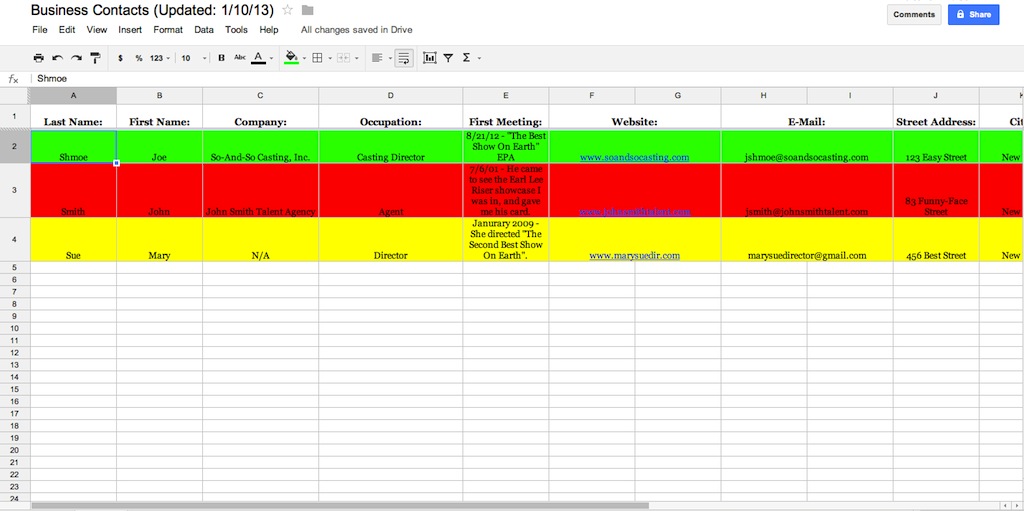
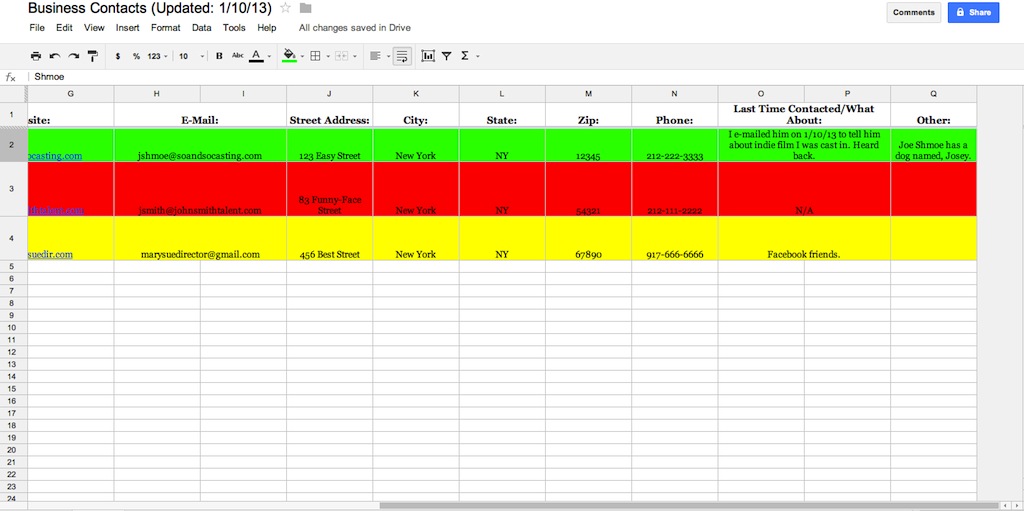
As you can see, I log the contact’s first/last name, company, occupation, when/where I first met them, website, e-mail, street address, phone, last time I contacted them, and anything else that may help me down the road. I recently found it helpful to color code my contacts.
Green= I contact them at least twice a year.
Yellow= I contact them occasionally. (Usually these are people I see often, and don’t feel the need to update as much.)
Red= I never contact them/I have lost contact with them.
I will continue to contact the green and yellow personnel as I did before, however I am now working on finding a better way to contact the red personnel. This will be my next challenge. I have taken a step already in creating a LinkedIn account, but now I need to work on Facebook and Twitter. I think one issue I struggle with is not having internet on my phone.
I would love to hear everyone else’s tactics! Good luck to everyone working on their New Year’s Resolutions!
Lasts and Firsts Coming Together
One thing I’ve learned in my time working in the NYC theatre world as an early career artist, is that when one job ends, you need to already have your next one lined up. Fortunately for me, I’m pretty good at finding work exactly when I need to start something new. The thing that made this time so different for me, is that there was an hour’s difference between the last thing I completed and the next thing I started.
I’ve held down a Literary Internship at a pretty good Off-Off Broadway Theatre for the past couple of months, which I just ended. Considering how it’s the first stable paying position I’ve ever had in the theatre world, it is sad that it’s come to an end. After all, aside from how much I truly loved what I was doing, but I learned how important reading and evaluating scripts are in this field. Granted, I knew that before, but I realize now that every theatre artist should do literary work at some point. No one in theatre can properly do their job and come up with the creativity in a production if they can’t analyze a script. Directors can’t come up with a vision, Actors can’t make choices, Designers can’t design, etc. It’s one of the most important aspects of being in the world of theatre (if not the most important), and I hope I can one day do more literary work.
Plus, before I left they gave me a card that everyone in the office had signed, along with a bunch of delicious (and expensive) cupcakes. It’s hard to want to leave after that.
Then an hour after leaving the office, I had a first rehearsal for a new play staged reading that I’m stage managing. It’s Off-Broadway, paid, and everyone apart of it is absolutely delightful. It certainly made leaving one loving theatre environment much easier, since I was able to feel that I head entered another one. Also, the director had asked me to read the stage directions, so it’ll be my first time performing on an Off-Broadway stage as well! (Does stage directions count as performing? I really don’t know).
Along with being back in rehearsals and not just reading and evaluating scripts in an office, I’ll also be starting my next internship this month as well. I get to assist a teaching artist in a Jr. High School. I don’t know the full details as of yet, but I do know that I’m looking forward to the teaching experience I’ll gain from this opportunity (even working with pre-teens, since that’s a thought that is still kind of scary to me). Things really do end and begin one on top of another in this field when you are good at what you do (or when you are fortunate enough to be able to get the opportunities).
Sometimes it’s really hard for me to be done working on a show or at a theatre, since I tend to get very emotionally invested into every project and job I do. However, the best thing about working in the theatre is that when one show closes, you can dive into rehearsals right afterwards for your next one opening.



 The Green Room
